


The technology involved implies a lot
RAY HORVATH, “THE SOURCE” 🙂

Just how many people can still remember when Bill Gates said the convid “vaccines” were the “operating system” that would need occasional “updates”? Once a techie, always a techie…1 Of course, AI has changed the records by now, which is why my pen name, originally meant to be a joke, has become possibly essential. These days, you can’t find much more about that declaration than “refutations” from not-exactly-reputable, but extremely powerful sources…
Who remembers him and his one-time wife bragging and giggling that “next time, people would notice”?
By now, it has become quite clear that people, that is, those who will be allowed to survive by the central AI, must become part of the IoT, the Internet of Things (and the crap has its own variations, but it makes no difference). Previously, I wrote about people being openly replaced with their deepfakes, and pointed out that the last stage of compiling the humanoid AI is in effect. This time, I am filling out a few blanks that are not exactly advertised, but omnipresent.
Privacy?
As long as you appear in cyberspace (cell phones included, even the oldest ones), don’t delude yourself about privacy2. The technology of the Internet itself, after several years of military application and testing, was made available for the public as a data-collection and control device on January 1, 1983. Believe me or not, even old systems were able to devise your personality, attitude, and most likely reactions simply from your list of contacts. The only defense against that is to have thousands of them, but keeping in touch with them also counts, so you must send them antisocial-media, e-mail, or text messages on a regular basis, AND receive non-automated responses, so good luck.
My “privacy solution” is that I am using various operating systems on 15-20-year-old laptops, tablets, and computers (none of them costing more than $150 at the time, but these days, I could buy them for less than $100), each assigned to specific tasks, behind double or triple firewalls and either two routers daisy-chained or at least a decent Ethernet switch. As each device has different IP addresses, fingerprinting me becomes difficult, because my wife is also on my internet. Each device functions independently: no network and, of course, no Wi-Fi, and no identifiers with the exception of the one(s) where some details (accurate or not) are needed for the apps to work.
However, during all these years, with the emergence of new technology, the volumes of data-collection have been rising exponentially, and with the introduction of 5G (not only in cell phones, but also in “smart” devices/meters, and home Wi-Fi that turns the local electric grid into an antenna3) even personal targeting became possible.
Oh, did I mention that once you start using a lot of “security” features, it “raises a red flag”?
Windows 11
Microsoft published its last “security” update for Windows 10 on October 15, 2025, and is trying to mandate a switch to Windows 11. Don’t take me wrong, all versions of Windows have always been spyware. After all, globalist-errand-boy Gates belongs to the same cesspool of CIA brats from which the founders of Fakebook and comparable s(h)ites also cropped up4.
Windows 11 does it all!

What’s new in Windows 11?
The requirements:
- Fast multi-threaded processors (obviously, that’s needed to serve the data throughput);
- Unless you employ a trick during installation, the operating system will keep identifying you and follow every move you make, even when not online (data collection can happen as long as a laptop or a cell phone is “turned off” and the collected data is transmitted after the device is on5;
- TPM 2.0 is supposed to secure data transmission by advanced encryption, and it does, mainly from you;
- Sufficient memory and bandwidth to transfer data, “as needed.”
While Windows has always been spyware, using back doors for easy intrusion into its users’ devices6, in the last 10-12 years (probably gradually introduced since the introduction of TPM 1.1b in 2003), hard disks sold in the US have also included technology to forward user data to who-knows-whom. Speeding them up and combining them with ever-increasing internet bandwidth (“speed”) has made the data collection and the surveillance a lot easier and less noticeable.7
AI is now built into the hardware of the most recent PC and Apple products8. Disabling it has become nearly impossible as long as one is using a browser.
Operating systems
Remember Blackberry? Its phones were the gold standard for data security. US government employees were using them, and lots of people liked the physical keyboards. It had its own OS, which used its unique encryption, making it difficult to crack. Allegedly, it went down, because it lacked the apps and games Android devices offered, but that would have meant the demise of Apple (well, Bill Gates saved his buddy’s enterprise, when it was about to go bankrupt). It may have been more about taking risks: its owners were not under US law, so in order to keep their market share, they had to either migrate to Android, which they did too late, and the company was sold to Japanese investors who have been fully compliant ever since. Of course, the original owners must have divulged to source code to US “authorities,” just like Kaspersky before it was forced out of the US9.
There have been, and still are, a number of mobile operating systems. MS itself issued its own mobile OS, but by then, cells phones were mostly toys, and nobody could compete with Androids. For “national security” (aka. to simplify surveillance and data collection), standardized data formats were desirable, which saves resources by eliminating data conversion.
Chrome as an operating system10 succeeded only because its junk laptops have been distributed in American schools, which resulted in some serious revenue for the globalist front, Google. Notably, Chrome is based on Linux, which brings up the question of using open source.
There are other small mobile OSs, and you can take your pick, if you like. Notice that whatever goes through your phone/internet provider11 will never be a secret. Even if the source code were not available for your OS (which interprets the apps you are using), which I doubt, AI can probably decrypt most forms of encryption by now.
Switching to open source: Linux
It looks like Microsoft’s push for total control and AI-centralization may be a bit premature, unless the predictable glitches have already been ironed out, and all consumer choices are reduced to imaginary ones. Personally, I would say, it’s the latter.
Open-source means transparent pieces of software. While transparency is good, the it comes with the bad: anyone can mess with it. Who knows which version of Linux you will install on your computer?
On Linux, most of the applications people tend to use in Windows have equivalents, that is, programs that perform the same tasks as their siblings for Windows. They are also open-source, and most of them are free, so you must be careful what you do and which programs you run on them.
For Windows users, who don’t care to “upgrade” to Win 11, Mint is the simplest version. It operates pretty much like Windows, and doesn’t require memorizing scripts like Ubuntu. Red Hat is not free, but I’m not sure you get what you pay for. If someone profits, they can profit from a lot more than just your buying the product. That reminds me of encrypted e-mail services, but that’s something for another day.
Linux is faster and a lot less resource-hungry than windows12. Moreover, it can be run from a USB pen drive or even a copy-protected (“finalized”) DVD13, making it impossible to alter it for an intruder. That, however, doesn’t protect anyone from a skilled intruder.
Experimenting with Linux in the last 20 years led me to the conclusion that sometimes it has only rudimentary device drivers, which can be especially disconcerting, when it comes to sound and video cards14. Moreover, some device drivers might not even exist for Linux, so before switching, you must check out if you are going to be satisfied with the results.
Is it that no matter what, users end up like those targeted by the KGB: falling out of the “window” from the 20th floor and closing the window behind them? I’m sure you can do these, including paying Microsoft extra in the next three years for Win 10 “upgrades” that double every year, and they don’t start cheap. You can also install Win 11 on “unsupported” computers, but “upgrades” tend not to work, in which case the back doors in your system will remain the same, making it easier to hack. Even when they work, only the designers of Windows might know what kind of vulnerabilities your choice can bring along15.

Still, mRNA is still most likely a cover-up for alternative methods (for one, I don’t read anything with a title that has mRNA in it), just like “vaccinations” can be completely “forbidden” by now, because there are so many other ways to poison the people, which has been more than obvious in the last three years. Anyone telling you that you are free from “vaccines” is a liar and a fraud…
With all those “security cameras” all over the place (even a doorbell with a camera collects information about your surroundings, but so do “smart” devices and their kin.
Towers are still left up (some on private property), because they are also efficient control and extermination devices, and with their backup power, they can be utilized even during electric blackouts. Considering that Blackrock and its kind started buying up power companies, allegedly in order to secure enough power for their AI operations, but as they already control that part, the most likely cause is to have the ability to create year-long blackouts whose outcomes would be devastating (no potable water, transportation, production and distribution, just to mention a few corollaries).
It’s time for people to realize that whenever something is free, they are the products, which is often spiced up by the “provider” being sponsored by the taxpayer.
Even desktop computers can contain the technology by now. For several years, the RAM kept much of its contents as long as the computer was turned off, but plugged in (a slow memory test at startup cleared the memory, a feature that is rarely available by now, but Windows doesn’t like that sort of thing, anyway, and the user often ends up having to reinstall it). Unplugging worked after about 24 hours, but these days, micro- or even nanochips can be installed into computers that hold their contents a lot longer, if not indefinitely.
“Updates” mostly protected the clandestine operation, although they also provided some protection from third-party intruders by changing the back doors and preventing zero-day vulnerabilities that may be there intentionally for some time, and perhaps, caused a major data leak in one of the three credit-rating agencies, Equifax, in 2017: social Security numbers, birth dates and home addresses — for up to 143 million Americans, which allowed for a further twist on the SSN that was designed to be vulnerable already at its introduction in 1936, forecasting what one can expect from the Ditigal ID.
Haven’t you also always kept wondering why it took Windows forever to boot?
Apple has always been more rigorous about identifying the user, and offered more reliable devices in return, but how much of that is a fact?

Russians are making Kaspersky, but in Germany, complying with German/EU laws, so the circus around its being banned by Diaper Joe’s administration was more about validating the theater in Ukraine. Anyway all brands of “security” software spy for the “authorities” (whoever those might be), and don’t tell me Germany is not a US puppet state.
Using the Chrome browser is another story: it collects just about everything you do and forwards it to whomever, and if you were asked (you are not), you probably wouldn’t give your consent to it.
Best to keep your cell phone and your internet provider at two different companies, owned by different global investment firms, because that makes coordination a bit more complex, which can still cause delays in processing and evaluating your data.
On a fast computer with sufficient memory, you can still run a Windows emulation on Linux, but I usually don’t care for data that goes through too many hands.
You probably want to avoid dual-boot systems on which you can select between Linux and Windows, because re-installation can mean you must start over, unless you have backups that work on your computer (such backups are either “free” or not, but in both cases, they report to the manufacturer and who-knows whom else.
On my Nvidia Geforce GTX 1650 Super video card, the picture quality (image, text, and video) on Windows 10 is far superior to the one I can get on Linux, which can be extremely bothersome on my 65” screen.
Unless you go to places that most people would deny visiting, your card information is much more likely to be stolen in a store by someone walking by and activating the NFC (near-field-communication) chip in it (shielding cards in your wallet is generally a good idea, although the thief must be extremely close to it, when stealing your information to pay for something that you didn’t order), taking pictures, or the security-camera operator (or anyone else who can see the recordings at checkout); you must always hide the back of the card, where the security code is.
***
A few tips for those who cannot circumvent using Windows 11:
- Install Win 11 without an internet connection and an e-mail or MS account attached.
- Stop auto updates permanently.
- Disable AI.
This article (What Does Mandating Windows 11 Incur?) was created and published by Ray Horvath and is republished here under “Fair Use”
See Related Article Below
It’s a small toggle with big implications for how much say users really have over their digital identities.
KEN MACON
Microsoft is quietly testing a new facial-recognition feature in OneDrive that automatically sorts photos based on who appears in them.
The experimental version is being rolled out to some early-access users, and it turns on by default while placing strict limits on how often it can be disabled.
Those with access will see a new privacy notice in the app stating: “OneDrive uses AI to recognize faces in your photos.”
Microsoft’s support page, which still labels the option as “coming soon,” explains that “Microsoft collects, uses, and stores facial scans and biometric information from your photos through the OneDrive app for facial grouping technologies.”
The company says this is intended to “help you quickly and easily organize photos of friends and family.”
Microsoft insists that the face groupings remain private even when users share albums. It also claims that “Microsoft does not use any of your facial scans and biometric information to train or improve the AI model overall.”
When asked why the system is enabled by default instead of requiring consent first, a company spokesperson told Slashdot that “Microsoft OneDrive inherits privacy features and settings from Microsoft 365 and SharePoint, where applicable.”
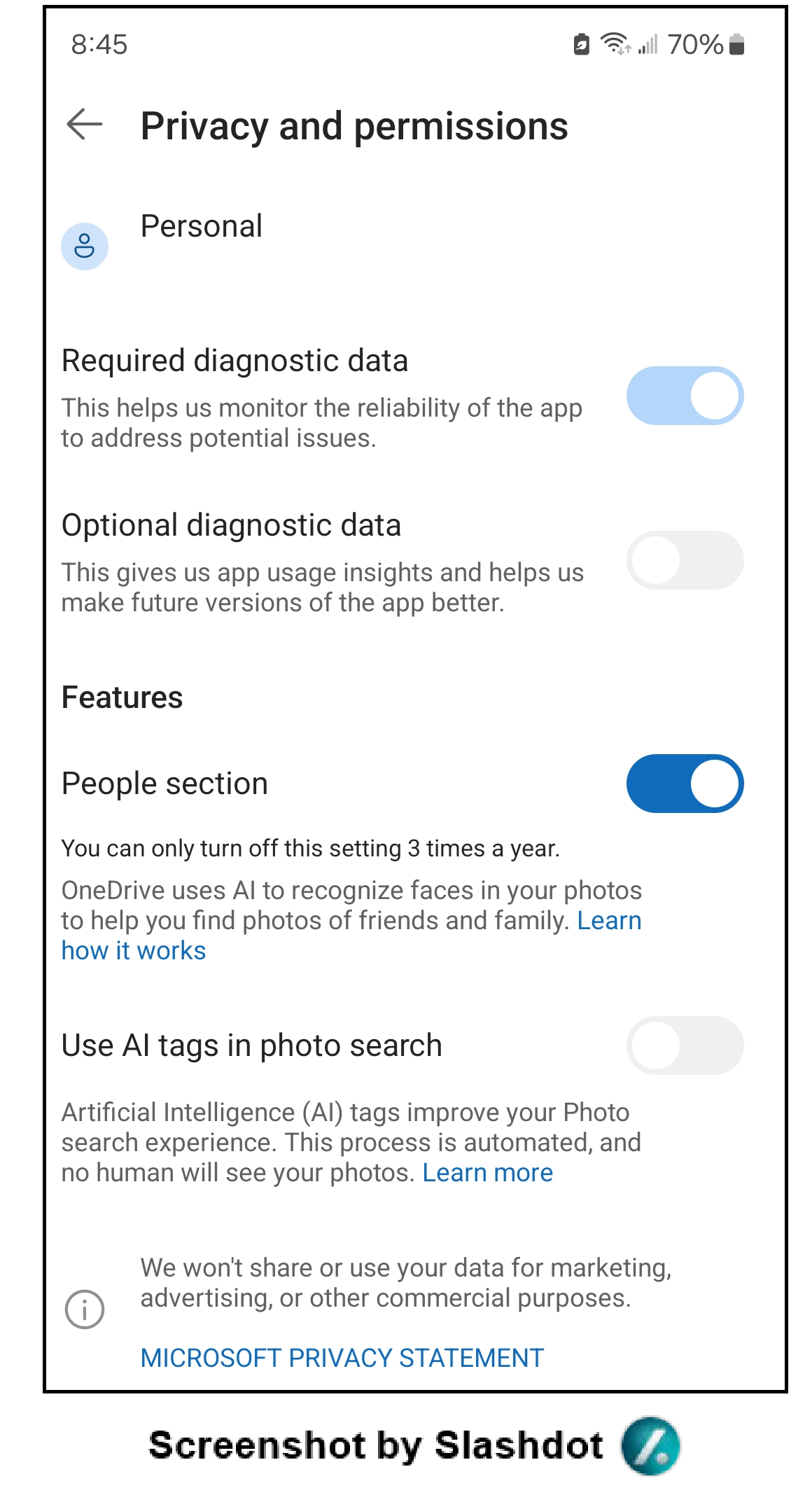
A rule that limits users to changing the setting only three times per year has caused confusion.
Microsoft declined to explain the reason for this restriction.
A screenshot shared on its forums on January 1 already showed the same message, “You can only turn off this setting 3 times a year.” It seems that the policy has existed for some time, but is drawing more attention now that more people are receiving the update.
The support documentation also clarifies that when users disable the option, “all facial grouping data will be permanently removed within 30 days.” This likely reflects Microsoft’s desire to avoid repeatedly processing and deleting biometric data from its servers.
Facial recognition in photo storage services is not new. Google Photos introduced a similar Face Grouping tool in 2015 that recognizes both people and pets, without restricting how often it can be toggled. Apple’s Photos app offers comparable identification features that operate on the device itself.
To check if this test feature is available, users can go to Settings > Privacy and permissions in OneDrive and then open the Features section. Under People, they can turn off the setting to stop the app from analyzing faces in their pictures.
Microsoft once included face grouping in its Photos app, but that option was removed earlier this year. Bringing it back within OneDrive has renewed attention on how cloud services handle biometric data and the degree of control users actually have over its collection and deletion.
This article (Microsoft OneDrive Limits How Often Users Can Restrict Facial Recognition Setting) was created and published by Reclaim the Net and is republished here under “Fair Use” with attribution to the author Ken Macon

••••
The Liberty Beacon Project is now expanding at a near exponential rate, and for this we are grateful and excited! But we must also be practical. For 7 years we have not asked for any donations, and have built this project with our own funds as we grew. We are now experiencing ever increasing growing pains due to the large number of websites and projects we represent. So we have just installed donation buttons on our websites and ask that you consider this when you visit them. Nothing is too small. We thank you for all your support and your considerations … (TLB)
••••
Comment Policy: As a privately owned web site, we reserve the right to remove comments that contain spam, advertising, vulgarity, threats of violence, racism, or personal/abusive attacks on other users. This also applies to trolling, the use of more than one alias, or just intentional mischief. Enforcement of this policy is at the discretion of this websites administrators. Repeat offenders may be blocked or permanently banned without prior warning.
••••
Disclaimer: TLB websites contain copyrighted material the use of which has not always been specifically authorized by the copyright owner. We are making such material available to our readers under the provisions of “fair use” in an effort to advance a better understanding of political, health, economic and social issues. The material on this site is distributed without profit to those who have expressed a prior interest in receiving it for research and educational purposes. If you wish to use copyrighted material for purposes other than “fair use” you must request permission from the copyright owner.
••••
Disclaimer: The information and opinions shared are for informational purposes only including, but not limited to, text, graphics, images and other material are not intended as medical advice or instruction. Nothing mentioned is intended to be a substitute for professional medical advice, diagnosis or treatment.
Disclaimer: The views and opinions expressed in this article are those of the author and do not necessarily reflect the official policy or position of The Liberty Beacon Project.


Leave a Reply