

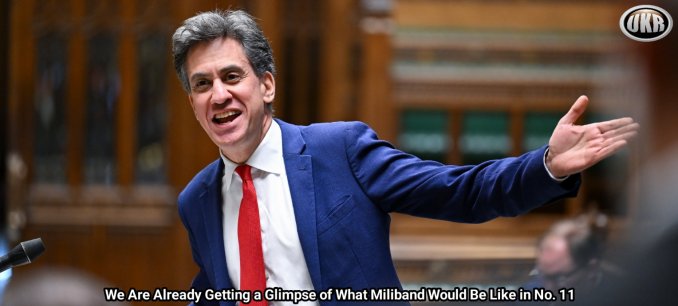
We are already getting a glimpse of what Miliband would be like in No. 11
TALI FRASER
Westminster is, as ever, a rumour mill. One of the latest doing the rounds concerns Ed Miliband – and whether his eventual destination in a future Labour government might be the Treasury. The failed Labour leader, now Energy Secretary, is increasingly tipped as a possible Chancellor in a post–Keir Starmer world.
But we may not need to speculate about what he would be like in No11. In many ways, the Miliband chancellorship is already on display.
Take energy policy. Miliband continues to press ahead with a ban on new North Sea drilling licences even as Norway – sharing the same basin – celebrates a string of new oil discoveries, including one of the largest in a decade. At the same time he maintains the North Sea windfall tax, widely faulted with hastening the decline of Britain’s oil and gas sector. The push towards ever more stringent net-zero obligations continues apace, even when the immediate effect is to increase costs for British taxpayers and businesses.
What is striking is how little this seems to trouble him – even when allies offer their warnings. Tony Blair has said the UK is heading in the wrong direction, and urged a reversal in the ban on new licences. Greg Jackson, the chief executive of Octopus Energy and hardly a fossil-fuel diehard, has pointed out that if Britain is going to use gas, it might as well use domestic supplies rather than importing liquefied natural gas from overseas. Even the chair of Miliband’s own GB Energy has cautioned that “oil and gas is our foundation”, warning of “haemorrhaging workers too fast and risks losing supply chains”.
None of it appears to matter. Miliband presses on regardless.
It is a revealing trait and this set of policies perhaps one of the clearest examples of just how uncompromising he is – putting dogged pursuit of his own pet projects and ideology at the cost of other people’s finances.
Miliband’s view is that he can centralise everything and see it run through the state. Consider GB Energy itself – the much-trumpeted state-backed energy company which, somewhat awkwardly, will not actually produce any energy. Miliband promised that it would lead to “mind-blowing” reductions in household bills. For now, it looks rather more like a vanity vehicle for his own ideology. Or take his intervention in the wind sector, where unionisation has effectively been mandated by government fiat.
As one Tory puts it bluntly: “He basically hates markets and doesn’t meet with business.”
The signs of what a Miliband Treasury might look like extend well beyond energy. During budget debates he has been among the most vocal advocates of scrapping the two-child benefit cap, accusing Conservatives who support it of seeking “to blame the poor for their poverty”.
Quite aside from that row, he bragged about how he has long championed higher taxes across a familiar list of targets: expensive homes, landlords, and gambling firms among them.
His broader philosophy was neatly summarised:
“Our vision of what makes an economy succeed is different from that of Conservative Members. We believe that public investment crowds in and does not crowd out private investment; that the only route to economic success is a government who support industry and workers with a proper industrial strategy; and that rights at work and strong trade unions are not an impediment to a good economy but an essential ingredient of it.”
Let’s take a look at how that vision is going: Good luck with private investment when this Labour government has seeb business confidence at some of its lowest levels; Industries, like hospitality, have been crying out for help as they collapse under Labour’s tax rises; And it’s all well and good saying you’re trying to create new workers’ rights, but what good does that do them when employers can’t afford to hire in the first place.
The two-child cap debate illustrates another tension. Conservatives have pointed out that retaining the cap would save roughly £3.2 billion – enough, they argue, to fund the recruitment of 20,000 additional soldiers, alongside their accommodation and equipment.
Which raises a further question: where exactly would defence spending rank in a Miliband Treasury? He famously opposed military action against Bashar al-Assad’s regime in Syria in 2013, whipping Labour MPs to block intervention. More recently, he has expressed deep reservations about military action against Iran, and reports suggest he was among those wary of even allowing the United States to use British bases for strikes.
Would a Chancellor Miliband be eager to prioritise defence spending in a more dangerous world?
To look again at his budget remarks, he said: “With the world at its most perilous for generations, their [Conservative] policy is to cross their fingers and hope…” and that is exactly what he is doing. It is a perilous moment for the country’s finances, for energy and fuel prices, yet Miliband presses on with his uncompromising ideology and hoping for the best.
Shadow energy secretary Claire Coutinho put the dividing line starkly in response to him in the Commons: “Labour Members believe the best way out of poverty is welfare; I think the best way is jobs and growth.”
If Miliband ever does make it to No. 11, that argument may well define his chancellorship. The trouble for Britain is that, on current evidence, we are already beginning to see how it might turn out.
See Related Article Below
What will Ed Miliband do when the lights go out?
How many times has Ed Miliband told us that his renewable energy policies were helping to free us from ‘fossil fuel dictators’? Wind and solar energy, he assures us, are saving us money and making us more energy-secure. Then we wake up to find that actually, Britain has only two days’ worth of gas left in storage.
If the people who run our gas network were to go on all-out strike we wouldn’t last five minutes
It has been clear for a long time that Miliband’s claims are somewhat contrary to reality. If Britain’s net zero policies are really helping to bring down prices, then how come UK households – even before the current crisis – were paying twice as much for their gas and two and half times as much for their electricity as US consumers? And no, the Energy Secretary can’t blame global gas prices for setting our high electricity costs: actually, the US generates a higher proportion of its electricity from gas than does the UK.
But the war has exposed Miliband’s claims for what they are: utter fantasy. There is not the remotest chance that Britain could end its reliance on fossil fuels in the foreseeable future; even Miliband’s increasingly unrealistic target of reaching 95 per cent zero carbon electricity by 2030 involves keeping a fleet of gas power stations to make up for the times when solar and wind energy are short. Moreover, only a sixth of the total energy consumed in Britain is delivered in the form of electricity. Even in 2024, with the North Sea well down from its peak, the UK still produced six times as much energy from oil and gas as it did from wind and solar. Renewables have done little to arrest Britain’s growing dependency on energy imports. In 2024, we produced only 43.8 per cent as much energy we consumed, up from 3.4 per cent on 2023. As recently as 2003, we were net exporters of energy.
If Miliband was really interested in energy security, the first thing he would do was lift his ban on new oil and gas exploitation in the North Sea. Even Greg Jackson, CEO of Octopus, which is as green an energy company as they come, is now telling him to do this. He would also address the acute shortage of gas storage facilities. The irony is that the UK has ready-made places for this, in the shape of empty aquifers from which natural gas has been extracted. This is what the Rough gas storage facility, off the Yorkshire coast, is. But our energy market does not incentivise the provision of such facilities. Rough was even decommissioned by Centrica in 2017 before being reopened five years later during the Ukraine crisis.
If we can’t store gas we don’t necessarily run out of it, but it means that we end up having to pay through the nose to keep homes, businesses and power stations supplied when they need the fuel. Gas is a lot cleaner than the coal it has now entirely replaced in the energy mix, but it is very much more difficult and expensive to handle and transport.
The Spectator: continue reading

••••
The Liberty Beacon Project is now expanding at a near exponential rate, and for this we are grateful and excited! But we must also be practical. For 7 years we have not asked for any donations, and have built this project with our own funds as we grew. We are now experiencing ever increasing growing pains due to the large number of websites and projects we represent. So we have just installed donation buttons on our websites and ask that you consider this when you visit them. Nothing is too small. We thank you for all your support and your considerations … (TLB)
••••
Comment Policy: As a privately owned web site, we reserve the right to remove comments that contain spam, advertising, vulgarity, threats of violence, racism, or personal/abusive attacks on other users. This also applies to trolling, the use of more than one alias, or just intentional mischief. Enforcement of this policy is at the discretion of this websites administrators. Repeat offenders may be blocked or permanently banned without prior warning.
••••
Disclaimer: TLB websites contain copyrighted material the use of which has not always been specifically authorized by the copyright owner. We are making such material available to our readers under the provisions of “fair use” in an effort to advance a better understanding of political, health, economic and social issues. The material on this site is distributed without profit to those who have expressed a prior interest in receiving it for research and educational purposes. If you wish to use copyrighted material for purposes other than “fair use” you must request permission from the copyright owner.
••••
Disclaimer: The information and opinions shared are for informational purposes only including, but not limited to, text, graphics, images and other material are not intended as medical advice or instruction. Nothing mentioned is intended to be a substitute for professional medical advice, diagnosis or treatment.
Disclaimer: The views and opinions expressed in this article are those of the author and do not necessarily reflect the official policy or position of The Liberty Beacon Project.


Leave a Reply