
A red-faced Met Office?
MARK HODGSON
It wasn’t supposed to be like this. Last autumn, after a dry summer, the Guardian scare stories warned us that climate change meant the UK was facing the prospect of terrible water shortages. “England facing drastic measures due to extreme drought next year” warned the Guardian headline on 8th November 2025. It was so bad that the secondary headline told us “Government and water companies are devising emergency plans for worst water shortage in decades”.
Executives at one major water company told the Guardian they were extremely concerned about the prospect of a winter with lower than average rainfall, which the Met Office’s long-term forecast says is likely...
Ah, the good old Met Office. Wrong, again. As was the Guardian, wrongly relying on the Met Office’s inaccurate forecast:
So Met Office warnings of increased risk of dry spells through an important time of year for recharge of our water resources will ring alarm bells.
It wasn’t just the Met Office and the Guardian ringing alarm bells:
Prof Hannah Cloke, a professor of hydrology at the University of Reading, said: “We now need exceptional rainfall all winter just to recover….With climate change drying Britain out for longer periods in the future, we need to adapt to the climate we have now. Building new reservoirs will help, but we also need much more management of demand, and a more ambitious plan for water resilience.”
I don’t argue with the need for a more ambitious plan for water resilience. With the UK’s population having increased by millions without a large reservoir having been built for decades, and with expansive plans for water-hungry AI datacentres, we certainly need to take steps to ensure we conserve the rainwater that falls. And it is true that some versions of climate alarmism do warn of dry summers and wet winters. So I am not entirely justified in complaining about drought alarmists. However, I think it’s fair to criticise those who warned of an extended drought on the assumption that the Met Office correctly predicted a dry winter to be sandwiched between last year’s dry summer and an assumption of a dry summer this year.
Even had the warning been correct it wouldn’t have justified claims that this was because of climate change. Those of us old enough to remember it know well that the 1976 drought wasn’t caused solely by an exceptionally prolonged and hot dry summer (though the summer of 1976 was all of those things). Rather, it was the result of a two-year drought that included the winter of 1975/6:
The famous DROUGHT of 1975/76 was memorable for its severity over most of the British Isles, and also for its exceptional persistence. It produced the highest values for a drought index for south-east England in three hundred years. Not since 1749/50 had a period from one summer to the following spring been so dry in southern Britain. At Oxford, every month from May 1975 to August 1976 had below average rainfall with the sole exception of September 1975. It was the DRIEST 16-month period on record for England and Wales. The severity of the drought was highlighted by the acute hydrological impact of an exceptionally dry winter being sandwiched between two hot, dry summers.
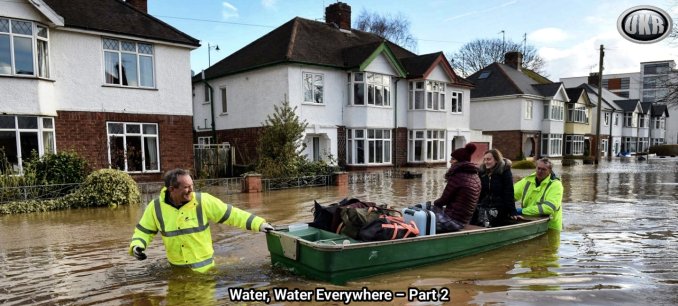
As for the winter of 2025/26, what a difference three months makes. If one believed the hype and headline of the Guardian story of 8th November 2025, one wouldn’t have expected to read an article with today’s Guardian headline (“Why is the UK so rainy this year and how is the climate crisis making matters worse?”) and certainly not its secondary headline (“It has rained in parts of the country every day of the year so far and downpours are expected to continue this week”). Needless to say, the Guardian managed to blame the rain on the “climate crisis” (sic), just as three months ago it blamed the prospect of an extreme drought exacerbated by a forecast dry winter (that didn’t materialise) on the same imaginary crisis.
It’s worth re-visiting the Met Office three month forecast for the winter of 2025/26 :
The chances of a wet 3-month period are less than normal, with the chance of a dry period higher than normal. This is due to an increased likelihood of high pressure patterns influencing the UK through the period.
In a Q&A under the Met Office three-month forecast, one answer says “…this Outlook does not suggest consistent improvement from the current drought conditions across the UK.” Today the Guardian reports:
Neumann said: “One positive to come from the recent rainfall is the move to recovery status for UK water resources.” She added that England is now free from drought for the first time since May, with reservoirs and aquifers slowly restocking and recharging to healthy levels.
In November 2025 the Guardian was happy to spread drought concerns on the basis of the Met Office forecast, and to blame this state of affairs on climate change. It’s most unfortunate for the cause that the high pressure was supposed to be stuck over the UK, whereas instead we’ve had a blocking high over Scandinavia. Consequently, the Guardian now says “[s]cientists think fossil fuel pollution is making the jet stream more erratic…”. Heads the climate alarmists win, tails the climate sceptics lose.
But it’s not a good look for the Met Office (not that I imagine the BBC or the Guardian will be drawing our attention to its failure any time soon, so long as it continues to propagandise about the “climate crisis”). I wonder if the Met Office has any employees old enough to remember the drought of 1975/6?
This article (Water, Water Everywhere – Part 2) was created and published by Climate Scepticism and is republished here under “Fair Use” with attribution to the author Mark Hodgson

••••
The Liberty Beacon Project is now expanding at a near exponential rate, and for this we are grateful and excited! But we must also be practical. For 7 years we have not asked for any donations, and have built this project with our own funds as we grew. We are now experiencing ever increasing growing pains due to the large number of websites and projects we represent. So we have just installed donation buttons on our websites and ask that you consider this when you visit them. Nothing is too small. We thank you for all your support and your considerations … (TLB)
••••
Comment Policy: As a privately owned web site, we reserve the right to remove comments that contain spam, advertising, vulgarity, threats of violence, racism, or personal/abusive attacks on other users. This also applies to trolling, the use of more than one alias, or just intentional mischief. Enforcement of this policy is at the discretion of this websites administrators. Repeat offenders may be blocked or permanently banned without prior warning.
••••
Disclaimer: TLB websites contain copyrighted material the use of which has not always been specifically authorized by the copyright owner. We are making such material available to our readers under the provisions of “fair use” in an effort to advance a better understanding of political, health, economic and social issues. The material on this site is distributed without profit to those who have expressed a prior interest in receiving it for research and educational purposes. If you wish to use copyrighted material for purposes other than “fair use” you must request permission from the copyright owner.
••••
Disclaimer: The information and opinions shared are for informational purposes only including, but not limited to, text, graphics, images and other material are not intended as medical advice or instruction. Nothing mentioned is intended to be a substitute for professional medical advice, diagnosis or treatment.
Disclaimer: The views and opinions expressed in this article are those of the author and do not necessarily reflect the official policy or position of The Liberty Beacon Project.


Leave a Reply