

MATT GOODWIN
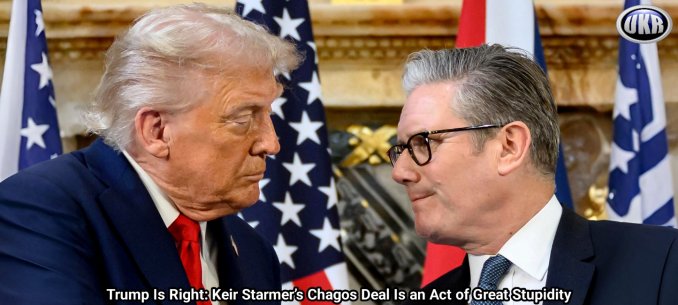
President Trump does not mince his words. And this week, when he described Keir Starmer’s Chagos deal as an “act of GREAT STUPIDITY,” he was absolutely right.
In fact, it is hard to think of a more accurate description.
Because what the British government has attempted to do over the Chagos Islands is not merely incompetent or naïve. It is a textbook example of how a ruling class that no longer believes in its own nation ends up surrendering power, sovereignty, territory and leverage — while wrapping the whole thing in the language of international law, human rights, and moral virtue.
Let’s be clear about what Starmer’s Labour agreed to.
Under this deal, Britain would hand over sovereignty of the Chagos Islands to Mauritius — a country with close ties to Communist China — while permanently exiling the Chagossian people from their homeland.
In return, the British taxpayer would be forced to pay tens of billion of pounds – £34 billion to be exact – to lease back Diego Garcia, one of the most strategically important military bases on earth, which underpins both British and American security in the Indo-Pacific.
Nobody voted for this. It was not in the Labour Party’s manifesto. There was no public debate. No democratic mandate.
Just a quiet surrender, negotiated by lawyers and diplomats who appear to believe that Britain’s interests and history are something to be apologised for.
It may well be the worst deal any British government has struck in modern history.
It is also hard to avoid the conclusion that senior UK officials deliberately mislead their American counterparts. Last year, they were running around America proclaiming that Britain had “no choice” but to hand over the islands.
They insisted that a ruling by the International Court of Justice made the deal unavoidable. That resistance was futile. That sovereignty was no longer ours to defend.
But this was, quite simply, nonsense.
The Court’s ruling in question was advisory, not binding. It did not compel Britain to surrender anything (much like Starmer’s Labour was not compelled to grant China a Mega Embassy in the heart of London but decided to do so anyway, once again undermining our national security and sovereignty).
And yet this legal fiction was repeated again and again by British officials — chief among them Jonathan Powell, Tony Blair’s former fixer and now Keir Starmer’s National Security Adviser — in an effort to bounce the Trump administration and our most important ally into accepting the fait accompli.
At the time, it worked.
In May last year, when Britain signed the deal, US Secretary of State Marco Rubio even issued a statement welcoming what he called a “monumental agreement”.
But then something changed.
When Nigel Farage, leader of Reform, started to raise the issue directly with senior figures in Washington, it became clear that the penny was starting to drop.
Senior Republicans began to point out that Diego Garcia is America’s most important overseas military base. Without it, US power projection in the Indo-Pacific is severely weakened. Others started to point to the obvious problem: Britain handing sovereignty of the base to a China-friendly state made no strategic sense whatsoever.
And then came the realisation that the legal justification for the deal was built on sand. The ICJ judge whose opinion Labour leaned on was Chinese. She later backed Russia’s invasion of Ukraine. Her judgment aligned neatly with Beijing’s long-standing effort to weaken Western military infrastructure. Suddenly, the idea that Britain had been acting out of legal necessity looked more like geopolitical self-harm.
Which is why Trump’s intervention matters so much.
When he went on Truth Social and denounced the Chagos deal as being done “FOR NO REASON WHATSOEVER,” he wasn’t posturing.
He was stating a fact. The deal does nothing for Britain. Nothing for America. And nothing for the Chagossian people.
Indeed, the bitter irony is that a Labour Party that is utterly obsessed with “human rights” has completely ignored the most fundamental right of all: self-determination.
Indeed, isn’t it ironic that while Starmer’s Labour now preaches about the importance of respecting the rights and views of the people of Greenland (which I agree with), they were more than happy to sell the rights and views of the Chagossians down the river when it suited them and their international elite cronies?
The Chagossians were forcibly removed from their islands in the 1960s. They have been treated appallingly ever since — first by Britain, then by Mauritius.
And yet this deal would lock in their exile permanently, while transferring their homeland to a government that has never represented them.
There is a better solution.
Allow the Chagossians to return. Allow them to settle. Let them build a future through tourism and environmental stewardship. Protect Diego Garcia as a joint UK-US military facility. Preserve both security and justice.
But that would require a government that is actually capable of thinking in terms of national interest. And that is precisely what Starmer’s Labour Party cannot do.
This whole episode, of course, exposes a deeper truth about the modern Labour movement. It does not believe in borders. It does not believe in sovereignty.
And it does not believe Britain has interests of its own that must be defended — only obligations to international institutions, foreign courts, and abstract moral causes.
We were saved from the consequences of this worldview not by Westminster, but by Washington. So let us hope, in the days ahead, we will be saved once again.
And there is one final irony here, too.
When he was foreign secretary, David Lammy himself admitted that the Chagos deal could only proceed with American consent. “Of course,” he said, “they’ve got to be happy with the deal or there is no deal.”
Well, America is not happy. And if Labour keeps its word — a big if — then this shameful surrender should now be dead. Indeed, it should never have been contemplated in the first place …
We cannot write, share, and promote pieces like this one without your support. Help us tell millions of people the truth by supporting us as an Inner Circle member or Paid Subscriber.
This article (Trump is Right: Keir Starmer’s Chagos deal is an act of GREAT STUPIDITY) was created and published by Matt Goodwin and is republished here under “Fair Use”
See Related Article Below
Why Washington Could Block Keir Starmer’s Chagos Deal

CP
For nearly sixty years, the United Kingdom has made solemn, written promises to the United States about one of the most strategically valuable military locations on Earth, the Chagos Archipelago, and especially the island of Diego Garcia.
Those promises were not casual.
They were set down in binding agreements in 1966, 1976, and 1982, negotiated at the height of the Cold War, renewed automatically in 2016, and designed to last until 2036 unless formally terminated.
Across those texts runs a single, unmistakable theme: Britain would keep the territory available for US defence purposes on a stable, bilateral basis, under a legal framework in which London retained sovereignty and Washington enjoyed wide operational freedom.
Now, critics argue, that framework is being fundamentally altered.
Under Prime Minister Keir Starmer’s plan to transfer sovereignty of the Chagos Islands to Mauritius and lease back Diego Garcia for roughly ninety nine years, the UK is proposing to replace the very structure on which those earlier assurances were built.
From Washington’s perspective, that is not a technical tweak. It is a seismic change.
The promises Britain made
The 1966 Exchange of Notes established the foundation. Britain undertook that the British Indian Ocean Territory would remain under UK sovereignty and that the islands would be available to meet the defence needs of both governments for an indefinitely long period, subject to agreed procedures for construction, access, and third-party use. The deal included an automatic renewal clause that carried the arrangement to 2036.
The 1976 agreement went further, authorising and regulating the US naval support facility on Diego Garcia itself. It set out rights of access, construction, communications, security arrangements, and confirmed that the facility would operate within the wider 1966 framework.
In 1982, the two governments supplemented those arrangements again, refining rules on personnel, environmental protection, and consultation, and explicitly tying the life of the new text to the continuing force of the 1976 and 1966 agreements.
Taken together, the three instruments formed a layered legal regime. Britain remained sovereign administrator. The United States built and ran the base. Decisions about facilities and third-party access were taken bilaterally. And the whole structure was designed to endure well into the twenty first century.
That, critics say, was the bargain.
What is changing now
The proposed UK–Mauritius settlement would replace that architecture.
Sovereignty over the islands would move to a third state.
British authority over Diego Garcia would become derivative, exercised by lease and authorisation rather than by title.
New joint bodies with Mauritius would oversee security, development, and environmental matters elsewhere in the archipelago, and potentially in surrounding waters.
UK ministers insist that none of this will affect US operations, that the base is secured for a century, and that Washington has been closely consulted.
But the treaties with the United States do not speak in terms of leases from third parties or tripartite governance mechanisms. They speak in terms of Britain making territory it controls available directly to the United States, within a bilateral framework.
That distinction matters in international law and in strategic planning.
From an American vantage point, the question is not whether the UK intends to keep its promises today. It is whether the new arrangements legally and politically guarantee the same freedom of action tomorrow, and the decade after that, and under governments yet to be elected in Port Louis, London, or Washington.
Why US lawyers might bristle
Under orthodox treaty law, a state cannot sidestep obligations to one partner by striking a new deal with someone else. If the new framework results in new approval processes, regulatory constraints, or political veto points that were not part of the original bargain, Washington could plausibly argue that Britain is no longer delivering what it undertook to provide.
Even if access to Diego Garcia remains uninterrupted at first, the Americans could say the UK has introduced legal uncertainty where none previously existed.
They could point to the fact that the 1976 and 1982 agreements expressly depend on the continuation of the earlier BIOT regime.
They could stress that they never consented to operate their most sensitive Indian Ocean facility as tenants under a third sovereign’s umbrella.
They could demand formal, written assurances that their rights remain intact until 2036 and beyond.
And if they were dissatisfied with those assurances, they would not need to go anywhere near an international court to make their displeasure felt.
The Trump factor
That is where Donald Trump enters the equation.
He would not need to persuade judges in The Hague that Britain has breached the letter of the treaties.
He could simply decide, as a matter of US policy, that the new governance model is unacceptable for American forces.
Washington could freeze investment.
Curtail upgrades.
Decline to station certain assets.
Refuse to participate in new oversight bodies involving Mauritius.
Or in the extreme case, begin planning for a drawdown.
None of that would void the UK–Mauritius agreement.
But it would drain it of much of its strategic meaning.
A base that exists on paper but is no longer central to US operations is not the crown jewel London believes it has secured.
The real danger
This is why critics say the Starmer government is playing a dangerous game.
The UK is trying to solve a long-running colonial and legal dispute by reshaping a defence settlement that underpins Western power projection across half the globe.
In doing so, it is asking the United States to trust that a new, more complex legal structure will never be used to constrain the base, no matter who governs Mauritius in thirty years, no matter what international pressure campaigns emerge, no matter how regional politics shift.
That is a large ask in an era of great-power rivalry.
For nearly six decades, the Chagos arrangements rested on a simple proposition, Britain controlled the territory, and Britain made it available to America.
Replace that proposition, and Washington is entitled to re-examine the deal.
The treaties signed in 1966, 1976, and 1982 were meant to carry the partnership to 2036.
The question now confronting both capitals is whether Britain’s new course is compatible with those undertakings, or whether it risks persuading the United States that the foundations of Diego Garcia are no longer as solid as they once were.
If that happens, the consequences will not be theoretical.
They will be strategic, expensive, and very hard to reverse.
This article (Why Washington Could Block Keir Starmer’s Chagos Deal) was created and published by Conservative Post and is republished here under “Fair Use” with attribution to the author CP

••••
The Liberty Beacon Project is now expanding at a near exponential rate, and for this we are grateful and excited! But we must also be practical. For 7 years we have not asked for any donations, and have built this project with our own funds as we grew. We are now experiencing ever increasing growing pains due to the large number of websites and projects we represent. So we have just installed donation buttons on our websites and ask that you consider this when you visit them. Nothing is too small. We thank you for all your support and your considerations … (TLB)
••••
Comment Policy: As a privately owned web site, we reserve the right to remove comments that contain spam, advertising, vulgarity, threats of violence, racism, or personal/abusive attacks on other users. This also applies to trolling, the use of more than one alias, or just intentional mischief. Enforcement of this policy is at the discretion of this websites administrators. Repeat offenders may be blocked or permanently banned without prior warning.
••••
Disclaimer: TLB websites contain copyrighted material the use of which has not always been specifically authorized by the copyright owner. We are making such material available to our readers under the provisions of “fair use” in an effort to advance a better understanding of political, health, economic and social issues. The material on this site is distributed without profit to those who have expressed a prior interest in receiving it for research and educational purposes. If you wish to use copyrighted material for purposes other than “fair use” you must request permission from the copyright owner.
••••
Disclaimer: The information and opinions shared are for informational purposes only including, but not limited to, text, graphics, images and other material are not intended as medical advice or instruction. Nothing mentioned is intended to be a substitute for professional medical advice, diagnosis or treatment.
Disclaimer: The views and opinions expressed in this article are those of the author and do not necessarily reflect the official policy or position of The Liberty Beacon Project.


Leave a Reply