

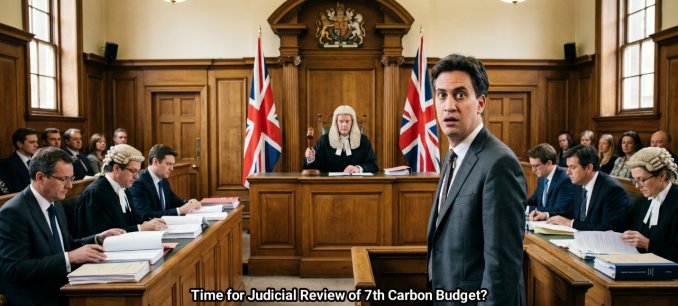
The Government is recommending approval CB7 but its impact assessment is fatally flawed.
DAVID TURVER
Introduction
Carbon budgets are produced every five years by the Climate Change Committee (CCC)and they set the UK’s emissions targets twelve years in advance. The CCC published the 7th Carbon Budget (CB7), covering the period 2038-2042, in February 2025 and the Government has to approve or reject it by 30th June 2026. CB7 sets a legally binding goal to cut emissions by 87% compared to 1990 levels by 2040.
The Government have accepted the CCC’s recommendations and has confirmed it will adopt CB7. Legislation in the form of a Statutory Instrument was laid before Parliament to approve CB7 on 2 June and will be debated later this month. The Impact Assessment (IA) justifying the Government’s position was buried in the resources section of the website and is available for download on the link below.

Analysis of the original carbon budget has demonstrated significant errors on many levels. Unfortunately the IA has introduced even more flaws so it is time to consider whether a fair judicial review would find it lawful to approve the 7th Carbon Budget.
What is Wrong with CB7?
On Eigen Values, we have criticised CB7 on many occasions. First on the list for scrutiny was the CCC’s assumption about the cost of renewables, the hockey stick forecasts for deployment of renewable capacity and the take up of low-carbon technology. Secondly, they repeated the same methodological error from CB6 about the length of any dunkelflaute period and therefore understated storage requirements. Finally, after the CCC released their methodology report, further errors were identified.
The Government has not been explicit about the technology costs it has used in the IA saying only that cost assumptions “have been aligned as closely as possible with the latest internal evidence from power technology experts and commissioned industry research.” The implication is they have overridden the CCC and used higher costs from their Generation Cost 2025 report. However, there are several parts of the IA that could be strongly challenged up to and possibly including Judicial Review. These are:
- Irrational choice of policy option
- Circular carbon costs and benefits
- Mismatched carbon costs and benefits
- UK action not reducing global emissions
- Reliance on unproven technologies
- Inadequate analysis of impact on families and businesses.
Irrational Choice of Policy Option
The cost-benefit analysis of CB7 in the IA analyses three options. Option 1, termed the Looser Option, targets a lower reduction in emissions of 84% from 1990 levels to 645MtCO2e. Option 2 is the CCC recommended option which targets an 87% reduction to 535MtCO2e. Option 3 is the Tighter Option that requires a 88% emissions reduction to 490MtCO2e which they say is broadly commensurate with the EU’s 2040 target to reduce emissions by 90%.
The cost-benefit analysis considers options against two baselines: the UK TIMES Energy and Emissions Projections and a no Net Zero baseline. Figure 1 below reproduces the results of the cost benefit analysis versus the no Net Zero baseline (p48 of the IA).

The costs and benefits are expressed as Net Present Values (NPV), meaning that both costs and benefits in future years are discounted back to the present to reflect the time value of money. The NPV of Option 1 is calculated at £905bn, with a benefit-cost ratio (BCR) of 2.3, meaning that benefits outweigh costs by a factor of 2.3. The NPV (and BCR) for Options 2 and 3 are £865bn (2.1) and £780bn (1.9), respectively. In other words, the Looser Option 1, costs less, delivers a higher NPV and a better BCR than both the recommended and tighter options.
Despite Option 1 being more cost effective, Ed Miliband has chosen Option 2 by invoking vague, unquantified transformational change benefits. It may be possible to challenge this decision in a judicial review on the grounds of rationality – the Wednesbury unreasonableness test. The Minister cannot rationally decide to recommend Option 2 when his own quantified evidence in the IA favours a different option.
Circular Carbon Costs and Benefits
Figure 1 shows the vast majority of the alleged benefits of CB7 for all three options is ‘Carbon Savings’. The recommended Option 2 with an NPV of £865bn relies on £1,495bn of benefits from carbon savings. These savings are calculated by using carbon values derived from the Government’s Green Book supplementary guidance. The Table 3 of the workbook shows carbon values in 2050 ranging from £199/tCO2e in the low scenario to £596/tCO2e for the high scenario. The IA updates these to 2025 prices to £226-£679/tCO2e.
Guidance (para 3.33) on valuing greenhouse gas emissions says the Government “adopts a target consistent approach, based on estimates of the abatement costs that will need to be incurred in order to meet specific emissions reduction targets.” In other words, if removing carbon from a particular activity is expensive, then they adopt a high price of carbon to make the abatement activity look economic. This creates circularity where higher and higher carbon prices can be used to justify ever more expensive abatement technologies. This also means that in future years, the easier to remove carbon is valued at a higher price and vast benefits can be claimed from the earlier removals.
It may be possible to challenge this decision in a judicial review on the grounds of irrationality because of circular reasoning. The Green Book (para 2.1) requires robust evidence and analysis and also says there is a duty to provide objective, honest and impartial advice. Using target-derived prices to justify the target itself renders the cost-benefit analysis defective and undermines Miliband’s claim the IA represents a “reasonable view of the likely costs, benefits and impact.”
Mismatched Carbon Costs and Benefits
All of the costs of CB7 fall on UK bill- and tax-payers while the alleged benefits are spread globally. The recommended Option 2 identifies capital and finance costs with a NPV of £880bn plus another £565bn of operational costs (excluding the £445bn of fossil fuel savings). The vast bulk of the £1,620bn of benefits, some £1,495bn are attributed to carbon savings.
The costs are real cash outlays (insofar as the costs can be believed), yet the carbon saving benefits are purely notional estimates of the cost of carbon required to make abatement look attractive. This is a category error comparing real costs with notional savings.
According to the IA, the carbon costs saved “represent the social value of an additional tonne of CO2e abated”. However, the atmosphere is global, so any alleged emissions savings are felt globally. This means that any alleged climate damage avoided by removing part of the UK’s 0.8% of global emissions are felt worldwide. The IA does not test who receives the alleged benefits versus who bears the cost.
It may be possible to challenge this decision in a judicial review on the grounds of failure to take into account relevant considerations. The Green Book (para 6.23) explicitly requires consideration of “who receives the social benefits of a proposal and who bears the social costs.” Para 6.6 also says proposals “should consider proportionately the social costs, social benefits and risks that a proposal might bring about for UK society.” It may also be possible to challenge under the grounds of rationality because the IA systematically overstates the benefits to the UK.
UK Action Not Reducing Global Emissions
The underlying purpose of UK Net Zero is to be part of a global effort to reduce emissions. However, the IA relies on territorial emissions and effectively assumes every UK tonne abated results in a global saving. However, despite huge reductions in UK territorial emissions, global emissions have continued to rise as shown in Figure 2 (from Our World in Data).

In reality, UK consumption emissions have fallen far more slowly and the UK’s share of global emissions has fallen as total global emissions have risen. Effectively, the UK has made energy and electricity expensive which has resulted in the offshoring of energy intensive industries and importing the emissions instead. The further dramatic reductions mandated by CB7 will likely intensify this process and result in a much lower net reduction in emissions.
It may be possible to challenge this decision in a judicial review on the grounds of failure to take into account relevant considerations. The Climate Change Act (section 10) explicitly requires consideration of “economic circumstances, and in particular the likely impact of the decision on the economy and the competitiveness of particular sectors of the economy”. It may also be possible to challenge under the grounds of rationality because the claimed global benefits are overstated or illusory.
Reliance on Unproven Technologies
The core pathway in the IA (para 169) calls for 80MtCO2e per year of carbon dioxide to be captured and stored (CCUS) by 2050. Their pathway 2 calls for a minimum of 70MtCO2e per year of removals by 2050. In Table 13 they state that 19-31MtCO2e of engineered removals will come from Direct Air Capture (DACCS) and 20-61 MtCO2e will be stored from Bio Energy with Carbon Capture and Storage (BECCS). They go on to state that their model cannot reach Net Zero by 2050 without these technologies and that CCUS will be “critical” to meet CB7 (para 218).
The Government target contrasts with the CCC’s Carbon Budget (Table 7.12.1) estimate of 35.8MtCO2e of engineered removals by 2050. The Government has effectively called for more than twice the amount of CCUS than the CCC. By 2040, the CCC assumes BECCS will account for 89% of engineered removals. The CCC also calls for 22% of engineered removals to come from DACCS by 2050 which is even harder to achieve than removing carbon from the exhaust stream of a power plant.
Perversely, in the Government calculations, deploying less CCUS technology costs more, presumably because less carbon is removed so the assumed high costs of stored carbon cannot be claimed as a benefit.
There are several problems with both the Government’s and the CCC’s approach to CCUS. First, Drax recently announced that its BECCS project was unlikely to proceed and wrote off the spending to date of £47.6m. Many other CCUS projects across the world have recently been cancelled for example the H2 Teesside blue hydrogen project, the Heidelberg CCS project and dozens of projects (mainly CCS) have been cancelled by the US Government because they are not economically viable.
Second, there are very few DACCS projects operating globally and those that exist are tiny. The flagship Icelandic Climeworks Mammoth project has allegedly failed to capture enough carbon to cover its own emissions. Even Climeworks’ earlier, smaller Orca plant has never consistently met its carbon removal capacity.
Third, the IA itself says the greenhouse gas removals (GGR) sector, which relies on CCUS “will require continued and further innovation and deployment incentives to help technologies reach technology maturity, reduce costs and deploy at pace and at scale.” In other words the technology is expensive, immature and unproven at the scale required.
It may be possible to challenge this decision in a judicial review on the grounds of irrationality. A legally binding carbon budget surely cannot be set on the basis of technologies the IA itself acknowledges are high risk, expensive and unproven at the required scale.
Inadequate Analysis of Impact on Families and Businesses
Section 10 of the Climate Change Act covers the matters that both the Secretary of State and the CCC must take into account when setting the carbon budget. These include the likely impact on the economy, the competitiveness of particular parts of the economy and both fiscal and social circumstances.
The distributional analysis contained in Annex 3 of the IA admits that a fully quantified analysis has been deferred because approving the carbon budget is only a “level-setting” decision. The IA does flag potential risks from fuel poverty, the impact of scarce or expensive energy on economic activity, the trade balance and regional imbalances but provides no numbers. The IA defers full policy appraisal to a later delivery plan yet still asks for Parliamentary approval of the Minister’s “reasonable view” now.
It may be possible to challenge CB7 in a judicial review on the basis of a breach of the public sector equality duty (Equality Act 2010). This requires rigorous consideration of impacts on protected groups. It could be argued that a high-level decision locking in tighter ambition without quantified distributional impacts is unlawful, especially when the IA itself flags the risk of uneven burdens without mitigations in place.
Benefits and Drawbacks of Judicial Review of CB7
There are several benefits of challenging CB7 in the courts. First, a judicial review by opposition political parties such as Conservatives, Reform or Restore would be tangible action to demonstrate they are serious about ending Net Zero. Second, judicial review would show leadership on the idea of reversing economic decline. Third, such a move would send a shockwave through the green-industrial-complex, damaging investor confidence and so slow down spending on grid integration and renewables projects. This would make it easier for a new centre-right government to reverse Net Zero. Finally, a successful court challenge may well make it easier to challenge earlier carbon budgets that have made similar errors.
The downside of course is that any challenge to CB7 would be met by ferocious opposition. The courts may be reluctant to interfere in high-level climate policy decisions and defer to ministers. A well-resourced government would likely argue that any flaws are matters for political or parliamentary accountability, not the courtroom. Finally, if the judicial review fails it might embolden Miliband to double down on his existing plans.
Conclusions
It is clear there is a great deal of fanciful thinking in the CB7 impact assessment. The Government has attempted to skate over the cost problems in the CCC’s work and introduced additional flaws into the carbon budget.
It appears as though Ed Miliband has made an irrational choice of policy option in direct contradiction of the quantitative evidence in his own IA. The evidence itself is flawed because it relies on a circular argument of ever higher carbon costs driving higher alleged benefits. In addition, the costs of CB7 all fall on UK bill- and tax-payers but the alleged benefits accrue globally, creating a mismatch. It is not even certain the claimed carbon reductions will result in reduced global emissions which is the supposed objective of the whole Net Zero project. The IA also relies upon even more extensive use of expensive and unproven carbon capture technologies than recommended by the CCC. Finally, the IA has ducked the question about how CB7 will affect families and businesses by providing only a qualitative analysis of the impact.
It surely questionable whether a legally binding carbon budget can be approved based on such dodgy foundations. Collectively, these points demonstrate that Ed Miliband’s declaration that the IA represents “a reasonable view of the likely costs, benefits and impact” is probably unlawful. It is surely time to put Ed Miliband in the dock and test his arguments in a fair judicial review.
Opposition parties, think-tanks and concerned groups should urgently seek specialist legal advice on how to proceed. The shockwave that would be sent through the green industrial complex would likely slow down spending and make the task of reversing Net Zero easier for an incoming centre-right government later this decade. The next steps would be to seek legal opinion; gain cross-party, industry and potentially union support and finally influence popular opinion through the media.
Eigen Values now has over 5,400 subscribers and is growing fast. If you enjoyed this article, please share it with your family, friends and colleagues. Please consider signing up for or gifting a paid subscription.
This article (Time for Judicial Review of 7th Carbon Budget?) was created and published by David Turver and is republished here under “Fair Use”
See Related Article Below
The Net Zero fantasy will cripple the economy
IVOR WILLIAMS
WITH 2050 in mind, a government report has announced a new target reduction of emissions by the period 2038-2042. The same report restated the earlier manifesto aim to have nearly all our electricity generation ‘clean’ (i.e. emission-free) by 2030. The three aims of the 2030 plan are ‘a secure and affordable energy supply . . . new industries and investments . . . and protection of the environment’.
Notice that ‘affordable’? ‘Families and businesses across the UK,’ they say, ‘will continue to reap the benefits of the clean energy transition.’ Are your clean energy benefits continuing? Have any of you received help of any kind from this Net Zero madness?
Emission reduction means we are seemingly committed to heat pumps, specifically designed to provide background warmth in a fully-insulated house, possibly needing larger radiators and a hot-water tank. Warning! They are no use for oldies like me who need at least one room really warm.
We are also told we should buy electric cars. This is only really practical if your house has an off-road site for charging. High-rise folks, flat-dwellers, terrace-house people and all those others who can park only on the highway have to use public charging stations. Good luck with that when there’s ten million of you on the road.
The real key to reducing our emissions, the experts say, is to manufacture our electrical life blood from wind and sun. That’s all free energy, because the wind always blows, especially in the North Sea, and the sun always shines. Except that they don’t. At the time of peak early evening demand over the winters of 2024/2025 and 2025/2026, even in the worst storms the 12,000 turbines on and off-shore could generate only about half the power needed.
The November to February winter evening peak electricity demand, usually between 6pm and 7pm, is the most critical time for the UK power supply. There is no direct solar power available at this time of day for six months of the year as the sun sets too early. Another interesting point: if they fill the North Sea with turbines, during the occasional spells of calm weather and light winds there will be little output even from 25,000 of them.
The government’s plan is to bring on the grid battery revolution, that is batteries storing surplus electricity when the winds blow hard and the climate-changing summer sun shines longer and ever more powerfully. Then at the touch of a switch releasing that energy when it’s needed.
Well now, how far has that got? The plan for 2030 is to have five or six times more battery capacity than we have now. The result would be useful in a short-term regional power cut, but would keep the whole of the UK going for only about 35 minutes. Technical translation: current capacity 4.5 GWh (gigawatt-hours) but the 2030 aim is for 23-27 GWh.
The foundations of the plan for 2030 are sun and wind. There is to be a massive expansion of both off and on-shore wind, a tripling of solar capacity, lots more batteries (as above) but less nuclear. All in the next three and a half years. Unbelievable.
You really cannot think that precious billions will be spent on all that when there are serious discussions about our miserable defence budget and the economy is collapsing. Besides, thanks to both this and previous government spending sprees, the national debt meant that for 2025/2026 the interest alone cost the country £110billion.
There are various other sources such as borrowing electricity from Europe (as we do now), consumer actions, and – would you believe it? – gas, forecast to provide the same as today. ‘We recognise,’ says the 2030 report, ‘the importance of gas capacity to maintain security of supply.’
Did you notice there’ll actually be less nuclear in 2030? The report says: ‘Nuclear power will . . . play a key role in achieving clean power 2030.’ Yet two of our five nuclear power stations will shut down before 2030, and none of the new ones, Hinkley Point C, Sizewell C and the Small Modular Reactors will be ready by then.
Emission reduction well under way, then, with help from wind, sun and batteries. More nuclear by 2050. All to slow down a possible change in the climate. Now let’s look at some details about emissions from this side of reality.
Seven nations emit 59 per cent of the global greenhouse gas total. China is by far the highest at 29 per cent. Ten other countries emit between one and two per cent. The remaining 193 (including the UK) in the Edgar (Emissions Database for Global Atmospheric Research) list emit between zero and 0.9 per cent. The UK’s dreadful behaviour in using petrol, oil and gas results in an emission total of seven-tenths of one per cent of the global total, the same as Egypt’s.
The 2025 data details are not available yet, but from that same source, you can discover that global emissions from 1990 to 2024 increased by around 21,000 MtonCO2eq. (That’s how they measure them: in megatons of carbon dioxide equivalent, and no I don’t how they do it.) During that same period the UK reduced our total by around 400 MtonCO2eq. Let me make that even clearer: the world’s increase was 50 times larger than the UK’s decrease.
Think about that. We proudly declared we were world leaders in the Net Zero race as countries like China took over making everything for us. One news item earlier this year said: ‘Proposals to build coal-fired plants in China reached a record high in 2025.’ Another found that global investment in coal has reached a new record.
Do you know why? It’s because generating electricity from coal is the cheapest and quickest way to do it.
Conclusion: there’s no way we’re going to have ‘clean power’ by 2030 and it is simply unthinkable madness for this country to go on crippling its economy until 2050.
I think I deserve a QED award.
This article (The Net Zero fantasy will cripple the economy) was created and published by Conservative Woman and is republished here under “Fair Use” with attribution to the author Ivor Williams

••••
The Liberty Beacon Project is now expanding at a near exponential rate, and for this we are grateful and excited! But we must also be practical. For 7 years we have not asked for any donations, and have built this project with our own funds as we grew. We are now experiencing ever increasing growing pains due to the large number of websites and projects we represent. So we have just installed donation buttons on our websites and ask that you consider this when you visit them. Nothing is too small. We thank you for all your support and your considerations … (TLB)
••••
Comment Policy: As a privately owned web site, we reserve the right to remove comments that contain spam, advertising, vulgarity, threats of violence, racism, or personal/abusive attacks on other users. This also applies to trolling, the use of more than one alias, or just intentional mischief. Enforcement of this policy is at the discretion of this websites administrators. Repeat offenders may be blocked or permanently banned without prior warning.
••••
Disclaimer: TLB websites contain copyrighted material the use of which has not always been specifically authorized by the copyright owner. We are making such material available to our readers under the provisions of “fair use” in an effort to advance a better understanding of political, health, economic and social issues. The material on this site is distributed without profit to those who have expressed a prior interest in receiving it for research and educational purposes. If you wish to use copyrighted material for purposes other than “fair use” you must request permission from the copyright owner.
••••
Disclaimer: The information and opinions shared are for informational purposes only including, but not limited to, text, graphics, images and other material are not intended as medical advice or instruction. Nothing mentioned is intended to be a substitute for professional medical advice, diagnosis or treatment.
Disclaimer: The views and opinions expressed in this article are those of the author and do not necessarily reflect the official policy or position of The Liberty Beacon Project.


Leave a Reply