

DR DAVID MCGROGAN

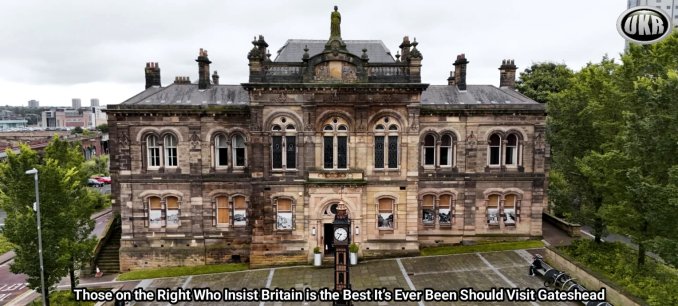
In an effort to head off my midriff’s desperate project to transform itself into a gigantic balloon, I have for the past several years been walking to and from my office on most days – a roughly 50 minute journey. The route takes me through central Gateshead, where there is a small but beautiful collection of – now almost entirely derelict – 19th century buildings, including the magnificent old town hall.
To pass through this area is like travelling past antique ruins of the Olmecs: we know something of the people who built these things, but we lack the capacity to fully comprehend their thinking. They are too attenuated from us in time, but also in mindset. These strange, half-forgotten folk, you see, actually wanted to make Gateshead look nice. This is incomprehensible to us now – the bizarre, dead theology of an irrecoverable past.
This afternoon, as I walked past the old Lloyd’s Bank building – now a rarely used space to hire for charity or church events – I was distracted by shouts coming from a side road just beside it. A group of three of four lads, about 12-14 years old or so, had picked up a traffic cone from somewhere and were using it (as one does) to smash one of the windows. They looked like they were having a grand old time. It was about 4.30pm and a constant stream of traffic was coming out of a nearby multistorey car park, and there were plenty of pedestrians out and about (including a homeless African man who was kneeling on the ground nearby examining his raised hands and muttering to himself). But everybody was studiously ignoring this little vignette of vandalism as they went about their business.
I went over to remonstrate with the kids and they quickly scarpered, after observing that I was a “wanker”. Since literally nobody else seemed prepared to even stop to notice what had happened, let alone do anything about it, I then decided to call the police’s non-emergency number and report the incident. I was put on hold for 10 minutes and told that this was an “exceptionally busy period” (Christ knows what they are like at 11pm on a Saturday night), but was finally given the opportunity to request a call-back through an automated message. Since time was ticking away and I had things to do, I then called the owner of the building to give him the bad news and went on my way.
I waited and waited for a call-back and it eventually came at past 8pm, i.e., almost four hours after the incident in question. I told the bored-sounding young man at the other end of the line what had happened and he said, “Leave it with me, but next time it happens, call 999, as technically it was an emergency.” He then hung up. I leave you to make up your own mind about the likelihood that the police will even bother investigating. I would say it is about as likely as the artist formerly known as Prince Andrew becoming King of the United Kingdom.
This incident caused me to reflect on the recent appearance of a certain narrative in some sections of the centre-Right media here in Britain, to the effect that, while most British people feel deeply in their bones that the country is going down the toilet, it is acshually doing splendidly well. Fraser Nelson is the world heavyweight champion when it comes to making this case; Jonathan Sumption was also at it in a recent podcast appearance, and just the other day James Kirkup was popping up in the Telegraph to inform us that he had just turned 50 and that “In my lifetime nearly everything in Britain has got better”.
Focusing on Kirkup, as he puts it the most succinctly, the argument runs roughly as follows: people may feel that Britain is getting worse, but the facts suggest otherwise. And if one is pessimistic about Britain’s direction of travel, it can only be that one does not possess the right facts. Hence:
On pretty much every measure, things have got better and better. We live longer, healthier, safer and happier lives. Our incomes are much higher and a far smaller share of them is spent on essentials. Food, transport, technology are all greatly improved. Almost everybody today has access to services, entertainment and experiences that would have been unattainable in 1976.
Now, this is self-evidently an asinine argument, and for many reasons. First, even if we grant that we live “longer, healthier, safer and happier lives” than in 1976, that doesn’t necessarily mean that we live “longer, healthier, safer and happier lives” than at another point in the interim – say, 2007, or 2019. We may do. But we may not. We might be better off than in 1976, but on a downward trajectory compared to more recent history; both of those things could be true. And, of course, it all depends on how you define what is “healthy” and “happy” – do we have better mental health than in 1976, for example? Are we more or less likely to be disabled, or obese, than people were in those days?
It is also, I think, worth observing that what one loses on the swings one gains on the roundabouts: we spend less money proportionately on essentials perhaps, but do we spend less proportionately on mortgages or rent? We have better entertainment, but do we spend more time or less time with friends and family? We have better transport, but do we have more or fewer children?
In other words, even if we accept the premise that it is possible to look at the facts to determine whether things are “better” than at some point in the past, our understanding depends on what facts we look at and how we interpret them and weigh them against each other. Children are probably physically safer than they have ever been in human history. But are they mentally or emotionally safer? Fewer of them are killed in road traffic accidents or by disease. But more of them are exposed to extreme pornography and more of them self-harm. Is that better, or worse?
Yet the really important flaw in the argument is that the premise itself is simply daft. It reminds me of the arguments that were trotted out in favour of remaining in the European Union around the time of the referendum (the Remain side was always ready with its facts), as though the decision was going to be made simply on the basis of the exact percentage point by which trade in bumper stickers to Latvia was going to go down and whether or not we’d continue to be allowed to be members of the European Atomic Energy Community. It is a bit like a husband sitting down with his wife when she has announced she wants to leave him in order to explain that, ‘Yes, but here are the facts about how frequently I put the bins out and how many lie-ins you get a year.’ We don’t assess these matters on the basis of a carefully curated selection of facts. We base them on what we see in the round.
And what we see in the round is decay – and fairly rapid decay, at that. It may not be evident to journalists who live in nice, leafy parts of London and write for the Times, and it might not be evident to former Justices of the Supreme Court who live in posh digs in Greenwich and spend half the year in Tuscany. But it is perfectly evident to those of us who inhabit the actual country itself, and see how visibly and terribly enshittified much of it is. I wasn’t alive in 1976, but I grew up in Liverpool in the 1980s – I know what a high crime rate looks like. Yet 12 year-old kids didn’t smash the windows in grand old town centre buildings in broad daylight in front of dozens of passers-by on an ordinary February afternoon in Liverpool in the 1980s. We now admittedly have Netflix and faster trains, and nicer recipe books and things like sorrel and rainbow chard for sale in the local supermarket. But we are also confronted with deterioration in the civic environment on a daily basis, such that it is now genuinely uncomfortable and depressing to have to interact with one’s physical surroundings in many parts of the country.
The ‘Britain isn’t broken’ narrative, in other words, may be true in some parts of the nation, but that just means the breakages are not evenly distributed. Fraser Nelson, James Kirkup and their ilk, I would suggest, just need to spend a few weeks walking around in Gateshead (or Birkenhead, for that matter) town centres to witness quite how quickly things are sliding. We may finally then start to abandon the narrative about curated facts and how this proves that our instincts are all wrong, and instead engage with the generally rubbish experience of living here and how it might be improved.
Dr David McGrogan is an Associate Professor of Law at Northumbria Law School. You can subscribe to his Substack – News From Uncibal – here.
This article (Those on the Right Who Insist Britain is the Best It’s Ever Been Should Visit Gateshead) was created and published by The Daily Sceptic and is republished here under “Fair Use” with attribution to the author Dr. David McGrogan

••••
The Liberty Beacon Project is now expanding at a near exponential rate, and for this we are grateful and excited! But we must also be practical. For 7 years we have not asked for any donations, and have built this project with our own funds as we grew. We are now experiencing ever increasing growing pains due to the large number of websites and projects we represent. So we have just installed donation buttons on our websites and ask that you consider this when you visit them. Nothing is too small. We thank you for all your support and your considerations … (TLB)
••••
Comment Policy: As a privately owned web site, we reserve the right to remove comments that contain spam, advertising, vulgarity, threats of violence, racism, or personal/abusive attacks on other users. This also applies to trolling, the use of more than one alias, or just intentional mischief. Enforcement of this policy is at the discretion of this websites administrators. Repeat offenders may be blocked or permanently banned without prior warning.
••••
Disclaimer: TLB websites contain copyrighted material the use of which has not always been specifically authorized by the copyright owner. We are making such material available to our readers under the provisions of “fair use” in an effort to advance a better understanding of political, health, economic and social issues. The material on this site is distributed without profit to those who have expressed a prior interest in receiving it for research and educational purposes. If you wish to use copyrighted material for purposes other than “fair use” you must request permission from the copyright owner.
••••
Disclaimer: The information and opinions shared are for informational purposes only including, but not limited to, text, graphics, images and other material are not intended as medical advice or instruction. Nothing mentioned is intended to be a substitute for professional medical advice, diagnosis or treatment.
Disclaimer: The views and opinions expressed in this article are those of the author and do not necessarily reflect the official policy or position of The Liberty Beacon Project.


Leave a Reply