

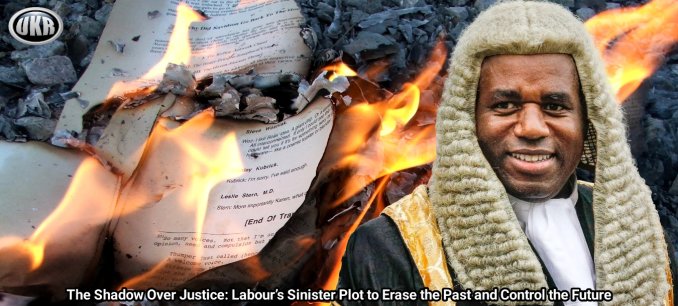
The Shadow Over Justice
Labour’s Sinister Plot to Erase the Past and Control the Future

ROGER CRAWFORD
In the dim corridors of power, where decisions are made far from the prying eyes of the public, a chilling narrative is unfolding in the United Kingdom. On February 11, 2026, reports emerged that the Ministry of Justice (MoJ), under the stewardship of David Lammy, has ordered the deletion of the nation’s largest archive of court records. This archive, maintained by Courtsdesk, a data analysis company pivotal in exposing systemic flaws in the justice system, is set to vanish within days. Simultaneously, the Labour government presses forward with plans to scrap jury trials for a vast swath of criminal cases, relegating judgments to solitary judges in so-called “swift courts.” These twin assaults on transparency and democratic safeguards are not mere administrative tweaks; they form a sinister tapestry, woven to obscure past scandals, shield the powerful, and consolidate control over the dispensation of justice. At the heart of this looms the spectre of covering up one of Britain’s most heinous chapters: the widespread child sexual exploitation by grooming gangs, predominantly involving Pakistani Muslim men, as highlighted in recent inquiries and public outcry.
To understand the gravity, one must first delve into the Courtsdesk saga. Launched in 2020 with explicit approval from the then-Lord Chancellor and Justice Minister Chris Philp, Courtsdesk was designed as a beacon of open justice. It aggregated magistrate court records into a searchable database, providing journalists, campaigners, and the public with unprecedented access to listings and outcomes. This tool was no frivolous endeavour; it was born from a government-commissioned project to enhance media coverage of courts, addressing long-standing complaints about opaque listings that left many cases unreported. Over the years, it served over 1,500 journalists from 39 media organizations, uncovering damning truths: journalists received no advance notice for 1.6 million criminal hearings, court listings were accurate on just 4.2% of sitting days, and half a million weekend cases went unnoticed by the press.
Yet, in November 2025, HM Courts and Tribunals Service (HMCTS), an arm of the MoJ, issued a cessation notice to Courtsdesk, citing “unauthorised sharing” of data via a test feature as a “data protection issue.” Despite repeated pleas for dialogue—16 letters from Courtsdesk’s CEO Enda Leahy—the government responded with a final refusal last week, mandating the archive’s deletion imminently. Leahy’s words echo with foreboding: “We built the only system that could tell journalists what was actually happening in the criminal courts. If the government were interested in open justice, they would engage in a dialogue.” Instead, silence and erasure.
The timing is suspiciously ominous. This order coincides with heightened scrutiny of Britain’s grooming gang scandals, where thousands of vulnerable girls were systematically abused, often with authorities turning a blind eye due to fears of racial sensitivity. Just days before the deletion mandate, MP Rupert Lowe initiated a private inquiry into these atrocities, fuelled by transcripts from Courtsdesk’s archive that circulated on platforms like X, igniting public fury. Figures like Tommy Robinson have decried this as a “mass destruction of evidence,” suggesting the government is scrambling to bury details of crimes that expose institutional failures. The Conservatives, now in opposition, have accused Labour of “covering up” future scandals, with former Justice Minister Chris Philp appealing to current Courts Minister Sarah Sackman to halt the deletion—to no avail.
Fears abound that this purge will shield perpetrators and complicit officials, particularly in child sexual exploitation cases. As one LinkedIn post starkly warns, “As deletion looms… fears grow that vital transparency on child sexual exploitation networks—and official failures to address them—will vanish.” The MoJ’s insistence on data protection rings hollow; no detailed explanation has been provided, and Courtsdesk’s request for referral to the Information Commissioner’s Office was ignored. This is not housekeeping; it’s a calculated obliteration of history, ensuring that inconvenient truths about unreported trials, botched notifications, and perhaps even suppressed evidence in high-profile scandals disappear forever.
But the darkness deepens when one connects this to the government’s relentless push to dismantle jury trials. Announced in December 2025 by Justice Secretary David Lammy, the reforms aim to scrap juries for offenses carrying likely sentences of under three years, funnelling them into “swift courts” where a single judge decides guilt or innocence. This threshold captures a quarter of current Crown Court cases, including theft, drug offenses, fraud, and many violent and sexual crimes. Jury trials, Lammy claims, remain the “cornerstone” for the gravest offenses like murder and rape, but the backlog, now at 78,000 cases, projected to hit 100,000 by 2028 – largely because of incompetence and inertia—demands “bold” action.
The rationale? Efficiency. Judge-only trials purportedly take 20% less time, saving £31 million, a paltry 0.2% of the MoJ budget. Yet, critics, including Labour rebels, legal experts, and cross-party MPs, decry it as an ideological assault on a right enshrined since the Magna Carta in 1215. Prime Minister Keir Starmer, undeterred, frames it as a “fundamental argument of principle” to deliver justice for victims of misogynist violence, who endure waits up to 332 days from charge to completion. But leaks reveal initial plans targeted sentences up to five years, watered down amid backlash, yet still far exceeding recommendations from Sir Brian Leveson’s independent review.
Parliamentary debates rage. In a February 5, 2026, session, the Minister for Courts and Legal Services admitted she’d scrap juries even absent a crisis, while Starmer calls for “conversation” on alternatives. Opposition MP Robert Jenrick lambasted it as an “unworkable attack on our civil liberties,” noting manifesto omissions and minimal backlog impact, only 3% of cases go to jury, with reforms affecting just a fraction. Leveson himself warns that blocking these changes risks “chaos” in courts teetering on collapse.
The sinister linkage between database deletion and jury abolition is inescapable. By erasing Courtsdesk’s archive, the government expunges records of past trials, including those revealing grooming gang horrors and official negligence. This paves the way for a future where, sans juries, judges appointed and influenced by the state handle sensitive cases in opacity. Imagine grooming-related offenses, often carrying sentences under three years, decided behind closed doors, without public scrutiny to ensure fairness. The archive’s revelations about unreported hearings already suggest a system rigged against transparency; removing juries amplifies this, allowing verdicts to be moulded without scrutiny.
This convergence hints at a broader authoritarian agenda under Labour. As many have noted, even cosmetic changes like dropping “His Majesty’s” from court titles erode accountability to the Crown, fostering self-appointed power. Coupled with jury curbs, it evokes dystopian control: delete the past to rewrite history, strip juries to dictate the future. Fears of covering asylum seeker crimes or institutional biases intensify, with the Daily Sceptic suggesting the government flees transparency amid murders and sex attacks.
Broader implications terrify. Jury trials embody democracy, ordinary citizens checking state power. Scrapping them risks biased judgments, especially in politically charged cases. As Al Jazeera queries, why erode an ancient right for marginal gains? Reform UK vows reversal, sufficient in itself to vote for them, with MP Danny Kruger affirming restoration under their governance. Yet, Labour persists, ignoring expert dissent that alternatives like increased sitting days could suffice.
In conclusion, this dual assault is no coincidence but a calculated erosion of justice’s pillars. Deleting Courtsdesk’s archive buries scandals like grooming gangs, while jury abolition ensures future ones evade public gaze. Britain stands at a precipice: will it allow this sinister veil to descend, or rally to preserve open, peer-led justice? The public must demand accountability, lest the shadows consume the light of truth.

••••
The Liberty Beacon Project is now expanding at a near exponential rate, and for this we are grateful and excited! But we must also be practical. For 7 years we have not asked for any donations, and have built this project with our own funds as we grew. We are now experiencing ever increasing growing pains due to the large number of websites and projects we represent. So we have just installed donation buttons on our websites and ask that you consider this when you visit them. Nothing is too small. We thank you for all your support and your considerations … (TLB)
••••
Comment Policy: As a privately owned web site, we reserve the right to remove comments that contain spam, advertising, vulgarity, threats of violence, racism, or personal/abusive attacks on other users. This also applies to trolling, the use of more than one alias, or just intentional mischief. Enforcement of this policy is at the discretion of this websites administrators. Repeat offenders may be blocked or permanently banned without prior warning.
••••
Disclaimer: TLB websites contain copyrighted material the use of which has not always been specifically authorized by the copyright owner. We are making such material available to our readers under the provisions of “fair use” in an effort to advance a better understanding of political, health, economic and social issues. The material on this site is distributed without profit to those who have expressed a prior interest in receiving it for research and educational purposes. If you wish to use copyrighted material for purposes other than “fair use” you must request permission from the copyright owner.
••••
Disclaimer: The information and opinions shared are for informational purposes only including, but not limited to, text, graphics, images and other material are not intended as medical advice or instruction. Nothing mentioned is intended to be a substitute for professional medical advice, diagnosis or treatment.
Disclaimer: The views and opinions expressed in this article are those of the author and do not necessarily reflect the official policy or position of The Liberty Beacon Project.


