

STEVEN BARNES
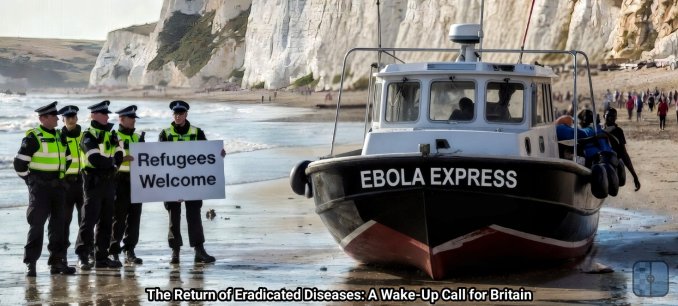
In recent years, Britain has found itself grappling with a troubling resurgence of diseases once thought to be firmly in the past. In an age where we celebrate medical advancements and the successes of public health initiatives, the reappearance of measles, tuberculosis, and even the spectre of Ebola raises serious concerns about the implications of uncontrolled mass immigration. This narrative reflects a broader conversation about public health, government responsibility, and the fragility of our hard-won victories against infectious diseases.
Britain has prided itself on its ability to eliminate or significantly reduce the prevalence of many infectious diseases through robust vaccination campaigns and public health policies. Smallpox and polio, once common, have been all but eradicated thanks to the diligence of the National Health Service (NHS) and the commitment of the British public to immunisation. Yet the landscape has changed. The past few years have seen a rise in diseases that were once eradicated, with public health officials sounding the alarm over outbreaks of measles. In 2019, the UK celebrated its elimination of the disease, but subsequent years have painted a different picture. Outbreaks have been reported, predominantly among communities reluctant to vaccinate, often influenced by misinformation and anti-vaccine sentiments – and I’m not referring to mRNA vaccines here, where extreme caution is required. Many of these communities include recent immigrants from regions where vaccination rates are lower, creating fertile ground for the virus to spread.
The threat of Tuberculosis (TB) is another stark reminder of the challenges facing the UK. Once on the decline, TB cases have started to rise again, particularly in urban areas with high levels of immigration. Many newcomers hail from countries where TB remains endemic, and the lack of thorough health checks upon arrival has heightened the risk. The disease can lie dormant, often going undetected until it becomes a public health crisis. The implications are profound. Public health systems must now expend considerable resources managing outbreaks that strain the very fabric of the NHS, which is already under pressure. The economic costs of treating TB and conducting public health campaigns are significant, not to mention the human toll on families affected by this resurgent disease.
Then there is Ebola, a disease that has proven to be both terrifying and deadly. Although largely confined to specific regions of Africa, the recent outbreak in the Democratic Republic of the Congo has raised alarms internationally. The World Health Organization (WHO) has issued warnings about the risk of Ebola spreading beyond its borders, particularly as global travel becomes increasingly common. The WHO’s latest declaration on Ebola underscores the importance of preparedness and vigilance in the face of such threats.
As Britain grapples with the reintroduction of these diseases, the question looms larger: why is the government allowing unchecked immigration from countries with known health risks? The responsibility to protect the health of British citizens is obviously, to most sensible people, of far greater importance that what is presented as compassion to ‘refugees. It is crucial, therefore, to ensure that the systems in place are robust enough to prevent the introduction of infectious diseases. The current approach raises profound concerns about public health policy and the prioritisation of safety. In a world that has become increasingly interconnected, the potential for disease transmission is ever-present. The return of measles, the rise of tuberculosis, and the looming threat of Ebola all highlight the urgent need for the government to reconsider its immigration policies and health screening processes.
The resurgence of previously eradicated diseases in Britain serves as a stark reminder of the fragility of our public health achievements. The implications of uncontrolled mass immigration are clear, and as we face the challenges posed by diseases like measles, tuberculosis, and Ebola, it is imperative for the British government to take decisive action. We must ask of our rulers why are they allowing individuals from Ebola-affected countries to enter the UK without thorough health checks? The health and safety of the British public must take precedence, and it is time for a re-evaluation of policies that could jeopardise the wellbeing of our nation. The stakes are too high to ignore.
See Related Article Below
A few security issues facing the UK – Energy, Food and … Health
We live in interesting times – as the Chinese curse has it
PETER HALLIGAN
We are all familiar with the lies told by the ‘net zero’ lunatics about the need to destroy the food producing areas of the Uk by taxing and regulating farmers out of existence – especially methane producing cows, pigs and chickens.
Fertile land for growing crops is also under threat from plantations od solar panels and forests of wind turbines. All of which require household bills to triple again from the tripling already suffered in the last ten years.
This pursuit of renewable energy takes place against the backdrop of sufficient hydrocarbons to supply the UK for many decades.
Instead of cheap energy, the ‘net zero’ lunatics want to replace it with expensive solar panels and wind turbines that require an entire duplication of transmission grids to connect it – and even then, when its not windy or sunny, run the risk of blackouts and power rationing.
There is another risk to the UK that is not discussed, let alone identifie – health risk from legal illegal immigration.
Illegal immigration mainly takes the form of small boats.
“More than 200,000 migrants have arrived in the UK via small boats since records began in 2018, a milestone reached in early May 2026. Official Home Office figures confirm that 200,013 people had crossed the English Channel by the weekend of May 9–10, 2026, following a crossing of 70 individuals on Friday, May 9.
Part od a fr larger number of immigrants:
“According to Office for National Statistics (ONS) estimates, approximately 5.55 million people arrived in the UK as net migrants between 1991 and 2021.
Over the specific 20-year period from the year ending June 2005 to June 2025, total immigration is estimated to have been around 10.5 to 11 million people, with net migration totaling approximately 5.5 to 6.0 million.
“Between mid-2020 and mid-2025, the UK population grew by approximately 2.75 million, with total immigration over the last four years (YE June 2021 to YE June 2025) totaling 5.6 million and net migration totaling 2.7 million. “
The current UK population is around 70 million.
‘How healthy are the people arriving by small boat from csmps in France?
From Brave AI:
“Small boat migrants are disproportionately affected by skin lesions and infectious diseases that present with cutaneous symptoms, such as scabies, cellulitis, and cutaneous diphtheria. These conditions are particularly common in this population due to the high risk of transmission in the communal accommodation settings where they often reside upon arrival.
While general migrant populations may carry higher rates of tuberculosis (particularly latent), hepatitis B, and parasitic infections like schistosomiasis or intestinal protozoa, newly arrived small boat migrants in the UK specifically present with an increased risk of these skin-related infections compared to other arrival routes. Other communicable diseases reported in broader refugee and asylum-seeking populations include measles, cholera, typhoid, and malaria, though these are not exclusively tied to the small boat migration route.”
These health risks are known to UK health authorities:
“ Key components of the health screening include:
- Infectious Disease Screening: Testing for communicable diseases based on country of origin, including active and latent tuberculosis (using IGRA for high-incidence countries), HIV (for countries with >1% prevalence), hepatitis B and C, and parasitic infections such as strongyloides, schistosomiasis, and malaria.
- Vaccination and Immunisation: Offering catch-up vaccinations for all newly arrived children, adolescents, and adults to align with the UK’s national schedule, ensuring protection against preventable diseases.
- Non-Communicable and Nutritional Health: Assessing for undiagnosed conditions like diabetes, hyperlipidaemia, and hypertension, as well as screening for nutritional deficiencies (e.g., vitamin D, iron, vitamin A) and oral health issues.
- Mental Health and Trauma: Evaluating for mental health impacts resulting from conflict, torture, trafficking, or displacement, with signposting to specialist trauma services, rape crisis support, or modern slavery advocates as needed.
- Safeguarding and Vulnerability Checks: Identifying risks related to female genital mutilation (FGM), domestic violence, and modern slavery, and assessing the health needs of pregnant women, children, and those with disabilities.
Asylum seekers and refugees are entitled to free primary care (GP registration) and free secondary care for specific services regardless of immigration status, including treatment for communicable diseases, maternity care, and conditions caused by torture or violence. Eligibility for free secondary care extends to refugees, asylum seekers, and their dependants, while refused asylum seekers may access free care if they receive Section 95 or Section 42 support or live in Northern Ireland, Scotland, or Wales.”
Sound expensive, but note the need to know the country of origin to determine risk.
- “Immigration Health Surcharge (IHS): This is a mandatory fee paid by most visa applicants to access the NHS. As of February 2024, the standard rate is £1,035 per year, with a discounted rate of £776 per year for children and students. Asylum seekers are explicitly exempt from paying the IHS.
- Health Assessments: The context mentions “initial health assessments for newly arrived migrants, refugees, and asylum seekers” as part of public health measures, but it does not specify the financial cost of these specific screenings for the state or the individuals.
- Asylum Seeker Access: Asylum seekers are entitled to access all NHS services free of charge. This includes registration with a GP and treatment for communicable diseases, which are free regardless of immigration status.
- Charging Regulations: While the NHS charges overseas visitors 150% of the actual cost for non-urgent treatment, asylum seekers and refugees are generally exempt from these charges.
To find the specific operational cost of health screening for small boat arrivals, one would need to consult specific Home Office or Department of Health and Social Care reports on asylum healthcare provision, as this detailed cost data is not present in the provided search results.”
The actual costs and the time spent treating ‘boat people’ is a secret.
Here’s what Brave AI has to say about meningitis, hantavirus and Ebola amongst ‘boat people:
Meningitis:
- Boat people (migrants and refugees traveling by water) can carry and transmit meningitis-causing bacteria, particularly Neisseria meningitidis (meningococcus), which is responsible for bacterial meningitis. High-Risk Conditions: Crowded living conditions, such as those found on refugee boats or in camps, are recognized risk factors for meningococcal outbreaks because the bacteria spread through respiratory droplets and close contact.
- Vaccination Gaps: Refugees and migrants often have interrupted or incomplete vaccination histories due to conflict or displacement, increasing their susceptibility to invasive meningococcal disease (IMD) and their potential role in spreading it to new populations.
“ Boat people can be on the run from authorities in their home countries for all sorts of crimes – incomplete vaccination records would not be a high priority – I wonder if they are forced to tak C19 injections MMR, etc..
Ebola:
“People on boats (including cruise ships and other vessels) can carry the Ebola virus, but the risk of transmission during travel is considered low by major health organizations
- “Incubation Period: A person is only contagious once symptoms appear, which typically occurs 2 to 21 days after exposure. During this incubation period, travelers do not pose a risk to others.
- Screening and Isolation: International health guidelines recommend exit screening in affected areas and isolation for anyone showing symptoms. Travelers who have been in contact with Ebola cases are often monitored for 21 days.
- Surface Contamination: While the virus does not spread through air or water, it can be transmitted via fomites (objects like railings, bedding, or medical equipment) if they are contaminated with fresh bodily fluids.”
Hantavirus
“People can carry the Andes strain of hantavirus, which is the only known variant capable of human-to-human transmission. This transmission typically occurs through close or prolonged contact with an infected person, such as sharing cabins or caring for symptomatic individuals, rather than casual airborne spread.
Risk Level: The risk to the general public remains very low, as transmission is not efficient and requires specific close-contact conditions not present in everyday community interactions.
What details there are of ‘boat people’ arriving from sub-Saharan Africa ( the location of the Ebola outbreak area summarised by Brave AI below:
“the following relevant statistics for Sub-Saharan African arrivals:
- 2025 Nationality Breakdown: In the year ending September 2025, 31% of asylum seekers were from African countries, with the largest nationalities being Eritrean, Sudanese, Somali, Nigerian, and Ethiopian.
- Recent Asylum Applications: In 2024, approximately 108,000 people claimed asylum in the UK in total (the highest since records began in 1979), though the specific regional split for that year is not detailed in the snippets.
- Small Boat Arrivals: In the year ending March 2026, Eritrea accounted for 18% of all small boat arrivals, indicating a significant portion of irregular migration from Sub-Saharan Africa.
- Historical Data (2008): Data from 2008 indicates the Black African-born population in the UK was nearly 0.5 million, with Nigeria, Ghana, Somalia, Zimbabwe, Uganda, and Kenya as the largest single-country origins.
Uganda is reporting cases – Kenya is adjacent – there are no DRC immigrants reported.
Three new Ebola cases declared in Uganda – as DR Congo’s World Cup team told to isolate
As it happens Moderna ha just developed a ‘vaccine for hantavirus. Surprise, surprise!
Moderna’s hantavirus ship comes in – The Expose
Onwards!
Please take a (paid or unpaid) subscription or forward this article to those you think might be interested.
You can also donate via Ko-fi – any amount from three dollars upwards. Ko-fi donations here:
https://ko-fi.com/peterhalligan
This article (A few security issues facing the UK – Energy , Food and … Health) was created and published by Peter Halligan and is republished here under “Fair Use”

••••
The Liberty Beacon Project is now expanding at a near exponential rate, and for this we are grateful and excited! But we must also be practical. For 7 years we have not asked for any donations, and have built this project with our own funds as we grew. We are now experiencing ever increasing growing pains due to the large number of websites and projects we represent. So we have just installed donation buttons on our websites and ask that you consider this when you visit them. Nothing is too small. We thank you for all your support and your considerations … (TLB)
••••
Comment Policy: As a privately owned web site, we reserve the right to remove comments that contain spam, advertising, vulgarity, threats of violence, racism, or personal/abusive attacks on other users. This also applies to trolling, the use of more than one alias, or just intentional mischief. Enforcement of this policy is at the discretion of this websites administrators. Repeat offenders may be blocked or permanently banned without prior warning.
••••
Disclaimer: TLB websites contain copyrighted material the use of which has not always been specifically authorized by the copyright owner. We are making such material available to our readers under the provisions of “fair use” in an effort to advance a better understanding of political, health, economic and social issues. The material on this site is distributed without profit to those who have expressed a prior interest in receiving it for research and educational purposes. If you wish to use copyrighted material for purposes other than “fair use” you must request permission from the copyright owner.
••••
Disclaimer: The information and opinions shared are for informational purposes only including, but not limited to, text, graphics, images and other material are not intended as medical advice or instruction. Nothing mentioned is intended to be a substitute for professional medical advice, diagnosis or treatment.
Disclaimer: The views and opinions expressed in this article are those of the author and do not necessarily reflect the official policy or position of The Liberty Beacon Project.


