

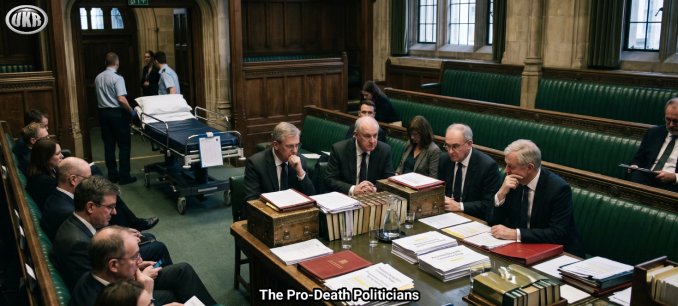
The pro-death politicians
On parliamentary priorities.
LAURA PERRINS
There are two Bills being introduced into the House of Commons and Dáil Éireann that say a lot about the priorities of the politicians doing the introducing. When it comes to life and certainly when it comes to politics, what policies you support are important. But what is even more important is what policies you prioritise.
What stories the media choose to focus on is a value decision because air time and print space is limited. Similarly, parliamentary time is rationed so what Bills politicians choose to spend parliamentary time on is critical. If you choose to introduce one Bill it means you can’t discuss another.
Rochester and Strood MP Lauren Edwards has announced that she plans to reintroduce a bill to legalise “assisted dying.” Ms Edwards came second in the ballot for private members bills in the new session of parliament and now plans to reintroduce Kim Leadbeater’s highly controversial Terminally Ill Adults (End of Life) Bill which would allow assisted deaths in England and Wales.
The original bill failed to pass in April after running out of time to clear all its legislative hurdles in the House of Lords because of a huge number of amendments attempting to bring in safeguards against it being abused. It had previously passed the House of Commons.
Meanwhile in Ireland, Sinn Féin will bring forward a bill to scrap the 3-day wait period before abortion in the Dáil on Tuesday evening. The bill seeks to remove the mandatory three‑day waiting period before an abortion can be certified. I wrote about the reflection period before.
If one was to be generous there are arguments in favour of both of these bills to knock off the old and the pre-born. The Assisted Dying Bill cleared the House of Commons and polling shows the public support it (like they support the return of the death penalty) so perhaps democracy demands it.
However, public support does not mean that the public are demanding assisted dying to the neglect of other issues. A new MRP poll shows that legalising assisted dying came rock bottom of a list of Lauren Edwards MPs, constituency Rochester and Strood voters’ priorities that they would want their MP to focus on if they had the opportunity to make a law change over the next year.
Quite a few in the Labour party itself are not demanding it. According to Right to Like UK, Deputy PM David Lammy, Home Sec Shabana Mahmood, Ex Deputy PM Angela Rayner, Ex Health Sec Wes Streeting, Chief Whip Jonathan Reynolds, No10 advisor and former PM Gordon Brown, PM’s Chief Sec Darren Jones and Scottish Leader Anas Sarwarall all oppose it. Jeremy Corbyn MP also opposed the last bill. Not a single medical or professional body supports it because the bill lacks adequate safeguards.
It is no accident that it is the left-wing Labour MPs who oppose assisted dying. They know exactly what will happen in the future – the assisted dying ward will be set up in their local NHS hospital, the cuts to social care and palliative care will mount and the poorest and the most vulnerable will be pushed towards Assisted Dying Ward 2. Just why if you were a parliamentarian would you make Assisted Death on the NHS a priority?
A similar question should also be asked of Sinn Féin. Why do they want more abortions? Why take aim at the the three day wait? Is this a priority for their voters? Sinn Féin opposed the last attempt to remove the three day wait under a much broader Social Democrat Bill, so they are at least being responsible in dealing with the reflection period separately from the very complex issue of life limiting foetal abnormality. But the question remains – why this?
If you were to knock on the door of SF voters their first priority is not the three day abortion wait. I suspect immigration, housing, the cost of living and the state of their local hospital are of much greater concern. Yet despite this, SF have chosen to speed up the abortion process. Just who actually thinks like this?
Even if you supported the substance of each respective Death Bill, their champions are depriving Parliament of time that could be spent on more important legislation by focussing on more death. When determining what you should prioritise as a MP and TD it is not simply a question of do your constituents support it, the other question is, is it a priority for them. And clearly in both of these cases it is not.
The left often accuse the right of ‘starting a culture war’ but both of these death bills are the kind of thing you will spend time on for the glory of culture war “win.” The voters don’t think it is a priority, in the case of assisted dying the professional medical bodies oppose it, and everyone is too concerned about the rising cost of living.
These Bills are a poor use of Parliamentary time. There is no public demand for these fundamental ethical changes that certain left wing politicians seem to fetish.
That says more about them, then it does the voting public.
Buy me an English breakfast tea.

This article (The pro-death politicians) was created and published by Laura Perrins and is republished here under “Fair Use”
See Related Article Below
Keir Starmer’s lethal legacy
No one voted for assisted dying

MARY HARRINGTON
A friend tells a blood-curdling anecdote about visiting Moscow for work, in that End of History interregnum, when the West still did business with the Russian bear. Even then, it was risky: my friend booked a driver to take him from the hotel to a client’s office, only to realise after a few minutes that the driver was heading at speed in entirely the wrong direction. When he queried this, the man simply pretended not to understand, and drove even faster. He realised with cold certainty he was being kidnapped.
The relation between British voters and the people elected to govern us feels a little like being stuck in that taxi. I know many decent people who voted for this Labour government, in exasperation at 14 footling years of the Tories, and who simply hoped that Starmer would deliver what he seemed to be promising: sensible centre-left policies plus a bit less psychodrama.
Instead, all those votes seem to have granted a thumping majority to a man who has U-turned on everything sensible and centre-left he ever promised, while showing a steely determination to ram through, either personally or via proxies, a whole shadow programme of policies which weren’t in the manifesto.
Of these, none is more egregious than the Assisted Dying Bill. This was never Labour policy. It was brought as a Private Members’ Bill, with the transparent connivance of government, and given the airiest of rides by a committee packed with supporters. Except then it ran out of time in the House of Lords, under the weight of 1,200 amendments brought against its shortcomings on behalf of the great many charities, experts, nurses, carers, GPs, psychiatrists, abuse campaigners, priests, and others who raised concerns about its lack of safeguards. But apparently that wasn’t enough to scotch it: tomorrow, another Labour MP, Lauren Edwards, will re-introduce the very same bill again, after coming second in the Private Members’ Bill ballot. Under existing Parliamentary procedure, if the Bill passes again in the House of Commons, it cannot be blocked in the Lords.
It’s like some sort of fever dream, in which you vote again and again for sensible taxation and functioning borders and public services, but every time you go outside there’s just the same Labour MP chasing you with a syringe. And what makes this so wearisome is that this will be the third attempt in five years to legalise suicide. Baroness Meacher’s 2021 bill in the House of Lords didn’t get much traction; Kim Leadbeater’s 2025 effort was stymied by the Lords. Now the gerontocide enthusiasts have donned the mantle of Our Democracy, insisting that the Lords doing what it’s supposed to do — scrutinise legislation — is somehow not constitutionally licit. Edwards called the bill’s failure in the House of Lords “the decision of a minority” blocking “long-overdue change”. It should be, she asserted, a “fundamental democratic principle” that the Lords shouldn’t be able to veto legislation in this way.
Now, perhaps you can correct me, but I don’t remember any such high-minded objections when the Lords threatened to block the invocation of Article 50 following the Brexit vote. Lord Falconer, for one, cheered on the Upper Chamber’s obstruction of Brexit, only to condemn it recently for affording assisted suicide the same level of scrutiny. It’s remarkable how swiftly constitutional safeguards can morph into anti-democratic obstruction when it’s your pet policy being scrutinised.
But surely, you might say, this is just politics? Well, it’s true that living in a democracy implies sometimes having to put up with political outcomes you don’t like, because some other lot voted for them. But the way people vote is supposed to be based on the publication of election manifestos. Of course hardly anyone actually reads them, but in theory the party publishes a list of pledges, the people assess them and vote to elect the party whose policies they like, then the winning party tries to get them passed in Parliament. Even the Brexit referendum was a Cameron election promise.
Most governments deviate in practice from the manifesto. But in most cases there’s at least an attempt at resemblance. Starmer appears to have begun in that spirit: barely two years ago, in his first speech as prime minister, he pledged to tread more lightly on our lives — which sounded like a welcome relief, and perhaps even what people voted for. Wrong. What we got, instead, was a party that had promised to spare a thought for ordinary people and not be a total hot mess, but which has instead dedicated a startling amount of energy to resigning, U-turning, and pursuing a weirdly post-humanist agenda, whose policies were never in any manifesto.
Digital ID wasn’t in the manifesto. But it’s now front and centre in Starmer’s programme.Nor was there anything in the manifesto about social media censorship, or changing the law on abortion. There definitely wasn’t anything about legalising doctor-assisted suicide. On Brexit, meanwhile, Starmer’s manifesto explicitly promised not to re-open free movement.
And yet: abortion has been de-criminalised all the way up to birth; new “youth safety” measures will in practice affect everyone including adults; and even Brexit refuses to stay done. Having promised not to reverse any of the headline Brexit changes, Starmer has since agreed to a “youth mobility” scheme that smells a lot like a fun-sized version of free movement, all while tying Britain back into “dynamic alignment” in some areas of EU regulation. This might all stay within the letter of manifesto promises, but it’s not the spirit. Labour fellow-travellers such as Sadiq Khan, meanwhile, think he should go further, urging Labour to fight the next election on rejoining the bloc.
Nor are we even being spared the psychodrama. Just this week we’ll all enjoy yet another by-election, which isn’t even the drama itself, but a sort of amuse-bouche for the real event, when Andy Burnham (should he win) will challenge Starmer for the top seat. (We might add that the good people of Makerfield voted for Josh Simons, and not any of the current ridiculous circus.) And most flagrantly of all, in the midst of financial meltdown, international unrest, simmering tensions over unwanted migration, and an ever-escalating cost-of-living crisis, the euthanasia ghouls still can’t accept defeat. No, they are going to suck all the oxygen out of Parliament for a second time, instead of focusing on issues that would actually make a positive difference to the lives of normal people.
Perhaps it’s unfair to blame all of this on Starmer personally. Who knows, perhaps none of it is strategic, just the organic result of a man who neither likes nor understands his country desperately mashing at the controls, in the hope that any resulting changes will be better or at least no worse than what was there before. But you don’t have to be a conspiracist to feel there’s a whiff of calculation about the document leaked to the Guardian last winter, which revealed Labour already strategising in opposition over how to smuggle assisted dying in — not via the manifesto and a proper mandate, but a Private Members’ Bill. The de-criminalisation of self-administered abortion to full term, too, was tucked into a much larger Crime and Policing bill, whose headline measures were on tackling shoplifting. A cynic might be forgiven for seeing the same preference for cajoling electorates into compliance with a pre-existing programme there, too.
The same also goes for the insistence that “Digital ID” will be voluntary (yeah, sure, to begin with) or Labour’s gradual assembly of a digital censorship engine. The legislative foundations for this were smuggled into a bill on children’s welfare, earlier this year, followed by a “public consultation” (aka policy laundering exercise) to grant legitimacy to the new restrictions, announced yesterday. You can be sure that what privacy advocates have long warned are the real implications of age-restrictions — that everyone will be forced to link their social media to an official ID — will only become apparent further down the line, once it’s too late to object.
Britain is genuinely divided on assisted suicide. You can find plenty of keen Rejoiners, pro-choice advocates, and even supporters of digital ID. I dare say people of good faith can make a case for all these policies singly. But no one did, in Labour’s manifesto. And so no one voted for any of these efforts to realise these policies. Indeed, the sidling manner in which they have been pursued strongly suggests that those doing so know perfectly well they aren’t vote-winners, especially not when combined with eye-watering taxes, crumbling services, inflation, riots, mass youth unemployment, and all the miserable rest of it. Taken all together, and in lieu of all the things people actually did hope Labour would deliver, it feels worse than inept: it feels actively malignant. If Joseph de Maistre was right, and every people really does get the government they deserve, we must have done something truly abominable.
In Moscow, trapped in that taxi, my friend saved his own skin by phoning his client, a well-connected man, who yelled over speakerphone in Russian at the driver. The tone was clear: the driver executed a handbrake turn and drove my friend, shaken but unharmed, at speed to his original destination. By contrast, the many good people I know who voted Labour and who just wanted a slightly less venal and dysfunctional rabble in charge, are now being driven at speed through concrete tower blocks, by mad ideologues deaf to every objection. Our destination appears to be a regime of state-sponsored killing, censorship, and surveillance, that would set screaming alarm bells off on the Left, were they not the ones bringing it about. Who can we call, to turn the car around?

••••
The Liberty Beacon Project is now expanding at a near exponential rate, and for this we are grateful and excited! But we must also be practical. For 7 years we have not asked for any donations, and have built this project with our own funds as we grew. We are now experiencing ever increasing growing pains due to the large number of websites and projects we represent. So we have just installed donation buttons on our websites and ask that you consider this when you visit them. Nothing is too small. We thank you for all your support and your considerations … (TLB)
••••
Comment Policy: As a privately owned web site, we reserve the right to remove comments that contain spam, advertising, vulgarity, threats of violence, racism, or personal/abusive attacks on other users. This also applies to trolling, the use of more than one alias, or just intentional mischief. Enforcement of this policy is at the discretion of this websites administrators. Repeat offenders may be blocked or permanently banned without prior warning.
••••
Disclaimer: TLB websites contain copyrighted material the use of which has not always been specifically authorized by the copyright owner. We are making such material available to our readers under the provisions of “fair use” in an effort to advance a better understanding of political, health, economic and social issues. The material on this site is distributed without profit to those who have expressed a prior interest in receiving it for research and educational purposes. If you wish to use copyrighted material for purposes other than “fair use” you must request permission from the copyright owner.
••••
Disclaimer: The information and opinions shared are for informational purposes only including, but not limited to, text, graphics, images and other material are not intended as medical advice or instruction. Nothing mentioned is intended to be a substitute for professional medical advice, diagnosis or treatment.
Disclaimer: The views and opinions expressed in this article are those of the author and do not necessarily reflect the official policy or position of The Liberty Beacon Project.


Leave a Reply