
HOTTENTOT
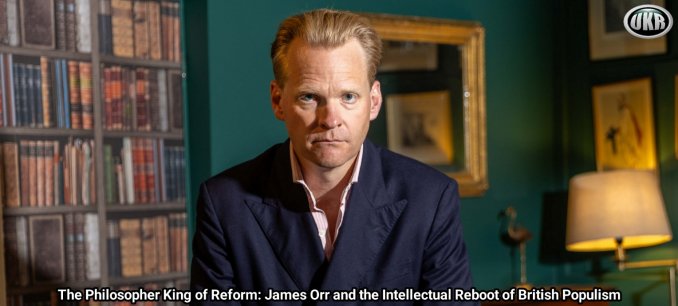
When Nigel Farage unveiled Reform UK’s shadow cabinet on 18 February 2026, one much overlooked appointment stood out to me for its intellectual heft and potential to reshape the party’s trajectory: Dr James Tristan Ward Orr, associate professor of philosophy of religion at the University of Cambridge, was named head of policy, succeeding Zia Yusuf. Farage’s choice of a 47-year-old theologian-philosopher with deep ties to the American ‘New Right’ signals an ambition to move Reform beyond headline-grabbing protest politics towards a more coherent, governance-ready programme.
Orr himself wasted no time staking his claim. In a statement posted on X under his handle @jtworr, he declared: “We’re going to build the best policy operation in British politics. And we will give our Shadow Cabinet all the support they need to govern. Britain needs new ideas. Britain needs Reform.” Working alongside Danny Kruger MP as head of PrepGov, Orr aims to professionalise a party often dismissed as a vehicle for Farage’s charisma. But who is the man now tasked with furnishing Reform with substance, and what direction is he likely to steer it?
Born in November 1978, James Orr was educated at Winchester College before reading Classics at Balliol College, Oxford. The young classicist arrived as an agnostic, steeped in Greek and Latin but untouched by the faith of his school. A pivotal moment came when a Christian friend handed him a copy of the New Testament in the original Koine Greek (κοινὴ διάλεκτος; “the common dialect” lingua franca of the Eastern Mediterranean from the 4th century BC until the 6th century AD). Reading the Gospels in their native tongue produced what Orr later described as a “lightning bolt”: the text felt as historically anchored as Thucydides or Herodotus.
After graduation he joined the City, working as a corporate lawyer at Freshfields Bruckhaus Deringer and then Sullivan & Cromwell. The high-flying career brought material success but existential emptiness. On New Year’s Eve 2002, after a few drinks, Orr uttered a sceptical prayer: if God existed, He should reveal Himself. Over the following weeks, a series of uncanny “coincidences” accumulated enough, he concluded, to make continued disbelief irrational. Smoking and drinking fell away; friends and family noticed the change and were unsettled. Without church connections, Orr began serious study of Christian evidence. The intellectual path led to a ‘personal encounter with Christ’. Providential circumstances, he says, drew him away from law to postgraduate study in philosophy of religion at Cambridge.
He completed an MPhil and PhD (thesis: “Divine lawmaking: a conceptualist account”) there in 2015. After four years as McDonald Postdoctoral Fellow in Theology, Ethics and Public Life at Christ Church, Oxford, he returned to Cambridge as associate professor in the Faculty of Divinity. His research interests are demanding: Husserl and early phenomenology, Heidegger’s critiques of theology, Edith Stein’s fusion of mysticism and scholastic metaphysics, and analytic debates on natural laws and causation between David Lewis and David Armstrong. He is particularly drawn to dialogue between continental phenomenology and pre-modern (especially monotheistic) metaphysics.
Orr is no ivory-tower recluse. In 2021 he invited Jordan Peterson to speak at Cambridge. He chairs the UK branch of the Edmund Burke Foundation, sits on the advisory board of the Free Speech Union, co-runs the Roger Scruton Legacy Foundation, and chairs the advisory board of the Centre for a Better Britain (formerly Resolute 1850), a think tank housed in Reform’s Millbank Tower headquarters. He also serves on the Prosperity Institute and the Alliance for Responsible Citizenship.
Orr’s most high-profile connection is with JD Vance. The pair met in 2019 and Vance has repeatedly called Orr his “British sherpa” and intellectual mentor. Orr hosted Vance and his family in Cambridge; they text regularly and share ideas on the future of the right. Orr has described Vance as “the future of MAGA” and a mentor to him in forging a 21st-century conservatism. The relationship was cemented at a Cotswolds barbecue in summer 2025 attended by Farage and several Tory MPs.
Domestically, Orr has become a leading voice in Britain’s national conservative movement. He frames Britain’s multiple crises of stagnant productivity, soaring debt, social breakdown, institutional decay as fundamentally spiritual. In interviews he speaks of “transnational, rootless, cosmopolitan ideologies” that repudiate national spirit and collective endeavour. Multiculturalism, he argues, has been a “disastrous experiment” turning Britain into “a laboratory for hyper-liberalism” where English culture is under threat and assimilation has failed at unprecedented scale. “This new nation that’s emerging is really no nation at all,” he told PoliticsHome.
On immigration he is uncompromising. He has spoken of “vast swathes of London where you can’t send your kids to school because English is just not spoken anymore” and “the mass rape of England’s daughters by rapist foreigners from morally backward cultures”. Asylum seekers have been described by him in terms critics – BBC types – call inflammatory; he has praised protesters against a new mosque in the Lake District as “heroes”. Diversity, in his view, is a “debilitating weakness”.
His social conservatism is equally robust. Orr opposes abortion at every stage of pregnancy, including in cases of rape. He has expressed opposition to same-sex marriage and holds traditional Christian views on sexuality and gender that have led outlets such as Attitude magazine to label him, encouragingly, as “anti-LGBTQ+”. In a 2016 piece for ConservativeHome he advocated reasonable accommodation for religious believers (including Christian bakers refusing to endorse same-sex marriage messages) under a proposed British Bill of Rights.
Free speech is a consistent theme. He campaigned to replace “respect” with “tolerance” in Cambridge’s statement on academic freedom, warning of a new “soft imperialism” of ideology eroding liberties. He sits on the Free Speech Union advisory council and frequently criticises university cancellations.
Orr joined Farage’s inner circle as senior adviser in October 2025. The Centre for a Better Britain, which he chairs, has supplied intellectual scaffolding for Reform: post-Brexit, pro-nation, pro-sovereignty policies rooted in national preference. In July 2025 he told the BBC that a Reform government would have to do “very unpopular things” in its first 100 days to fix the economy. No magic wand, just hard choices on spending, productivity and migration.
His February 2026 elevation to head of policy, replacing the more technocratic Yusuf, marks a clear but little remarked on shift. Reform now has a Cambridge divine shaping its platform alongside Kruger, another thoughtful conservative Christian. Orr has spoken of building “the most serious policy operation in British politics” and attracting talent across the right.
Critics are wonderfully alarmed. Left-leaning outlets such as Byline Times portray him as the “philosopher king of British authoritarianism”, more Tommy Robinson than Thomas Aquinas, providing metaphysical cover for “us and them” politics, culture-war crusades, and illiberal measures. An anonymous Cambridge colleague called his interventions “panicked Puritan witch hunter”. UnHerd, that snake in the grass, wonders whether Reform is “going too Christian” for a post-Christian electorate that largely rejects total abortion bans and Trump-style conservatism.
Orr rejects the authoritarian label. He sees himself reviving ordered loves (ordo amoris), national cohesion, and the common good against a hollow secular liberalism that has left Britain spiritually adrift. Hosting Peter Thiel for lectures in Cambridge in early 2026, he praised the tech billionaire as an “antidote to the modern multiversity”. Recent X posts show him defending free speech at Bangor University, decrying foreign aid to Pakistan and celebrating Reform’s momentum.
So, where will Orr take Reform? An informed guess, based on Orr’s writings, interviews, affiliations and recent statements, points to a distinct evolution. Reform under his policy leadership is likely to become more philosophically grounded and nationally conservative in the American mould, blending Farage’s populist energy with Scrutonian cultural conservatism, Vance-style post-liberalism, and Thiel-inspired techno-traditionalism. Expect emphasis on:
Immigration and identity: A points-based system with explicit cultural and civilisational filters, prioritising assimilation and national preference over (allegedly) GDP-maximising migration. Rhetoric of “invasion” may soften for electoral purposes, but the underlying policy will be restrictive, with deportations and English-language requirements front and centre.
Cultural renewal: Defence of British (especially English) history, symbols and heritage against “self-repudiation”. Policies to promote national cohesion, perhaps reforming education curricula, protecting free speech more robustly, and resisting “woke” capture in institutions. Christian heritage acknowledged without establishing a theocracy as Orr knows Britain is unlike America.
Family and life issues: Pro-natalist measures, tax incentives for marriage and children, and resistance to gender ideology in schools and medicine. Abortion policy may remain cautious (Reform’s base is not uniformly pro-life), but Orr’s influence could push towards greater conscience protections and limits on late-term procedures.
Economic sovereignty: “Unpopular” (with the Left) reforms such as cutting wasteful spending (including foreign aid), tackling productivity stagnation, and prioritising British workers and industry. National conservatism’s suspicion of globalist finance and supranational bodies will feature.
Governance preparation: A serious talent pipeline, policy depth on everything from net zero to welfare, and “PrepGov” work to make Reform look like a government-in-waiting rather than a protest vehicle.
I was going to say that the risk for Farage is that Orr’s intellectualism and social conservatism could alienate the party’s working-class, but my ever-so-working class friend Thomas Armstrong put me right on that, so let it drop, though I suppose it might alienate the non-religious base or scare off moderate Tory defectors. The reward is longevity: a Reform that survives Farage as a serious national-conservative force capable of winning power in 2029 or beyond.
Orr’s appointment is more than personnel shuffling. It represents an attempt to give philosophical backbone to British populism, to move from “stop the boats” to a coherent vision of national renewal rooted in history, faith, and sovereignty. Whether that vision can win a parliamentary majority in secular, liberal Britain remains the great unanswered question. I personally think it can. But one thing is clear: under James Orr, Reform UK is no longer just Farage’s party. It is becoming an intellectual project with ambitions far larger than its current polling surge. Britain’s political landscape has acquired a formidable new thinker in the engine room of its most disruptive force.

••••
The Liberty Beacon Project is now expanding at a near exponential rate, and for this we are grateful and excited! But we must also be practical. For 7 years we have not asked for any donations, and have built this project with our own funds as we grew. We are now experiencing ever increasing growing pains due to the large number of websites and projects we represent. So we have just installed donation buttons on our websites and ask that you consider this when you visit them. Nothing is too small. We thank you for all your support and your considerations … (TLB)
••••
Comment Policy: As a privately owned web site, we reserve the right to remove comments that contain spam, advertising, vulgarity, threats of violence, racism, or personal/abusive attacks on other users. This also applies to trolling, the use of more than one alias, or just intentional mischief. Enforcement of this policy is at the discretion of this websites administrators. Repeat offenders may be blocked or permanently banned without prior warning.
••••
Disclaimer: TLB websites contain copyrighted material the use of which has not always been specifically authorized by the copyright owner. We are making such material available to our readers under the provisions of “fair use” in an effort to advance a better understanding of political, health, economic and social issues. The material on this site is distributed without profit to those who have expressed a prior interest in receiving it for research and educational purposes. If you wish to use copyrighted material for purposes other than “fair use” you must request permission from the copyright owner.
••••
Disclaimer: The information and opinions shared are for informational purposes only including, but not limited to, text, graphics, images and other material are not intended as medical advice or instruction. Nothing mentioned is intended to be a substitute for professional medical advice, diagnosis or treatment.
Disclaimer: The views and opinions expressed in this article are those of the author and do not necessarily reflect the official policy or position of The Liberty Beacon Project.


What can he do about those who rule us ? Those who print the money for nothing .