

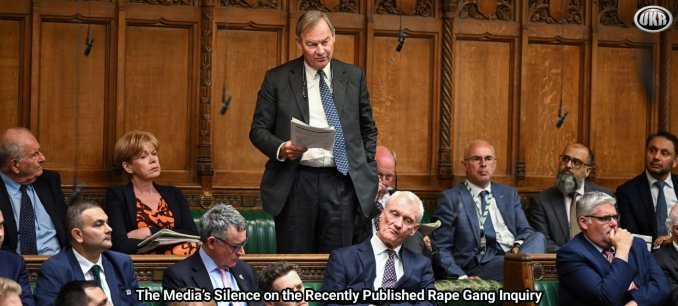
The Media’s Silence on the recently published Rape Gang Inquiry: Fake News by Omission
the silence is deafening and Google seems to be suppressing searches related to the report: independent and crowd funded and organised by Restore Britain. A final insult to victims.
C.J. STRACHAN
Yesterday, independent MP Rupert Lowe and the Restore Britain team published the 219-page independent report into the grooming gangs scandal. Titled the Rape Gang Inquiry, it was independently funded and had limited cross party support. It pulls together survivor accounts, whistleblower evidence, and lessons from previous failures like Rotherham. The findings are stark: up to 250,000 vulnerable girls, mostly White British, systematically targeted, groomed, raped, and trafficked over decades across at least 149 local authority areas. The perpetrators were predominantly groups of Pakistani Muslim men. The report lays bare the institutional collapse: police, councils, social services, and yes, the media, who looked the other way for fear of racism accusations.
It calls for real action: mandatory minimum sentences, deportations for foreign offenders, better victim support, and a new Childhood Sexual Exploitation Act. This is not some fringe document. It is crowdfunded by ordinary people demanding accountability.
So where was the coverage?
Sky News gave it a brief mention tied to the National Crime Agency reopening cold cases. GB News covered it properly, as did some pieces in The Telegraph. But the big hitters? BBC, ITV, Channel 4, The Guardian, The Times, Daily Mail, The Sun, Mirror? Largely absent. No front pages, no dedicated broadcasts dissecting the executive summary or the recommendations. This is the same pattern we have seen for years. Official inquiries get amplified when they fit the narrative. An independent effort from a critic of the establishment? Silence.
I have noticed something else troubling. Google seems to be suppressing searches for Restore Britain and the report itself. Plug in terms like “Restore Britain Rape Gang Inquiry report” or “Rupert Lowe’s latest work”, and the results feel throttled. Direct links to the official site at therapeganginquiry.org or the full PDF are buried under older stories, official narratives, or criticism rather than surfacing prominently as you would expect for a major new release. This is not neutral. It mirrors how Big Tech often de-ranks or delays indexing content that challenges the establishment line on grooming gangs, integration, and institutional failure. Many readers have messaged me with the same experience. When legacy media stays quiet, algorithmic gatekeeping completes the blackout.
This is fake news by omission. Not inventing stories, but burying truths that challenge the comfortable consensus on multiculturalism, integration, and two-tier policing. The grooming gangs scandal has always been uncomfortable because it forces us to confront ethnic and cultural patterns that polite society prefers to ignore. Decades of denial, dismissed reports, and girls failed by the very authorities sworn to protect them. Survivors spoke of abuse by hundreds of men while call handlers and social workers worried about community relations.
The motives seem clear enough. Mainstream outlets fear being labelled far-right or stoking division. Many are institutionally aligned with the political and bureaucratic class now under scrutiny. Highlighting the scale and the failures implicates Labour figures, police forces, and the broader post-2010 consensus. Easier to move on to the next story than demand deportations or long sentences that might upset certain voter bases.
I have written before about these scandals and the contempt shown to working-class communities. This latest omission fits the pattern. John Cleese and others have called out the BBC specifically. The public sees it. Trust in legacy media erodes further when they treat an issue involving tens or hundreds of thousands of victims as a niche story unworthy of sustained attention.
The report deserves to be read in full. It is available through Restore Britain channels. Survivors deserve justice, not another layer of institutional forgetting. Demand better. Complain to your broadcasters and papers. Support independent efforts that do the work the establishment will not.
This is not a partisan failure. It is a national one. The social contract between rulers and ruled frays when the state and its allies in the press abandon the most vulnerable.
This article (The Media’s Silence on the recently published Rape Gang Inquiry: Fake News by Omission) was created and published by C.J. Strachan and is republished here under “Fair Use”
See Related Article Below
Politics: out of his depth
RICHARD NORTH
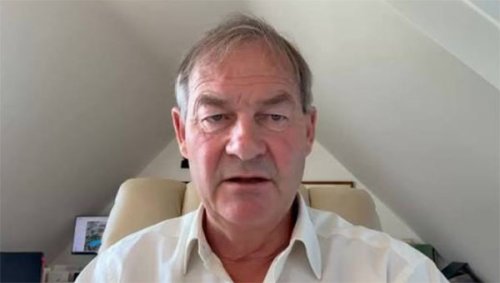
With almost no recognition or fanfare from the legacy media, Rupert Lowe has published his Rape Gang Inquiry Report – all 219 pages of it (including the covers).
Because of the gravity of the subject matter and the need to keep the issues in the public domain, one wills it to succeed. There is no dispute that crisis of group-based child sexual exploitation (CSE) in the UK – otherwise referred to as the “grooming gang” or “rape gang” phenomenon – represents one of the most significant institutional failures in modern British history.
We have seen how, for decades, multi-layered criminal networks operating across towns like Rotherham, Rochdale, Oldham, Huddersfield and many other places have systematically abused thousands of vulnerable young girls.
Such official inquiries as there have been have repeatedly exposed the failures of local councils and police forces, but it remains the case that public and political explanations for this catastrophe remain superficial. This is a gap which Lowe’s inquiry could have usefully filled.
In producing a report, it was in any event taking on a poisoned chalice, where the debate has become hopelessly polarised, reduced to a binary shouting match between those who blame the theology of Islam and those who dismiss systemic critiques as inherent racism.
Unfortunately, Lowe’s work has fallen into the trap of pinning the blame almost entirely on Islamic influences, thus marking down his report as a partisan study. It fails in any way to add to our understanding of the crisis, or why the official response was so profoundly inadequate – essential precursors to generating usable recommendations that might be accepted by a wider constituency than his natural audience.
Over term, I have expended a great deal of time and effort towards widening my own understanding of the issues – conveying much of the thinking in this blog, arguing that we need to look past the so-called culture wars and conduct a clinical, criminological analysis for what is, in effect, a vast criminal enterprise, centred largely on Kashmiri-heritage communities.
Through the many posts that I have written, I have concluded that the failure to contain and then stop the proliferation of these crimes stems, to a great extent, from three interconnected and largely unrecognised factors.
The first is the importation and weaponisation of a pre-modern South Asian kinship network (in the form specific to Pakistani Kashmir) known as the biradari system.
The second has been a deep-seated institutional myopia within British law enforcement that has failed to recognise that this group-based CSE is but one element in a series of interconnected enterprises and has treated incidents as isolated offences.
The third factor, which continues to this day, is the toxic political and social environments that paralyse objective thinking and prevent the formulation of an effective policy response.
One would have thought that, if a new inquiry and report was to add anything of value to our understanding, it would have evaluated such issues, with particular reference to the biradari system which drives the criminal enterprises which gave rise to the crisis.
Yet, all Lowe’s report can manage is a misplaced reference to the “Islamic clan culture”, which does not get close to understanding a system which predates the introduction of Islam in Kashmir by a number of centuries.
Within the largely Kashmiri diaspora in the UK, many of these baradari networks have morphed into crime syndicates, not dissimilar to the Mafia crime families in the United States,
Therefore, to get to grips with the “rape gang” phenomenon, it is necessary for law enforcement to understand what it is dealing with, recognising that it is confronted by organised crime networks bound by a social architecture previously unknown in Britain.
Crucially, a clinical analysis must recognize that the biradari is a stand-alone, pre-Islamic social structure. Prior to the mass conversion of the Kashmir Valley and Punjab to Islam between the 14th and 16th centuries, the region was governed by strict Hindu Varna (caste) and Jati (hereditary occupational lineage) frameworks.
When these populations embraced Islamic theology, they did not abandon their ancestral social structures. Instead, they retained their occupational hierarchies, endogamous marriage practices, and clan identities, applying an Islamic overlay to a pre-existing South Asian system. This historical retention is why many contemporary Kashmiri Muslim families still bear ancestral Hindu surnames, such as Bhat, Dar, Lone, or Rather, reflecting their pre-Islamic lineage.
When transposed to modern Western democracies, the biradari functions as a highly resilient, parallel governance model. In rural Kashmir, where the formal state has historically been weak, corrupt, or entirely absent, the biradari acted as the de facto provider of welfare, security, and dispute resolution.
In the UK, this insular structure, based on the extended family, has provided an exceptional, ready-made infrastructure for organised crime, relying on Mafia-like features such as its own powerful code of silence (izzat), where protecting the collective reputation of the kinship network is prioritised above external statutory laws.
The close familial ties promote absolute internal trust, engendering an extreme insularity which creates a closed loop, making the syndicates nearly impossible for undercover police forces to infiltrate.
On top of that, the embedded culture of patriarchal rule means that the networks are highly disciplined and are able to manage internal disputes and the illicit wealth distribution, without spilling over into the public domain, which has so often been the undoing of conventional criminal gangs.
Without realising what they have been dealing with, police and other authorities have looked at group-based CSE through a narrow, administrative “safeguarding” or social care lens. Authorities treated these crimes as isolated incidents of anti-social behaviour or localised abuse. They completely failed to realise that the rape gangs were not loose collections of predatory men, but highly organised, revenue-earning business enterprises.
Technically, these syndicates can be categorised as “polymorphous criminal portfolios”, structurally identical to traditional Mafia crime families, where the exploitation of young girls is systematically integrated with other lucrative illicit enterprises:
Multiple independent reviews (and sentencing remarks after criminal convictions) have shown that victims have been treated as disposable economic commodities. They have been systematically rented out, passed around, and trafficked across regional boundaries to generate cash revenue for the networks.
The mechanisms used to groom, control, and break the will of vulnerable victims – primarily supplying them with alcohol and Class A drugs – have linked CSE directly to localised drug distribution lines. The same safe houses, vehicles, and commercial properties used to move drugs have been utilised to harbour and exploit victims.
The financial windfalls generated from drug trafficking and sex exploitation have required laundering and the insular nature of the biradari facilitates this by routing cash through legitimate, cash-heavy high-street businesses dominant within their local spheres, such as private hire taxi firms, takeaways, and car washes. The cross-border character of the biradari, and their links with the homeland, simplify offshoring of funds.
Part of the reason why British law enforcement has failed catastrophically is because it has operated in separate compartments. The Vice Squad investigated the abuse allegations; the Narcotics Division chased the drug lines; the Economic Crime Unit looked at tax evasion. Because policing failed to map the underlying kinship structure – the biradari network that connected the taxi driver, the drug runner, the safe-house owner, and the business boss as cousins, uncles, and brothers – they missed the macro-picture. They have been fighting individual symptoms rather than unified, predatory syndicates.
Currently, this institutional blindness mirrors one of the most famous failures in international law enforcement history: the FBI’s long-standing refusal to admit the existence of the American Mafia.
Under J. Edgar Hoover, the pre-1950s FBI systematically denied that a unified, national Italian organised crime syndicate existed, preferring to prosecute isolated bank robbers or treat Mafia activities as localized, unrelated crimes. Hoover feared that admitting a vast, un-killable syndicate existed would expose the limitations of his agency.
In the UK, we have seen a structurally identical blind spot, largely driven by modern bureaucratic and political anxieties. Official inquiries, such as the landmark Jay Report into the abuse of over 1,400 children in Rotherham, revealed that local councils and police chiefs systematically suppressed or ignored warnings about Pakistani-heritage grooming rings.
This institutional myopia was sustained by paralysis-inducing factors: the fear of “racism” accusations, where white middle-class police officers and social workers were terrified that arresting large numbers of men from a specific ethnic minority would trigger allegations of institutional racism or inflame local racial tensions.
To avoid confronting an insular, culturally distinct criminal network, authorities routinely misclassified groomed children as “child prostitutes” or claimed they were making “lifestyle choices”. This administrative sleight of hand allowed bureaucratic institutions to close files and evade their duty of protection.
Furthermore, the biradari system protected itself by exploiting the mechanics of British local democracy. In several northern municipalities, the biradari operates as a highly organised political voting bloc. Elders were able to guarantee thousands of community votes to a specific local candidate in exchange for political patronage, resources, or a policy of non-interference in community affairs. This leverage effectively paralysed local state apparatuses, insulating the criminal elements from municipal scrutiny.
The final, and perhaps most insurmountable, obstacle to an adequate official response is the toxic polarisation of the immigration and religious debate in the UK.
Clinical, objective analysis requires isolating the exact cultural, economic, and structural mechanics of a criminal phenomenon. However, the British debate has been bogged down as the crisis has been used for ammunition in the broader culture wars, resulting in what might be regarded as two equally destructive ideological blind spots:
The anti-immigration and “Islamophobic” faction insists on viewing the problem through a purely theological lens – which is the central flaw of the Lowe report. By attributing the crimes almost exclusively to the doctrines of Islam, the report has misdiagnosed the threat.
It has ignored the anthropological reality that the biradari is a pre-Islamic, extended family structure rooted in caste and kinship, not scriptural theology. To an extent, the framing obscures the fact that these syndicates are driven by greed, power, and territorial control, not religious devotion.
Conversely, the progressive and multi-culturalist faction treats any critique of diaspora social structures as an existential threat to racial equality. Out of a desire to prevent community stigmatisation, they have enforced a strict ideological taboo around discussing the biradari dynamics.
This progressive omertà effectively shields powerful, patriarchal elders from scrutiny and leaves vulnerable victims within and outside those communities completely unprotected.
Yet you will find nothing of this in the Lowe report. Its lack of academic rigour and its general unprofessionalism have attracted criticism elsewhere but its main fault is its complete failure to identify a phenomenon where emerging crime syndicates have been able to run rings round the British law enforcement system, creating what might be called the architecture of impunity.
To my mind, this is a major opportunity lost. Lowe was offered help but he chose not to take it and has shown himself to be completely out of his depth.
Pete has a view and another critic remarks that the only thing his report serves to do is to justify every left-wing criticism of the right’s treatment of the rape gangs. It only serves, he says, to rile people up and uses the rape gangs to justify other positions that don’t logically follow and constantly goes on about irrelevant Islamic cultural practices even though there’s no need to.
This is a shame. We needed something better.

••••
The Liberty Beacon Project is now expanding at a near exponential rate, and for this we are grateful and excited! But we must also be practical. For 7 years we have not asked for any donations, and have built this project with our own funds as we grew. We are now experiencing ever increasing growing pains due to the large number of websites and projects we represent. So we have just installed donation buttons on our websites and ask that you consider this when you visit them. Nothing is too small. We thank you for all your support and your considerations … (TLB)
••••
Comment Policy: As a privately owned web site, we reserve the right to remove comments that contain spam, advertising, vulgarity, threats of violence, racism, or personal/abusive attacks on other users. This also applies to trolling, the use of more than one alias, or just intentional mischief. Enforcement of this policy is at the discretion of this websites administrators. Repeat offenders may be blocked or permanently banned without prior warning.
••••
Disclaimer: TLB websites contain copyrighted material the use of which has not always been specifically authorized by the copyright owner. We are making such material available to our readers under the provisions of “fair use” in an effort to advance a better understanding of political, health, economic and social issues. The material on this site is distributed without profit to those who have expressed a prior interest in receiving it for research and educational purposes. If you wish to use copyrighted material for purposes other than “fair use” you must request permission from the copyright owner.
••••
Disclaimer: The information and opinions shared are for informational purposes only including, but not limited to, text, graphics, images and other material are not intended as medical advice or instruction. Nothing mentioned is intended to be a substitute for professional medical advice, diagnosis or treatment.
Disclaimer: The views and opinions expressed in this article are those of the author and do not necessarily reflect the official policy or position of The Liberty Beacon Project.


Leave a Reply