

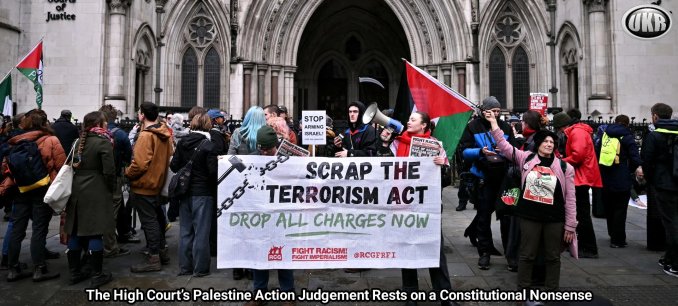
The High Court’s Palestine Action judgement rests on a constitutional nonsense
HENRY HILL
The first candidate for this morning’s editorial was Labour’s proposal to change the way seat boundaries are calculated by introducing an ‘opt-out’ electoral register.
But as that will surely be an ongoing story, we’re instead going to take a peek under the bonnet of the Government’s recent court defeat over Palestine Action. Because R (Ammori) vs SSHD is an excellent example of how the courts have expanded their reach – and the extent to which politicians are (and in this case, are not really) to blame.
You can read the full judgement via the above link, but the critical passage to which I want to draw your attention is section 84:
“Drawing this together, the policy is an additional qualitative threshold to use of the power to proscribe. The policy requires the Home Secretary to assess the restrictions consequent on proscription of the organisation under consideration and determine whether they are, in a general sense, proportionate to the nature and scale of the threat presented by the organisation, to the extent that it is concerned in terrorism (and not by reference to other activities that it may undertake).”
Our specific concern is with this “additional qualitative threshold”. This refers to internal guidance published by the Home Office about the use of the power to proscribe. The High Court has ruled that the Home Secretary, in proscribing Palestine Action, did not adequately comply with this internal guidance, and thus the proscription was unlawful.
Which is, when you stop to think about it, extremely strange. The power of proscription is laid down in an Act of Parliament (the Terrorism Act 2000). The provisions of the Home Office’s internal guidance are not. So in reaching their decision, the High Court appears to have decided that the Home Office can, through the publication of internal documents, modify the provisions of an Act of Parliament.
This is not the first time this very radical notion has reared its head. Readers might remember the almighty row which followed the Conservatives’ decision to remove a stated obligation to comply with international law from the Civil Service Code. Notwithstanding that it is the United Kingdom, rather than individuals, which is subject to international law, there were in that case many commentators – including lawyers – whose distress at the move suggested they thought the prime minister had the power to impose or lift legal obligations via internally-published documents.
Yet if you were to ask those lawyers – or, one suspects, the judges of the High Court – if, in the abstract, they thought the executive has or ought to have the power to modify acts of parliament in this way, they would be horrified at the prospect. Much waving of shrouds and wailing about the rule of law would surely ensue.
Much of the expansion of the role of the courts into British governance is the fault of politicians. It is ultimately MPs who pass broadly or vaguely-worded legislation, or freight bills with endless ‘have regard’ clauses which provide them with a way of feeling like they have contributed without having to do any detailed work at the expense of providing fertile vectors for judicial review.
In this case, however, the finger of blame really does seem to point at the judges. One might suggest that government should stop publishing internal guidance that constrains ministers’ freedom of manoeuvre beyond the constraints imposed by Parliament, and as a practical adaptation to the status quo it would make sense to do so. But government should be able to adopt and publish internal guidelines without having them wrongly elevated to the status of law; whether or not a department has followed its internal guidance in implementing a policy is not the courts’ businesses.
Even so, responsibility for fixing the problem does rest with MPs. This is not the first time the judiciary has played fast and loose with the status of law – see its invention of so-called ‘constitutional statutes’ with special protections against implied repeal, which were never created by Parliament. Short of sacking judges or an unusually energetic and effective programme of appeals, the only way to reimpose the proper lines of constitutional authority is for Parliament to legislate against bad judgements.
I have previously suggested that this could take the form of a regular Bill of Clarification, tabled once per session or per parliament, which identified cases where the courts had interpreted the law contrary to the intentions of Parliament and laid down, in law, what the actual intention of Parliament was (and thus, what the actual law was).
Perhaps in this case the Court of Appeal will see sense and do the job of reminding the High Court what is and is not law. But if any government is to solve the problems that have led serious figures in both major parties to conclude that Britain is becoming impossible to govern, a reliable way must be found to prevent the judges randomly bestowing legal status on things which shouldn’t have it.

••••
The Liberty Beacon Project is now expanding at a near exponential rate, and for this we are grateful and excited! But we must also be practical. For 7 years we have not asked for any donations, and have built this project with our own funds as we grew. We are now experiencing ever increasing growing pains due to the large number of websites and projects we represent. So we have just installed donation buttons on our websites and ask that you consider this when you visit them. Nothing is too small. We thank you for all your support and your considerations … (TLB)
••••
Comment Policy: As a privately owned web site, we reserve the right to remove comments that contain spam, advertising, vulgarity, threats of violence, racism, or personal/abusive attacks on other users. This also applies to trolling, the use of more than one alias, or just intentional mischief. Enforcement of this policy is at the discretion of this websites administrators. Repeat offenders may be blocked or permanently banned without prior warning.
••••
Disclaimer: TLB websites contain copyrighted material the use of which has not always been specifically authorized by the copyright owner. We are making such material available to our readers under the provisions of “fair use” in an effort to advance a better understanding of political, health, economic and social issues. The material on this site is distributed without profit to those who have expressed a prior interest in receiving it for research and educational purposes. If you wish to use copyrighted material for purposes other than “fair use” you must request permission from the copyright owner.
••••
Disclaimer: The information and opinions shared are for informational purposes only including, but not limited to, text, graphics, images and other material are not intended as medical advice or instruction. Nothing mentioned is intended to be a substitute for professional medical advice, diagnosis or treatment.
Disclaimer: The views and opinions expressed in this article are those of the author and do not necessarily reflect the official policy or position of The Liberty Beacon Project.


Leave a Reply