

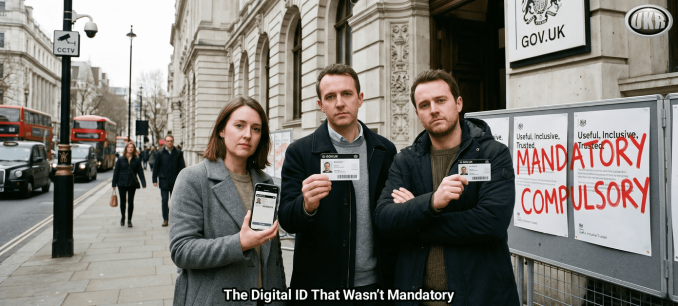
How a compulsory BritCard quietly became “Useful, Inclusive, Trusted” – and why the rebrand deserves scepticism.
THE RATIONALS
One of the quieter satisfactions of political observation is watching a grand ministerial vision quietly collide with stubborn public reality, only to reappear months later in softer, more agreeable clothing.
Last Wednesday’s King’s Speech offered a textbook case. Delivered with the customary pomp in the House of Lords, it contained this carefully polished line, “My Ministers will also proceed with the introduction of Digital ID that will modernise how citizens interact with public services [Digital Access to Services Bill].”
Six months ago the same government was rather less circumspect. A compulsory “BritCard” was to be the answer to illegal working and small-boat crossings. Right-to-work checks would be mandatory, ministers declared, and the app non-negotiable.
Then came the backlash—a petition nearing three million signatures, pointed questions from their own benches, and the dawning realisation that voters were not quite as enthusiastic as the briefing notes had suggested. By January the word “mandatory” had vanished. In its place arrived the gentler language of “voluntary”, “convenience” and “cutting the faff”.
Now, in the royal prose of 13 May 2026, the project has acquired a fresh coat of three unimpeachable adjectives: Useful, Inclusive, Trusted.
It is the sort of linguistic alchemy New Labour once specialised in.
What began life as a tool of border enforcement has been quietly repackaged as nothing more threatening than a helpful upgrade for renewing your driving licence or claiming Universal Credit.
Beneath the courteous phrasing and the royal seal, however, sits something rather less benign. The Digital Access to Services Bill will create a digital identity framework that sits uneasily with long-standing British instincts about privacy. It carries a genuine, documented risk of making large-scale identity theft easier, not harder. And it does so while maintaining—with an impressively straight face—that none of this is remotely compulsory.
The ordinary citizen, in other words, is being invited to place a good deal of trust in ministers who have already performed one rapid policy pirouette. On the evidence assembled so far, that trust may prove more touching than wise.
The Government’s Own Measuring Stick
Ministers have kindly supplied their own yardstick. In the March 2026 consultation document they state that the new digital ID will be guided by three principles.
It must be Useful — widely usable across the economy as a way for individuals to prove their identity and central to the next generation of public services.
It must be Inclusive — available at no cost and inclusive by design.
And, most reassuringly, it must be Trusted — underpinned by robust privacy, resilience and security measures that put people in control.
The phrasing is neat. What began as a compulsory “BritCard” for tackling illegal working has been quietly rebranded as a public-service convenience. Any future objection can now be met with the reminder that the system has been designed to be Useful, Inclusive, and Trusted. The rest of us are still free to test those claims against the evidence.
Useful? Or Merely Ubiquitous?
The first principle is Useful. The consultation document promises that the digital ID will cut the faff of repeated identity checks when claiming benefits, renewing a driving licence or applying for a passport.
The claim sounds reasonable enough. Who enjoys filling in the same details for the sixth time in a month?
Yet the same document is rather more expansive about what “widely usable across the economy” actually means. The digital ID is explicitly designed to work in the private sector too. It will help citizens prove their age for online platforms, streamline bank-account verification, and ease purchases of age-restricted goods. In short, it is intended to become the default way of proving who you are whenever someone asks.
This is where usefulness starts to look rather more like ubiquity. Once private platforms begin to accept the GOV.UK Wallet as a convenient method of age assurance or identity verification, the line between voluntary and expected starts to blur. The citizen who declines to adopt it may face slower processes or repeated manual checks.
The government calls this modernisation. A more sceptical observer might call it the creation of a single, high-value point of failure.
Inclusive? For the Smartphone-Owning Classes
The second principle is Inclusive. The consultation document states that the digital ID will be available at no cost and inclusive by design, helping those who currently struggle to prove who they are or are digitally excluded.
This has a pleasingly egalitarian ring to it. The government presents the scheme as a levelling measure, no fees, no barriers, help for the vulnerable.
The only snag is that the entire system is built around the GOV.UK Wallet app, which requires a smartphone. The consultation itself quietly acknowledges the difficulties this creates for the elderly, the disabled and those without reliable internet or digital confidence. These, of course, are the very groups ministers say the scheme is designed to help.
One notes the timing. This is the same administration that speaks frequently of “levelling up”. Yet it is now constructing an identity system in which proving who you are for benefits, a driving licence or a passport etc may depend on owning a working smartphone and knowing how to use it.
The principle sounds generous on paper. In practice it risks leaving a significant portion of the population at a practical disadvantage.
Secure? Or Vulnerable?

The third principle is Trusted. Here, however, the assurances become rather less reassuring. The consultation document assures us that the digital ID will be underpinned by robust privacy, resilience and security measures.
This is the claim that matters most. If the system is not secure, the other two principles collapse. Yet the digital ID is not being built from scratch. It sits directly on top of GOV.UK One Login and the forthcoming GOV.UK Wallet. Here the record is far less encouraging.
Whistleblower disclosures reported by ITV News and Computer Weekly between December 2025 and April 2026 make uncomfortable reading. One Login had already lost its certification under the Digital Identity and Attributes Trust Framework in May 2025. It failed to meet the mandatory “Secure by Design” standards set by the National Cyber Security Centre—in plain terms, satisfying only 21 of the 39 required security tests—despite serving 13 million users.
In a red-team exercise—a simulated cyber-attack designed to expose weaknesses—simulated attackers gained privileged access without triggering the expected alerts. Internal assessments warned of the risk of bulk personal-data theft, identity fraud against government services, and economic damage.
The biometric element raises the stakes further. The government’s own explainer states that the digital ID will include “a photo – as the basis for biometric security – just like an eVisa or Passport.” That facial image is one of the four core components of the credential. Unlike a password or a PIN, a biometric cannot be changed if it is stolen or copied. Once compromised, it is compromised for life.
The government calls the system Trusted. The internal evidence and the irreversible nature of the biometric data suggest it may be rather more vulnerable than the slogan allows.
What This Means for the Ordinary Citizen
In practice the digital ID would turn routine transactions into digitally verified events. Proving you are over 18 for a pint or an online video, claiming Universal Credit, renewing a driving licence or opening a bank account could all be routed through the GOV.UK Wallet app.
On paper this sounds like a modest convenience. In reality it creates a permanent, auditable record of those interactions. Liberty and Big Brother Watch have already labelled the likely result a “logbook of our lives”.
If the system is breached—and the whistleblower evidence suggests this is more than a theoretical risk—the consequences are not temporary. The biometric facial photograph at the heart of the credential cannot be cancelled or replaced. A single successful phishing attack could expose linked credentials across benefits, tax, health records and private-sector services in one go.
Ministers present the scheme as a harmless upgrade. The ordinary citizen, however, is being invited to accept lifelong stakes for the sake of a slightly smoother trip through the bureaucracy.
Echoes from Abroad – and from Britain’s Own Recent Past
Similar schemes abroad offer a useful reminder that good intentions do not always survive first contact with reality.
India’s Aadhaar system was launched as a voluntary welfare convenience. It is now required for tax returns, banking, mobile SIM cards and a growing list of other services. In practice, authentication failures occur at a documented real-world rate of approximately 6.5 per cent—roughly one in every fifteen attempts—equating to some 20 million failed attempts each month—with exclusion errors reaching 20 per cent in vulnerable regions. These failures have been linked to denial of rations, pensions and healthcare, particularly among the elderly, manual labourers and the rural poor.
Estonia’s much-praised e-ID card suffered a cryptographic flaw in 2017 that affected 760,000 cards. Certificates had to be suspended overnight to prevent potential identity theft.
Kenya’s Huduma Namba project (predecessor to Maisha Namba) has faced repeated court challenges over privacy and exclusion concerns. Judges ruled the collection of DNA and GPS coordinates unconstitutional and intrusive, critics warned of surveillance risks and disproportionate impact on ethnic minorities.
Britain has its own recent memory of the subject. The Identity Cards Act 2006 was repealed in 2010 on civil-liberties and cost grounds. The government that scrapped it was Labour.
History, it seems, has a sense of irony.
The party that once concluded such a scheme was a step too far is now quietly resurrecting the idea under a softer slogan.

A Quiet Reckoning
The rebranding has been neatly done. A compulsory border-control tool has been quietly transformed into a voluntary public-service convenience wrapped in the soothing slogan “Useful, Inclusive, Trusted”. The King’s Speech of 13 May 2026 presented it as little more than administrative modernisation. The evidence suggests it is rather more than that.
The architecture rests on a platform with documented security shortcomings. The biometric element is irreversible. The scope already stretches well beyond public services into the private economy. And history, both at home and abroad, shows how quickly such schemes expand once they are in place.
The Digital Access to Services Bill will now make its way through Parliament. Ordinary citizens would be wise to watch its progress closely. They might also ask whether “voluntary” in Whitehall speak has a habit of becoming expected in daily life.
When ministers promise something is Useful, Inclusive and Trusted, the prudent reader reaches for the small print, the recent history books, and a healthy measure of scepticism. In this case, the small print is worth reading twice.
What do you think?
Reply below, share this with someone who still trusts Whitehall’s slogans, or forward it to a friend who values privacy. The Bill is coming—better to read the small print now.
This article (The Digital ID That Wasn’t Mandatory) was created and published by The Rationals and is republished here under “Fair Use”

••••
The Liberty Beacon Project is now expanding at a near exponential rate, and for this we are grateful and excited! But we must also be practical. For 7 years we have not asked for any donations, and have built this project with our own funds as we grew. We are now experiencing ever increasing growing pains due to the large number of websites and projects we represent. So we have just installed donation buttons on our websites and ask that you consider this when you visit them. Nothing is too small. We thank you for all your support and your considerations … (TLB)
••••
Comment Policy: As a privately owned web site, we reserve the right to remove comments that contain spam, advertising, vulgarity, threats of violence, racism, or personal/abusive attacks on other users. This also applies to trolling, the use of more than one alias, or just intentional mischief. Enforcement of this policy is at the discretion of this websites administrators. Repeat offenders may be blocked or permanently banned without prior warning.
••••
Disclaimer: TLB websites contain copyrighted material the use of which has not always been specifically authorized by the copyright owner. We are making such material available to our readers under the provisions of “fair use” in an effort to advance a better understanding of political, health, economic and social issues. The material on this site is distributed without profit to those who have expressed a prior interest in receiving it for research and educational purposes. If you wish to use copyrighted material for purposes other than “fair use” you must request permission from the copyright owner.
••••
Disclaimer: The information and opinions shared are for informational purposes only including, but not limited to, text, graphics, images and other material are not intended as medical advice or instruction. Nothing mentioned is intended to be a substitute for professional medical advice, diagnosis or treatment.
Disclaimer: The views and opinions expressed in this article are those of the author and do not necessarily reflect the official policy or position of The Liberty Beacon Project.


Leave a Reply