

Giving simple explanations of important topics.
JUPPLANDIA
Today I’m going to talk about something very simple. Many of you may be well aware of the truth of everything I’m going to say. But millions of other people, clearly, are not as aware as you.
Even if you think what I’m going to say here is blindingly obvious (and you’re right, it is) it may be helpful to you to see it set out in this simple way. You can then explain it succinctly to others.
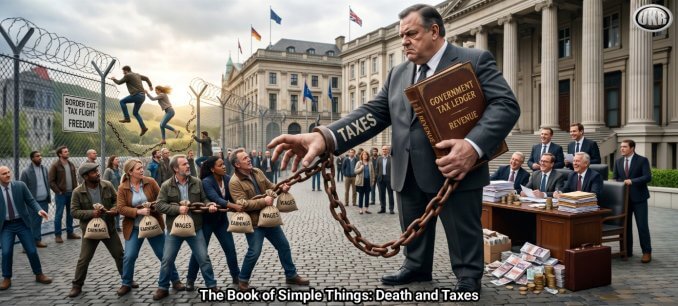
So the first thing I’m going to talk about in this very simple way is taxation. Taxation represents the first and most fundamental decision of government regarding BOTH economic policy AND the relationship that exists between the individual and the State.
The more lightly a government taxes people, the more it trusts them to manage their own affairs and the less it assumes responsibility for managing their affairs itself. The more heavily a government taxes the people, the more it assumes that it is more capable of managing their affairs than they are, and the more responsibility and power it takes on itself, to do so.
So taxation isn’t just a measure of how much money the government takes from you. It’s also a measure of how much freedom to own and spend the government allows you….which is also how much freedom you have, in many ways, from government control. Low tax regimes trust individuals with money. High tax regimes trust governments with money.
And your choice, as a government, is always going to be a high tax or a low tax choice. You will always be heading in one of those directions, and always choosing one of those options, because even if you keep taxes at a level you inherited from a previous government, that’s generally in the modern world a choice to keep taxing at a high rate. It’s a less destructive choice than choosing to increase taxes even more, but given that most nations today have very high tax rates, it’s still a choice in favour of high taxation.
The Modern High Tax System
Modern tax levels are insanely high.
That’s the second thing to recognise after recognising that low taxes work and high taxes fail. Income tax, for instance, is a modern invention. Inheritance tax had some older equivalents, but nothing like modern levels. The levels of taxation in the 18th century in the British Empire, for instance, the taxes asked of American colonials which prompted the War of Independence/the American Revolution, were far less onerous than the modern tax burden. Every modern government taxes people much more heavily than George III did, and George III could point to a much more reasonable reason for that taxation (covering the cost of defending the thirteen colonies from conquest by others) than the things which most modern spending covers.
A bloody revolution was fought over tax levels that were trivial compared to today.
Even if you go back much further modern taxation and modern spending by government are both extraordinarily high.
Under feudalism, for example, the nobility took tithes from peasant workers, and so did the Church, but actually at lower percentage rates of their overall crop or overall earnings than modern tax systems take. Under feudal land tenure the villeins, the lowly peasants, worked 2-3 days on the lord’s land before spending the rest of the time working the land set aside for themselves. There was also a great deal of common land they could use. Today, most common land has long since gone, and if we compare Tax Freedom Day (the point at which an average person has equalled the amount of their yearly earnings that go on tax), the modern worker spends more time working as a slave for the government via taxation than the medieval peasant spent working free for his lord (5.5 months, just under 46%, rather than 2.5 days per week, around 35%).
Only monarchs known for rapaciousness taxed as heavily, in the western world, as modern nations do.
We are not starting from a neutral point on this, we are starting from historically high levels of taxation.
So you are picking between high tax and low tax regimes even if you do nothing.
And here is the basic, fundamental fact of that choice:
High tax systems always fail, and low tax systems always succeed.
High Taxes Versus Low Taxes
Throughout human history, and in modern history with very clear and obvious repetition, low taxes always lead to economic success, and high taxes always lead to economic failure. Always. People will dispute this, but actually it’s been proven again and again and again.
If you want to look at how well low tax regimes work, look at the history of Hong Kong. Hong Kong grew from a fishing village to one of the mightiest cities on Earth because its British rulers taxed it very lightly, and more lightly than anywhere else with similar characteristics.
If you want to look to look at how totally high tax regimes fail, look at the history of any Communist country, at the Soviet Union, at Cuba, at nations that move towards Communism the way Venezuela did, at the difference between decades of Argentinian failure under socialism and its current revival under Milei, who despises socialist high tax models.
The fact that low taxes work and high taxes fail is the most repeatedly tested and proven fact in the entirety of economics, and perhaps in the entirety of politics.
Why?
State Decision Making versus Individual Decision Making

Well the fact is that the individual will nearly always spend his own money more wisely and with more appreciation of its limits than a government will.
Unless the individual is a drug addict, an alcoholic, a lunatic, or a hopelessly compulsive gambler, he will spend his own money more wisely than the State will. You know what you need better than the government does. You know what you can afford better than the government does. You have more invested in your own success than the government does. You have more incentive for your spending to be focused on things you actually do need and want than the government has. You don’t have any administrative costs when you spend your own money.
You have the ground level knowledge of what directly benefits you and improves your life, and you have far more desire to see those things realised than a clerk, a bureaucrat, a politician or a faceless apparatchik has.
And EVERYONE ELSE knows best how to spend their own money too, save only for the small minority of people who are addicts or lunatics. It doesn’t matter whether you are poor or rich, you can spend on your basic needs more efficiently than the State can. And you can spend on the things that make your life more enjoyable, the luxuries you can afford, with more knowledge of what makes your life worth living too.
At an individual level, very few people are prone to waste their money on ideologically demanded things that show no real benefit, on white elephant projects that fail, or on simply transferring their own money to people who don’t deserve it. We might decide to give a little to causes we support, a little to charity, but it’s unlikely that we would do that to an extent that harms us or our own family. Most families have an innately better understanding of what actually benefits them, and what they can afford to give to others…..
Whereas no State official is ever worrying in the same way, with the same accuracy and the same self interest, about what you can afford or about what you want. It’s innately the case that it is far easier to waste other people’s money.
Governments, especially in the modern world, don’t tend to spend money wisely. This is long before we start thinking about waste that comes from ideologically crazy spending decisions driven by false political ideas, or the deliberate losses and wealth transfers of corruption. Acting at a vast scale with money that isn’t your own when the consequences of failure or poor choice don’t impact directly on you in any way whatsoever is not a recipe for wise decision making or canny spending restraint.
State spending is always more wasteful than private spending. Sometimes especially so when it considers its spending more moral than that of private citizens.
When you are allowed to keep more of your own money, you are more inclined to purchase and spend in ways that generate benefits to others, particularly to retail companies and their staff. You are actually spending your money more productively when you go into a shop and buy a luxury, than when the government is redistributing your wealth to non productive causes you don’t support and losing administrative costs in the process too.
The Laffer Curve

Let’s say though that you don’t think that’s true. Let’s say that you do support everything that the government spends money on. You think that all welfare is necessary and good. You think we should spend as much as it needs on the NHS or on socialist health systems because they are doing good. You’ve backed every war. You agree with every cause. You are happy with high taxes. You want to pay for asylum hotels.
Your support of high taxes is still wrong. It’s still harming other people. It’s still harming the overall economy. And it’s even harming the tax revenue you insist must be increased.
And that’s because of the Laffer Curve.
The Laffer Curve is the proof of the absolute stupidity of supporting high taxes and opposing low tax rates or tax cuts when they occur. Because the Laffer Curve shows us precisely the point where over-taxation becomes counter productive. You can quite literally plot tax rates against the Laffer Curve and predict when taxing people heavily will reduce tax revenue. There’s a point where increasing taxes doesn’t even achieve the income it’s supposed to. People with the means to do so flee high tax regimes. They leave the country, and everything you intended to gain from them is lost, together with everything they were contributing before that. Your tax increase has reduced tax revenue.
It is true that revenue can increase at a low rate level of tax increase without harm. But you have to be beginning from a low point for that to be true. It is also true that there are some things that almost everybody wants the State to do, so taxation can be justified for these activities. But both the level at which the State taxes people today AND the things the State does are at historic highs, far into the range of taxation that the Laffer Curve proves to be counter-productive.
Modern supporters of high taxes or ‘tax the billionaires’ sloganising are economic retards. The damaging effects of such policy choices have been clearly shown from Venezuela to France. Punitive tax regimes are the second fastest way to destroy your country, second only to devastating wars and conquests where you are the losing party.
The Murder of Incentives
“The decline of the Soviet system was characterized not by an organized “anti-work” movement, but by mass labor unrest driven by deteriorating conditions, including absenteeism, high turnover, and spontaneous strikes. As the regime attempted rapid industrialization during the First Five Year Plan (1928–1932), workers engaged in mass migrations and insubordination to escape worsening standards of living, leading the state to criminalize job-changing and absenteeism by 1940.
This friction was exacerbated by a sharp ideological shift in the late 1920s, where Soviet press campaigns initially vilified workers as “loafers” and “thieves” before abruptly transforming into a “workerist” myth that glorified shock workers to enforce productivity. Earlier dissent, such as the Workers’ Opposition faction (1920–1921) and the Kronstadt revolt (1921), had already been suppressed to consolidate party control, preventing the formation of independent labor movements and atomizing the working class under a repressive administrative apparatus.”
Even for those who don’t leave or can’t, high taxes disincentivise. Workers seeing vast chunks of their wages being taken away, work less. Reach a sufficient tax level and people are conscious that they aren’t keeping what they earned. So why work so hard?
High taxes destroy productivity.
Why work hard when you won’t see the benefit, when the government is going to steal most of it off you straight away?
Why work hard when you don’t have freedom and can’t make any gain for yourself?
Even before full Communism, this is especially true in welfare societies, when people see they can gain more by not working than by working. A choice between hard work and not being able to afford a home, and between a welfare lifestyle and being given a home, is one where your high tax, high welfare society destroys its own productivity and incentivises non productive lifestyles while disincentivising productive ones.
The worker who can’t escape becomes less productive, while the individuals and corporations able to escape do so. Tax at 100% and you have Communism, with zero freedom too and with individuals knowing that their work is slavery. All property belongs to the State, and there is virtually no reason to strive and work except as an agent of the Party. Such a system has less freedom and worse incentives than either capitalism or feudalism.
Ironically, those who complain about capitalism forcing work without sufficient incentive and pay, those who say that capitalism creates wage slaves, are apparently fine with the State creating actual slaves and a State enacted level of theft from the working class far worse than that enacted by any capitalist boss.
Lower taxes and you increase freedom and improve the economy.
Raise taxes and you decrease freedom and damage the economy. It really is that simple. Freedom to acquire and retain what you acquire is the most fundamental freedom in terms of incentive towards achievement, innovation, success and work. Knowledge that your property rights don’t exist is also knowledge that your civil rights are equally missing, and the strongest disincentive to achievement, innovation, success and work that there is.
General Interest Versus Vested Interest
“Courage is a decision you make to act in a way that works through your own fear for the greater good as opposed to pure self-interest. Courage means putting at risk your immediate self-interest for what you believe is right.”
Above, quote from Derrick Bell, who helped create the race hate theory (Critical Race Theory) that defines white people aa inherently and innately guilty and the ‘greater good’ as any punishment or redistribution inflicted in the name of equity. In other words, the immediate self interest of anyone non-white wishing to unjustly appropriate the possessions of anyone white.
If everything I have written above is true and obvious, and glaringly obvious when we compare capitalist countries with communist ones and when we recall the grinding poverty, the grotesque crimes and the starvation level failures of Soviet Russia or Maoist China, why have these things happened since the fall of the Soviet Union:
- Communist ideas have become more popular with western youth than ever before.
- Western governments have moved towards more and more high tax, high spending regimes.
- Business has often backed high tax, high spending regime parties and policies and attacked attempts to lower taxation or lower spending.
There are various historic explanations for this, which all tie into High Tax winning against Low Tax even though all the economic evidence points in the other direction.
All of these explanations though can be united by considering that there are two things existing at the same time, the General Interest and the Vested Interest.
The General Interest will be what actually works, and what is most beneficial to the general economic health of the nation and most people in it (low taxes, a small State that doesn’t impose on freedom or choice, and a capitalist democracy accountable to the people).
The Vested Interest will be anything inimical to the General Interest, including unions that place their interests before those of the nation, corporations that do likewise, and professional castes and classes that do the same or that serve foreign interests.
It’s an odd but true thing that those serving the General Interest will not ever describe themselves as doing so, but will instead simply argue that their position WORKS and makes more sense on that basis. Those who speak most about the General Interest, or who claim to champion abstract fairness, equity, kindness, empathy and the like, will always be advocating for Vested Interest, in which they themselves profit from policies that harm most other people and society as a whole.
Indeed, claiming to work on behalf of the General Interest and invoking abstract concepts while doing so, is the surest sign that somebody is serving Vested Interests that in reality are inimical to the general interest and work to the detriment of the average citizen or of the nation as a whole. Communism is the ultimate example of this, but socialism deploys the same language of universal benefit (welfare in the UK is even called ‘benefits’) tied to vested interest.
“The Cambridge Dictionary defines “the greater good” as help for the majority of people in a society, especially when this involves harming one person or group. It is often used to justify actions that might be considered unethical on an individual level.”
The Welfare State, Keynesian Economics, and Pay to Fail

“The project, originally estimated at $33 billion for a Los Angeles to San Francisco line, is now projected to cost between $128 billion and $135 billion for a much shorter 171-mile segment between Merced and Bakersfield, with no track laid in some areas after nearly two decades.”
For the best understanding of the historic processes that have created this situation of high taxes, high spend and high sanctimony all united towards purposes that are actually corrupt and malign, we could use two main examples: white elephant projects like the California High-Speed Rail line, or the more general existence of the Welfare State.
If it was stated that the Welfare State was created largely by the Attlee government in the UK after 1945, and thereafter became a model adopted by most western nations, that would be reasonably accurate. The creation of the Welfare State massively expanded the remit of government and the size of the State, bringing with it a permanent blank cheque for rising costs in State provided healthcare, and enormous negative social impacts by creating a permanent State funded class of administrators, medical staff, and bureaucrats with an inherent vested interest in the State funding them and the State maintaining high levels of spending. At the same time Welfarism turned sections of the previously proud and independent minded working class into a dependent underclass whose poor life choices were to be REWARDED and incentivised, leaving them generationally trapped in unproductive existences.
In the US the combination of the early New Deal model and post Civil Rights movement affirmative action and social engineering to ‘address inequalities’ did much the same thing, albeit with a racial dimension that was even more toxic. In both cases Keynesian economics falsely said that large scale ‘benevolent’ government interventions and the expansion of the State had no negative consequences and no end limit, but could become the ongoing and irreversible model for the future: a Big State enacting socialist solutions, taxing heavily and spending even more heavily while engaging in infrastructure projects not as when genuinely necessary but as false stimulus built on high tax and additional debt.
The promise is of something useful like the Hoover Dam. The reality today is often of enormous waste and spending that delivers nothing, like Gavin Newsome’s high-speed rail system for California that doesn’t exist, or like Boris Johnson’s UK Northern rail extensions that don’t exist. Both projects have spent billions without any track or train journeys to point to as the result. Primarily, the purpose of the spending becomes the spending itself, the unlocking of huge contracts regardless of delivery.
Arguments made today for Net Zero are not only the consequence of a modern Green con accompanied by poor scientific methodology and mass hysteria, but also direct inheritors of the way the Ever Growing State was going to solve, by central planning and enormous expenditure, poverty, inequality, illness and death. And they are of course also inheritors of this Invisible Rail Line phenomenon of the purpose of the project being the spending, and not the thing it promised to create.
What all this State expansionism, high tax and high spending does is create a professional caste who themselves profit from the problems they are ‘addressing’ actually never being solved. Indeed, if any of these problems get WORSE following the expansion of the State to take on more and responsibilities ‘solving things’, this professional caste then argue that the problem simply needs more spending on more people like them. Their own failure is used as ANOTHER argument for taxing more and spending more with more of that money going to their wages, pensions and perks.
The strongest advocates of additional State spending on education, are quite naturally the largest recipients of additional State spending on education (teachers and academics), while a Department of Education that is seriously failing will be a LOUDER advocate of increased taxation to pay for increased spending on them, then a Department which is doing better with the resources already assigned to it. The more this model fails, the more this model demands.
The company obtaining the contract for the Invisible Railway are quite happy to keep failing if that results in the continuation of payments to them. The medical professional is quite happy to administer drugs or vaccines that don’t work or do more harm than good if they are being given a payment for every dose delivered.
And what’s ironic in all this is that State spending directly contradicts the sane adjustments in a genuinely capitalist system (like a company going bust if all its customers are unhappy with its products) but the failure of State spending is again taken as a failure of capitalism (rather than of the corporatism more often involved in public-private initiates that combine the worst excesses of both public incompetence and private greed).
It is not that death and taxes are inevitable that one must worry about. It is that high taxation is the death of any sane checks on what the State can do, any sane limits on how much the State can waste, and any sane functioning of the individual as an independent, responsible, free and aware adult focused on the things that bring genuine success without a sociopathic bureaucratic nursemaid attending and correcting his actions or stealing and wasting his inheritance.
This article (The Book of Simple Things: Death and Taxes) was created and published by Jupplandia and is republished here under “Fair Use”

••••
The Liberty Beacon Project is now expanding at a near exponential rate, and for this we are grateful and excited! But we must also be practical. For 7 years we have not asked for any donations, and have built this project with our own funds as we grew. We are now experiencing ever increasing growing pains due to the large number of websites and projects we represent. So we have just installed donation buttons on our websites and ask that you consider this when you visit them. Nothing is too small. We thank you for all your support and your considerations … (TLB)
••••
Comment Policy: As a privately owned web site, we reserve the right to remove comments that contain spam, advertising, vulgarity, threats of violence, racism, or personal/abusive attacks on other users. This also applies to trolling, the use of more than one alias, or just intentional mischief. Enforcement of this policy is at the discretion of this websites administrators. Repeat offenders may be blocked or permanently banned without prior warning.
••••
Disclaimer: TLB websites contain copyrighted material the use of which has not always been specifically authorized by the copyright owner. We are making such material available to our readers under the provisions of “fair use” in an effort to advance a better understanding of political, health, economic and social issues. The material on this site is distributed without profit to those who have expressed a prior interest in receiving it for research and educational purposes. If you wish to use copyrighted material for purposes other than “fair use” you must request permission from the copyright owner.
••••
Disclaimer: The information and opinions shared are for informational purposes only including, but not limited to, text, graphics, images and other material are not intended as medical advice or instruction. Nothing mentioned is intended to be a substitute for professional medical advice, diagnosis or treatment.
Disclaimer: The views and opinions expressed in this article are those of the author and do not necessarily reflect the official policy or position of The Liberty Beacon Project.


Leave a Reply