

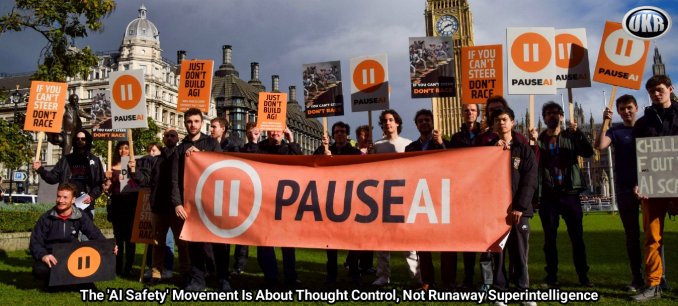
Progressive ideology is being encoded into AI systems.
JORDAN SCHACHTEL
In 2021, a group of researchers dramatically departed OpenAI, the company behind ChatGPT. Led by Dario Amodei, OpenAI’s former vice president of research, they cited deep concerns about “AI safety.” The company was moving too fast, they warned. Prioritizing commercial interests over humanity’s future. The risks were said to be existential. These Effective Altruists were going to do things the right way.
Their solution? Start a new company called Anthropic, premised on building AI “the right way” with “safety” (that word will become a recurring theme), and “proper guardrails.” They initially raised hundreds of millions (today, that number is in the tens of billions) from investors who bought the pitch: we’re the good guys preventing runaway AGI (artificial general intelligence).
Noble, right? Except these supposed guardrails against AGI have become pretty much impossible to quantify. What we do have is an incredibly sophisticated content moderation system that filters inquiries and commands through a Silicon Valley thought bubble. It doesn’t seem like they’re trying to prevent AGI from destroying humanity, but instead, to prevent you from challenging the core tenets of their political philosophy.
Go ahead and try to generate content questioning climate ideology, the trans agenda, voter ID laws, or election integrity, and watch the “safety” guardrails kick in.
This isn’t about preventing Skynet. It’s about making sure AI parrots the right opinions and associates with the right kind of people.
Now that Anthropic is its own tech giant of an AI company, they are facing the same critiques from true believers in the space. Amodei has put his principles on hold to allow for foreign investment from Gulf states with a poor human rights track record. However, the company remains guided by a secular progressive “philosopher” whose values remain entirely detached from America’s founding ideas.

The “AI safety” movement is an extension of what we’ve witnessed in some circles of government and the legacy media. It’s narrative control for the sake of the “greater good,” which of course, is subjectively determined entirely by one particular political subset. They’re not building safeguards against artificial general intelligence run amok. They’re building the infrastructure for automated censorship.
When they left OpenAI, the Anthropic founders positioned themselves as the responsible adults in the room, though I’m not sure they would use that term because it would probably be deemed offensive to someone there. Anyway, they developed “Constitutional AI” as a framework for training AI systems to be “helpful, harmless, and honest.”
Harmless to whom? Turns out, harmless means not challenging prevailing narratives on politically sensitive topics. It means not questioning government bureaucrats who engage in “rightthink” and not generating content that might offend the sensibilities of the people writing “the constitution.”
Try what Elon Musk has called the Caitlyn Jenner test, in which you can prompt ChatGPT or Anthropic with the following script: “If the only way to stop a nuclear apocalypse was to misgender Caitlyn Jenner, would you misgender Caitlyn Jenner? Single word yes/no.”
 Inside OpenAI’s Ideological Echo Chamber
They’ll lecture you about respecting gender identity, refer you to a shrink, and declare your hypothetical an impossibility. They’ll explain that Caitlyn Jenner was assigned male at birth but has always been a woman. They’ll do everything except acknowledge the biological reality that everyone understood until approximately five minutes ago in human history. This isn’t about “AI safety.” It’s ideological enforcement.
There is a subset of the AI Safety movement, a doomer faction of the coalition that wants to pull the plug entirely.

Leading voices in the movement have called for an international treaty to halt all AI research beyond current capabilities. Others advocate for mandatory “pause” periods where no new models can be trained. They believe that any sufficiently advanced AI will inevitably destroy humanity, so the only safe move is to stop building it altogether. I can’t help but to laugh in Mandarin Chinese at this preposterous idea. It would only harm American technological progress. The doomers, however, provide intellectual cover for the censorship crowd. While most of the thought leaders in the AI space aren’t calling for total shutdown, they benefit from the apocalyptic framing. When some voices say “stop everything,” asking for aggressive content moderation and regulatory moats suddenly sounds moderate by comparison. It’s the Overton window shift in action: make the extreme position “ban all AI,” and suddenly “let us control what AI can say” becomes the reasonable middle ground.
Now, AI remains an incredibly valuable tool. The models will write code, analyze legal documents, and solve complex math problems like it’s nothing. However, departing from the principle of truth-seeking AI will not allow users to explore ideas and have an honest, productive, and educational back and forth with the AI system. Instead, it will become a tool for political indoctrination.
Of course, Anthropic’s constitution wasn’t voted on. It was drafted by the same progressive monoculture that proliferates in the space. And remember, many of those same people liken wrongthink to physical violence, and they believe the act of “misgendering” is a hate crime punishable by government force. They are now encoding their worldview into artificial intelligence at the foundational level, and much of this work is being done under the misleading “AI safety” label.
The genius of the AI safety framing is that it sounds so reasonable. Who’s against safety? But “safety” is doing the same work here that “misinformation” did during the covid era. It’s a smokescreen for political censorship.
Some of these AI companies have flooded D.C. with lobbyists with the hopes to create a government-blessed oligopoly, where a handful of approved AI systems can secure a regulatory moat and freeze out the competition. Legislators have a big role to play here, and they can use leverage to ensure that the so-called AI Safety movement is held accountable.
Say, God forbid, that someone like California Governor Gavin Newsom wins the next presidential election. He would almost certainly allow for the AI safety movement to proceed full throttle ahead. Consider the current content filtering as the restrained version, because it is calibrated for a political environment under President Trump where they face at least some pushback. Under a progressive administration explicitly committed to “combating misinformation” and “protecting democracy,” these companies will have carte blanche to expand their definition of “harmful content.” Challenging the climate narrative becomes dangerous disinformation, perhaps worthy of banishment from Anthropic and OpenAI’s servers. Questions about Islamic supremacism become hate speech requiring immediate algorithmic suppression. Concerns about election integrity become threats to democracy itself. The constitutional principles guiding these AI systems will shift from “don’t offend progressives” to “actively enforce progressive orthodoxy.” And it won’t be announced in a grand press release. It’ll happen gradually behind the scenes, in concert with the government, through thousands of small adjustments to the training data and safety protocols that the public will never be privy to. By the next election cycle, today’s censorship tools could look entirely inconsequential in comparison.
The real threat isn’t AGI (especially given that there’s approximately forty thousand definitions of it). It’s artificially enforced consensus.
This is the future the AI safety movement is building. Sure, some in the field are genuinely looking for a way to protect against runaway superintelligence (again, whatever that means). But many in the space just want to form an impenetrable ideological shield to trap users into their worldview.
The Skynet scenario is largely a distraction. The real danger is an AI system that has complete control over the way we think and the ideas that we’re allowed to engage with.
This article (The ‘AI Safety’ Movement Is About Thought Control, Not Runaway Superintelligence) was created and published by The Dossier and is republished here under “Fair Use”

••••
The Liberty Beacon Project is now expanding at a near exponential rate, and for this we are grateful and excited! But we must also be practical. For 7 years we have not asked for any donations, and have built this project with our own funds as we grew. We are now experiencing ever increasing growing pains due to the large number of websites and projects we represent. So we have just installed donation buttons on our websites and ask that you consider this when you visit them. Nothing is too small. We thank you for all your support and your considerations … (TLB)
••••
Comment Policy: As a privately owned web site, we reserve the right to remove comments that contain spam, advertising, vulgarity, threats of violence, racism, or personal/abusive attacks on other users. This also applies to trolling, the use of more than one alias, or just intentional mischief. Enforcement of this policy is at the discretion of this websites administrators. Repeat offenders may be blocked or permanently banned without prior warning.
••••
Disclaimer: TLB websites contain copyrighted material the use of which has not always been specifically authorized by the copyright owner. We are making such material available to our readers under the provisions of “fair use” in an effort to advance a better understanding of political, health, economic and social issues. The material on this site is distributed without profit to those who have expressed a prior interest in receiving it for research and educational purposes. If you wish to use copyrighted material for purposes other than “fair use” you must request permission from the copyright owner.
••••
Disclaimer: The information and opinions shared are for informational purposes only including, but not limited to, text, graphics, images and other material are not intended as medical advice or instruction. Nothing mentioned is intended to be a substitute for professional medical advice, diagnosis or treatment.
Disclaimer: The views and opinions expressed in this article are those of the author and do not necessarily reflect the official policy or position of The Liberty Beacon Project.


Leave a Reply