

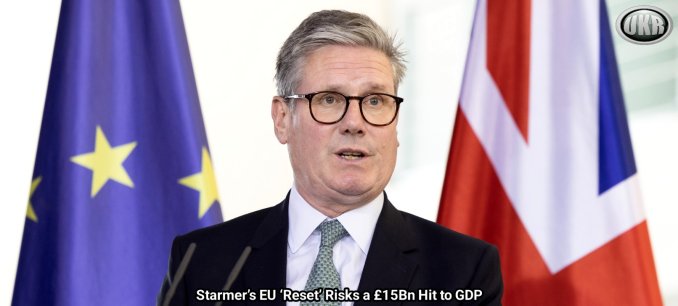
Starmer’s EU ‘reset’ risks a £15bn hit to GDP
SHANKER SINGHAM
When it comes to the global trading system, there is an ongoing battle between two competing models.
The first sees regulatory competition with equivalence and mutual recognition as far as regulations are concerned. That’s the classic system embodied by the likes of the United States, the World Trade Organisation and the Comprehensive and Progressive Agreement for Trans-Pacific Partnership (CPTPP).
The second model is that favoured by China and the European Union, which demands harmonisation of regulations at the most restrictive level, making market access dependent on replicating regulations.
The United Kingdom’s vote to leave the EU was in part a rejection of this latter model; and without question one of the greatest benefits of Brexit – albeit one still yet to be fully embraced and taken advantage of – is the ability to reject the one-size-fits-all approach to regulation taken by Brussels and instead calibrate our own home-grown rules for the maximum benefit of British consumers and businesses.
Regrettably, as part of its so-called ‘reset’ of relations with the EU, the current British Government is looking at going down the route of aligning its Sanitary and Phytosanitary (SPS) regulations with those of the EU. These are the rules relating to health and safety standards for agricultural commodities, animal-derived foods and plant-based products; and if the UK were dynamically to align its SPS regulations with those of the EU, it would effectively be once again ceding power over British rules to Brussels and causing a colossal hit to the British economy in the process.
The Growth Commission, which I chair, has calculated that such a move would likely cause a £15 billion hit to the UK economy. Moreover, we estimate that the EU’s existing SPS rules are already costing the 27 member states around €39 billion.
That is why the Commission is today urging the UK Government to abandon proposals for alignment with EU SPS regulations.
As it is, the EU boasts one of the most anti-competitive and growth-destroying regulatory systems in the world, which has led to stagnant growth across the continent. With a pressing need to grow its economy, the last thing a country like the UK should be thinking of doing now is aligning to European regulations.
Some argue that it would make sense to align to European regulations because we do a lot of trade with the EU and it would take the friction out of trade. But Growth Commission models demonstrate how the lack of competition in domestic regulation has a huge economic impact.
The chart below shows the GDP per capita forgone by Western European countries as a result of their regulatory and property rights barriers. This demonstrates how much more distorted the EU regulatory system is compared to the United States – and therefore why locking into that EU model would be such a bad mistake. The area between the two lines represents the UK’s regulatory headroom compared to US regulations which it would forgo with regulatory alignment.

.There really is a significant difference between the economic cost of adopting EU regulations as compared to the American model. Having extricated ourselves from the strictures and structures of the European Union, we now have the freedom to chart our own course when it comes to rules and regulations. We can and should have more pro-competitive regulations than any country, which is possible under the mutual recognition model which is the norm for non-EU, non-China markets.
It would be madness now to hand back control of our regulations to Brussels, thereby preventing future gains from adopting pro-competitive regulation and significantly damaging the UK’s external trade policy because much of that trade policy is dependent on a country’s domestic regulatory settings.
The other incalculable downside of the UK aligning with EU regulations would be its impact on the ability to do trade deals elsewhere in the world.
Any alignment to EU SPS regulation would, for example, have a very negative impact on the US-UK relationship. After the recent US Supreme Court ruling on tariffs, it is even more likely that any backsliding on regulation would trigger US concerns as market distortions are now the central plank of the authorities on which the President must rely to deliver his tariff policy.
It would also raise questions about our continued membership of the CPTPP and our trade deals with countries like Australia and New Zealand.
Hardwiring into UK law SPS regulations which are already costing EU economies dear and may restrict our room for manoeuvre in future trade negotiations would be a monumental act of self-harm – and one that would be extremely difficult to reverse, given how supply chains get locked in over time.
If Sir Keir Starmer remains true to his word that growth is the ‘number one priority’ of his Government, he should scrap this proposal for alignment with EU regulations forthwith.
Click here to subscribe to our daily briefing – the best pieces from CapX and across the web.
CapX depends on the generosity of its readers. If you value what we do, please consider making a donation.
This article (Starmer’s EU ‘reset’ risks a £15bn hit to GDP) was created and published by CapX and is republished here under “Fair Use” with attribution to the author Shanker Singham

••••
The Liberty Beacon Project is now expanding at a near exponential rate, and for this we are grateful and excited! But we must also be practical. For 7 years we have not asked for any donations, and have built this project with our own funds as we grew. We are now experiencing ever increasing growing pains due to the large number of websites and projects we represent. So we have just installed donation buttons on our websites and ask that you consider this when you visit them. Nothing is too small. We thank you for all your support and your considerations … (TLB)
••••
Comment Policy: As a privately owned web site, we reserve the right to remove comments that contain spam, advertising, vulgarity, threats of violence, racism, or personal/abusive attacks on other users. This also applies to trolling, the use of more than one alias, or just intentional mischief. Enforcement of this policy is at the discretion of this websites administrators. Repeat offenders may be blocked or permanently banned without prior warning.
••••
Disclaimer: TLB websites contain copyrighted material the use of which has not always been specifically authorized by the copyright owner. We are making such material available to our readers under the provisions of “fair use” in an effort to advance a better understanding of political, health, economic and social issues. The material on this site is distributed without profit to those who have expressed a prior interest in receiving it for research and educational purposes. If you wish to use copyrighted material for purposes other than “fair use” you must request permission from the copyright owner.
••••
Disclaimer: The information and opinions shared are for informational purposes only including, but not limited to, text, graphics, images and other material are not intended as medical advice or instruction. Nothing mentioned is intended to be a substitute for professional medical advice, diagnosis or treatment.
Disclaimer: The views and opinions expressed in this article are those of the author and do not necessarily reflect the official policy or position of The Liberty Beacon Project.


Leave a Reply