

BEPI PEZZULLI
BRITAIN once exported English common law to half the planet. Today, it is ready to import a Muslim blasphemy code.
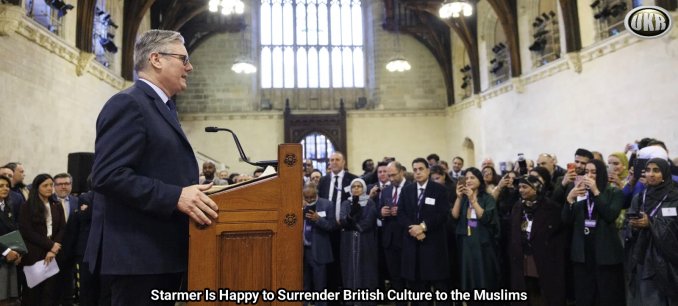
Sir Keir Starmer has unveiled a new official definition of what his administration calls ‘anti‑Muslim hatred’, accompanied by plans for an institutional apparatus designed to monitor and combat it across public life. Ministers insist that the measure is merely descriptive. It is presented as guidance rather than statute, a technical clarification meant to help authorities recognise prejudice and respond to rising tensions. The proposal forms part of a broader social cohesion strategy that also includes the appointment of a dedicated envoy tasked with addressing anti‑Muslim hostility and advising government departments, universities, and public institutions.
The language surrounding the initiative is carefully moderated. Officials stress that criticism of Islam remains lawful and that free speech will not be curtailed. Yet definitions once adopted by government have a curious tendency to acquire regulatory force. Universities consult them when disciplining students. Civil servants invoke them in training programmes. Police officers rely on them when recording incidents. What begins as guidance soon hardens into orthodoxy.
The Labour Party frames the initiative as a response to rising hostility toward Muslims in Britain. That concern is legitimate. A civilised society does not tolerate intimidation or violence against religious minorities. Israel’s Muslim minority, for instance, enjoys democratic protections, freedom of worship, political representation and legal recourse far exceeding those available to Muslims in most Muslim-majority states. The difficulty lies elsewhere. The concept being introduced in the UK is not limited to violence or harassment. It gestures toward a wider cultural category, one that risks transforming political disagreement into moral transgression.
Such an approach reflects a deeper intellectual current that has grown influential within Britain’s governing class. The country’s political elite increasingly treats its own historical identity as a problem to be managed. Christianity, once understood as the cultural grammar of the nation, is now recast as a relic best handled with polite embarrassment. Official rhetoric celebrates diversity while quietly detaching public institutions from the civilisational foundations that produced them.
The new definition must be read in that context. Britain is not merely attempting to shield a minority from abuse. It is reorganising the moral language of the state. Islam is granted a protective conceptual architecture. Christianity, meanwhile, survives mainly as heritage décor: cathedrals for tourists, carols for December, and the occasional reference to ‘Judeo-Christian values’ stripped of theology.
A strange inversion follows. The civilisation that produced the institutions of liberty begins to treat itself as morally suspect. The religious tradition that shaped Britain’s law, literature and political thought becomes something to be tiptoed around in public life. Another religious tradition acquires an expanding halo of institutional sensitivity. The balance gradually shifts.
This process amounts to a quiet form of civilisational re‑engineering. No minister announces such a project. The transformation proceeds through definitions, diversity frameworks and regulatory guidance. Cultural inheritance is recoded as exclusion. Administrative language replaces historical memory. A society begins to forget why its institutions exist.
Starmer’s government appears comfortable with this drift. The Prime Minister speaks often of cohesion and respect, yet his policies reveal a curious asymmetry. Christianity is treated as a private sentiment whose public expression must remain discreet. Islam receives a protective political vocabulary reinforced by state authority. The effect resembles a soft hierarchy of sensitivities.
Such arrangements cannot remain stable. Liberal democracies depend on a shared cultural grammar, even when citizens hold different beliefs. Remove that grammar and public life becomes an exercise in competing grievances. Government then responds with ever more elaborate definitions designed to manage the friction. The cycle feeds itself.
Britain already shows signs of that dynamic. Universities debate what constitutes permissible discussion of religion. Teachers worry about offending community groups. Police forces record thousands of ‘non‑crime hate incidents’, a category that exists nowhere in statute yet carries reputational consequences for those involved. The boundary between protection and intimidation grows faint.
None of this strengthens social harmony. A society cannot sustain pluralism while simultaneously hollowing out the tradition that made pluralism possible. Christianity provided the moral architecture within which Britain developed its ideas of conscience, tolerance, and limited government. Remove that architecture and the liberal language built upon it loses coherence.
Starmer seems unwilling to acknowledge this inheritance. His government prefers the vocabulary of managerial multiculturalism, where communities exist as administrative categories overseen by regulators. That model replaces historical continuity with bureaucratic supervision. Political leaders then congratulate themselves for maintaining harmony while quietly dismantling the cultural foundations of the nation.
Britain deserves better from its Prime Minister. A confident civilisation does not criminalise disagreement through semantic engineering. It protects minorities while affirming the traditions that shaped its public life. The state does not need new definitions to accomplish that task. It needs clarity about what the country actually is.
The paradox of contemporary Britain lies here. The nation that once trusted free institutions now seeks refuge in bureaucratic definitions. The society that taught the world the virtues of confident pluralism increasingly doubts its own cultural legitimacy.
Starmer may yet discover that nations rarely collapse through conquest; they erode through leaders who mistake civilisational surrender for progress. He is busy writing his own Honorius moment.
This article appeared in the Times of Israel on March 10, 2026, and is republished by kind permission.
See Related Article Below
‘Blasphemous’ drawings and the myth of tolerance

t’s often assumed and frequently stated that the biggest threat to British society these days comes from cultures which are alien and inimical to ours. Yet our way of life has for decades faced an equally formidable threat – from forces which emanate from within. A well-meaning, self-abasing and cowardly coterie of white liberals have sought to dilute our culture in the dread names of multiculturalism, diversity and inclusivity.
Sometimes diversity isn’t our strength. Often, encouraging difference doesn’t increase mutual respect. Frequently, pleasant gestures aren’t reciprocated
In spite of last month’s Gorton and Denton by-election, an event which laid bare the dangerously fragmented state of the nation along ethnic and religious lines, this left-liberal sect is blithely carrying on, unaware or unconcerned as to the havoc it has wreaked over the years with its thoughtless interventions.
This demographic has always been prominent and influential in local government and educational sectors. So it’s no surprise to learn that guidance issued by Labour councils in northern England has advised teachers that children’s drawings could be considered blasphemous under Islamic law.
The advice, designed to help staff adapt to religious sensitivities, warns that images made by pupils in art lessons may been seen as ‘idolatrous’ by some Muslims. It also counsels that music and dance classes could be contrary to the teachings of Islam. Entitled ‘Sharing the Journey,’ the subject-by-subject guide advises that ‘three-dimensional figurative imagery of humans is considered idolatrous by some Muslims.’ To clarify matters: ‘Some Muslim pupils may not wish to draw the human figure.’
So much for the exhortation in the latest government social cohesion plan, ‘Protecting What Matters’, that integration should be a ‘two-way’ process. This new guidance will give succour to the long-held perception, and experience of many, that multiculturalism and integration has never been a two-way street, that it has always entailed far more give than take.
This process of appeasement and cultural cringe, rather than abating, is getting worse. We have seen it elsewhere this week with the new government ruse to rebrand ‘Islamophobia’ as ‘anti-Muslim hostility’. Many rightly regard this as yet another sop to a section of society the Labour establishment fears.
Spinelessness and fear are not the only explanation for the craven behaviour of the liberals who have run the civil service, the judiciary, local government and education in our lifetimes. Their actions are also driven by a naive belief in the innate goodness of people and one of the most dangerous motives known to mankind: good intentions. They sweetly think that if you are kind to other people, they in turn, overwhelmed and humbled by your benevolence and compassion, with necessarily reciprocate.
Hence wording found elsewhere in the ‘Sharing the Journey’ report, a title oozing inane sentimentality, which reminds its readers that diversity in the classroom can be ‘a great source of strength’, and that schools ‘will want to be flexible in catering for religious difference.’
Yet sometimes diversity isn’t our strength. Often, encouraging difference doesn’t increase mutual respect. Frequently, pleasant gestures aren’t reciprocated. Tolerance can be abused and ultimately used against those who bequeath it, thrown back in their faces by those who don’t want to tolerate them or anyone else.
[…]
Many people throughout the country are deeply concerned about this insidious and relentless process of surrender. The most frightening thing now is that the means through which we can legitimately express dissent continue to narrow. Since new proposed measures on anti-Muslim prejudice include the nebulous definition ‘hostility’ and the even more dangerously subjective word ‘perceived’, anyone who dares complain faces being silenced, or even worse, silencing themselves.
The Spectator: continue reading

••••
The Liberty Beacon Project is now expanding at a near exponential rate, and for this we are grateful and excited! But we must also be practical. For 7 years we have not asked for any donations, and have built this project with our own funds as we grew. We are now experiencing ever increasing growing pains due to the large number of websites and projects we represent. So we have just installed donation buttons on our websites and ask that you consider this when you visit them. Nothing is too small. We thank you for all your support and your considerations … (TLB)
••••
Comment Policy: As a privately owned web site, we reserve the right to remove comments that contain spam, advertising, vulgarity, threats of violence, racism, or personal/abusive attacks on other users. This also applies to trolling, the use of more than one alias, or just intentional mischief. Enforcement of this policy is at the discretion of this websites administrators. Repeat offenders may be blocked or permanently banned without prior warning.
••••
Disclaimer: TLB websites contain copyrighted material the use of which has not always been specifically authorized by the copyright owner. We are making such material available to our readers under the provisions of “fair use” in an effort to advance a better understanding of political, health, economic and social issues. The material on this site is distributed without profit to those who have expressed a prior interest in receiving it for research and educational purposes. If you wish to use copyrighted material for purposes other than “fair use” you must request permission from the copyright owner.
••••
Disclaimer: The information and opinions shared are for informational purposes only including, but not limited to, text, graphics, images and other material are not intended as medical advice or instruction. Nothing mentioned is intended to be a substitute for professional medical advice, diagnosis or treatment.
Disclaimer: The views and opinions expressed in this article are those of the author and do not necessarily reflect the official policy or position of The Liberty Beacon Project.


Leave a Reply