

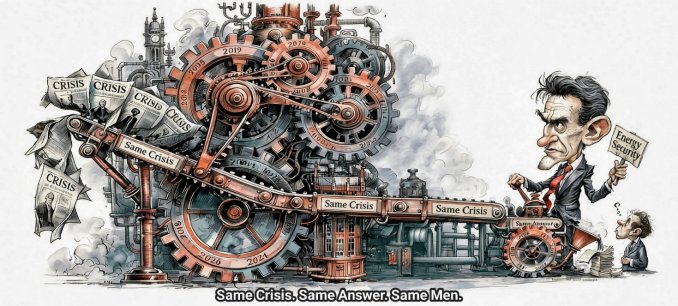
Part Three: The machine is still running. This article explains why.
THE RATIONALS
Series Introduction
In 2008 a law was passed without the courtesy of disclosing its costs. Domestic gas production was quietly run down in the name of energy security. Import dependency grew. Bills rose. The borrowing required to fund the transition helped push up mortgage rates. Levies multiplied. Billions in subsidies flowed smoothly into the accounts of foreign shareholders. And each crisis this machinery produced was immediately presented, with an almost touching consistency, as conclusive proof that the policy must accelerate — more spending, more borrowing, more levies, more contracts, and more foreign dividends. The next crisis duly arrived. The same argument was made again, with undiminished sincerity.
The policy creates the crisis. The crisis justifies the policy. It is a perfect, self-reinforcing loop. The same men who built the machine are still running it, still explaining it to the public, and still quietly filing away the letters that once inconveniently calculated what it would cost.
Three articles. One mechanism. Every dot connected — from the 2008 vote to your energy bill, your mortgage, your rent, your food shop, the foreign hands collecting the returns, and the question neither side of the repeal debate will honestly answer.
The dots have always been in the public record. Until now, nobody has connected them.
The machine described in Parts One and Two is still running. This article explains why it cannot stop — and why the people calling most loudly for repeal have been so conspicuously quiet about what stopping would actually cost.
There is a pattern to Britain’s energy crises that becomes visible only when one steps back far enough to view the last three major episodes at once — and resists the official invitation to treat each as a fresh and unforeseeable surprise.
In 2021-22 wholesale gas prices reached historic levels. Household bills surged. The structural vulnerabilities that had amplified the crisis — declining domestic production, permanent levy floors, growing import dependency — were nowhere mentioned.
What was mentioned, with admirable urgency, was the necessity of accelerating the transition. More investment. More subsidies. More contracts guaranteed to foreign generators.
Clean energy, ministers intoned with the serene confidence of men who had never met a levy they didn’t like, was the only route to energy security.
In 2024 bills rose again. The structural vulnerabilities were not mentioned. What was mentioned was the urgent necessity of accelerating the transition. More investment. More subsidies. The Warm Homes Plan.
Clean energy, ministers intoned, was the only route to energy security.
In May 2026, Ofgem confirmed a further rise in the price cap from July — the structural vulnerabilities once again not mentioned, the necessity of accelerating the transition once again the prescribed remedy. More investment. More subsidies. More contracts.
Clean energy, ministers intoned, was the only route to energy security.
Why the Loop Cannot Stop
This is not coincidence. It is a mechanism. It has four moving parts. Understanding them explains why a change of government, a different Energy Secretary, or even a different prime minister has not — and without deliberate structural surgery cannot — break it.
The narrative is self-sealing. The institutions charged with explaining energy costs to the public — government communications, Ofgem’s consumer guidance, the BBC’s energy coverage — operate entirely within the framework established by the Climate Change Act.
The institutions that administer Net Zero policy have lived inside its statutory framework for so long that they have largely ceased to see it as a political choice.
From within that framework, the mechanisms appear not as decisions but as the natural background condition of modern government — as unremarkable as the existence of the National Grid itself.
Nobody scheduled a ninety-minute debate on a trillion-pound commitment by oversight. Nobody passed the Climate Change Act without disclosing the costs by accident. Nobody left the Lilley letter unanswered through distraction. Whether the word for this is suppression is a question each reader may settle for themselves.
The institutions have, at minimum, lost the capacity to see the framework from the outside — a touching occupational hazard when one has spent long enough mistaking statute for nature.
This explains, without recourse to conspiracy, why Ofgem describes its network charges as necessary infrastructure investment rather than as the consequence of a 2008 parliamentary vote. It explains why fourteen years of ministerial statements on energy security have never mentioned the letter Miliband received from Peter Lilley in 2009 — asking for Parliament to discuss the costs.
And it explains why the BBC published an apology for giving airtime to the parliamentarian who tried to have the costs discussed, removed the programme from iPlayer and submitted the producers to an internal editorial review.
The national broadcaster did not suppress a truth. It genuinely did not recognise one — an admirable display of institutional consistency.
The institutions are aligned. The Climate Change Committee recommends the carbon budgets and certifies the resulting costs as acceptable. Ofgem implements the network charges and describes them as prudent infrastructure investment.
The North Sea Transition Authority manages the production decline and presents it as responsible transition stewardship. Each institution’s purpose is defined by the framework. None has an interest in questioning it. None does.
This is not coordination. It is what institutions do when they have existed long enough inside a structure — one of the quieter triumphs of modern governance.
The legislation is entrenched. The Climate Change Act cannot be repealed by ministerial whim, departmental reorganisation or a change of government that neglected to put repeal in its manifesto. It requires primary legislation, passed by a parliamentary majority willing to absorb consequences — diplomatic, financial and constitutional — that have never been honestly costed or publicly discussed.
No government has been willing to pay that price.
The Conservative opposition has pledged to repeal the Climate Change Act itself. Reform UK has pledged to scrap the net zero target. Both movements have been conspicuously silent about what either act would actually cost — and the voters they are addressing have not been told the difference between the two.
The financial architecture resists reversal. This is the part the repeal movement has been most silent about. Since 2021 the United Kingdom has issued green gilts — government bonds whose proceeds are earmarked for Net Zero-related spending and which carry use-of-proceeds commitments to the institutional investors who hold them.
The framework governing these bonds, published by HM Treasury, is explicit about the compliance expectations it creates. Credit rating agencies have, since the Paris Agreement, formally incorporated climate transition risk into sovereign assessments.
A government announcing repeal of the Climate Change Act would face an immediate review of that component of its sovereign risk profile. The direction of any such review would not be favourable.
Many of the institutional investors holding those green gilts — the pension funds, asset managers and ESG-mandated funds that dominate both markets — are among the same institutions that fund the mortgage-backed securities markets determining British fixed-rate mortgage pricing.
They sit on both sides of the transaction, collecting interest on government green bonds while simultaneously setting the rate at which British households borrow to buy their homes. A repeal that disturbed their gilt holdings would feed directly and immediately into the mortgage rates of the households the repeal was intended to help.
The cost of a poorly managed exit — in gilt yield terms, in refinancing risk, in the reassessment of UK sovereign credibility by ESG-mandated investors — could, in a plausible scenario, cost households more in elevated mortgage rates than the energy-bill savings repeal would deliver in the near term.
This has not been raised in a single parliamentary debate about Net Zero repeal. The politicians calling most loudly for abolition have not addressed it. The voters they are addressing have not been told.
Curious omissions, one might think, from those otherwise so voluble on the subject.

What Repeal Can and Cannot Deliver
The repeal argument deserves an honest accounting that it has not received — not the version its advocates offer, which overstates the immediate relief, and not the version its opponents offer, which dismisses the enterprise as reckless populism. Both mislead. Both serve institutional purposes. Neither serves the public.
There are, in fact, two distinct acts being discussed under the single word ‘repeal’ — and the distinction between them is the entire question the repeal movement has declined to answer.
The first is scrapping the net zero target, amending the Climate Change Act to remove or change the 2050 objective.
The second is repealing the Climate Change Act entirely, removing the primary legislation, dissolving the statutory framework, and triggering the complete liability exposure this article has been examining. The repeal movement calls for the first and promises the consequences of the second. They are not the same thing.
Reform UK’s 2024 manifesto pledged to scrap the net zero target — the first act. The Conservative opposition, under Kemi Badenoch, has pledged to repeal the Climate Change Act entirely — the second.
They are not the same pledge. They do not produce the same consequences. Neither party has explained this distinction to the voters who support them.
To understand why it matters, consider what scrapping the target — the policy Reform’s manifesto actually pledges — would and would not change.
It would remove the 2050 net zero objective from statute. It would not cancel a single Contract for Difference. It would not touch the energy levies on your bill. It would not dissolve the Climate Change Committee. It would not affect the network charges running to 2028. It would not alter the capacity market costs. It would not change the mortgage chain. It would not reduce the foreign dividends.
The machine described across three articles would keep running. The same costs would keep arriving. The same money would keep leaving. The voter who supported Reform expecting lower bills and an end to foreign subsidy extraction would receive, from the policy their vote actually delivered, essentially none of those outcomes. The repeal movement has not said this.
What repeal delivers immediately is modest. The Contracts for Difference are legally binding private-law contracts between generators and the Low Carbon Contracts Company regardless of the parent legislation. The above-market payment obligations run to 2038 and beyond. The RIIO-3 network charge determination runs to 2028. The capacity market contracts are similarly binding.
Full repeal of the Act — the Conservative pledge — goes further and costs considerably more. The Contracts for Difference, being under the Energy Act 2013 rather than the Climate Change Act, are not cancelled by repeal of the parent legislation. The above-market payments continue regardless.
What full repeal does trigger is the financial architecture examined below, the green gilt constraint, the Energy Charter Treaty liability running to 2045, the devolution conflict with Scotland and Wales, and the institutional reconstruction costs.
The household saving in year one from full repeal would be in the low tens of pounds on energy bills — potentially offset by elevated mortgage costs from gilt market disruption before eventual rate relief arrives. This has not been presented to the voters who support the Conservative pledge.
The structural cost floor documented in Part Two does not evaporate on repeal day. It unwinds on the timescales of its contractual obligations — slowly, over years and in some cases decades.
Repeal advocates do not say this. Their opponents cite it triumphantly as proof that repeal is pointless. Both miss the point, which concerns trajectory rather than immediate impact.
Over the medium term, a post-repeal government that reversed the North Sea investment suppression — eliminating the Energy Profits Levy surcharge, restoring licensing certainty, removing the statutory terminal risk signal that has been driving capital from the basin — could slow the production decline documented in Part One. Not reverse it.
The North Sea is a mature field and its best years are behind it regardless of policy. But slow it sufficiently to reduce import dependence at the margin and send a credible signal to capital markets that the basin has a future worth investing in.
New-build costs would ease as the Future Homes Standard was relaxed. Vehicle mandate compliance costs would fall. Agricultural land diversion would slow. These are real improvements. They are gradual ones.
What repeal would not deliver — and what its advocates have been strikingly reluctant to address — is a credible answer to the energy-security question that underlies everything.
A Britain that exits Net Zero without an alternative energy strategy is trading one structural vulnerability for another. The North Sea cannot be fully restored by policy. Domestic renewable generation has already reduced import dependence — in 2025, domestic sources accounted for 53 per cent of UK energy, the lowest import share since 2004. Once the capital costs are sunk, it genuinely is cheaper and more secure than imported fossil fuel.
The transition’s long-run logic is sound. The problem has never been the destination. It has been the management of the journey — the dishonest accounting, the hidden costs, the regressive distribution, and the systematic misdirection of public attention toward geopolitical scapegoats.
The Injustice Nobody Has Named
There is one further dimension of the repeal question that has received no attention whatsoever — and it is not about timing.
The households currently paying the Net Zero component of their mortgage rate are not the households that would benefit from repeal’s eventual rate relief. The relief, if it materialises, does not return to the household that paid for its absence. It accrues to whoever remortgages next.
The household that paid for the machine is not the household that would benefit from switching it off. That is, in its quiet way, the cruellest observation in this account.
The Bill Nobody Has Calculated
The repeal movement has a number it has never published — not because it has calculated it and declined to share it, but because it has never calculated it at all.
No government has ever published an estimate of what fully unwinding the Net Zero commitment would cost. The legislative cost of repeal is trivial — a single Act of Parliament. What repeal would actually cost — in contracts broken, gilts repriced, devolution conflicts triggered and institutions dismantled — is a figure nobody in authority has thought it convenient to produce.
Consider the financial and legal exposure alone: compensation claims from CfD generators arguing breach of legitimate expectation; green-gilt investor relations consequences and sovereign credit implications, legal challenges under the Energy Charter Treaty — from which the UK notified withdrawal in April 2024, with withdrawal taking effect in April 2025, but whose sunset clause under Article 47(3) means all existing energy investments remain protected for twenty years from that date, until April 2045, leaving foreign CfD holders with treaty-level protection against any government action that materially alters the value of their contracts regardless of what Westminster legislates in the interim
Then consider the constitutional and institutional exposure: the devolution conflict — Scotland has its own Climate Change Act with targets more aggressive than Westminster’s, and Wales has equivalent provisions under the Environment (Wales) Act 2016, neither of which a UK government could simply dissolve, and the regulatory reconstruction cost of replacing fifteen years of institutional infrastructure built around a statute that no longer exists.
These liabilities have never been assembled into a single public accounting. A government that has committed this country to a programme worth hundreds of billions of pounds has never told the public what stopping would cost.
One might, at a stretch, attribute the absence to administrative oversight. One would require considerable credulity to do so. A commitment of this scale, with this liability profile, affecting every household in the country, has never been subject to an honest public reckoning of what exit would require.
No published estimate exists. The absence of that estimate is itself the most damning single observation in this series — more damning, in its way, than the Lilley letter or the Miliband circularity or the Drax subsidy or the nineteen years.
One side of the ledger. Permanently. By design.
What Neither Side Will Say
The pro-Net Zero establishment will not admit that the transition as currently structured is not primarily an environmental policy. It is a fiscal and regulatory architecture that transfers costs from future generations to present households, from the less affluent to the more affluent, and from British bill-payers to foreign state enterprises and overseas investment funds — through a subsidy mechanism so attractive that around two-thirds of announced FDI projects into Britain between 2022 and 2025 were in clean energy and AI, according to McKinsey’s January 2026 report, with megadeals in clean energy accounting for the largest individual transactions.
The 0.2 per cent of GDP net-cost figure, produced by the committee whose founding purpose is to recommend the policy, conceals distributional consequences that have been documented by independent researchers and ignored in every government communication about the “just transition”.
The repeal movement will not admit that abolishing the legislation does not cancel the contracts, that the financial architecture has been structured in ways that make rapid reversal expensive, that reversing the production decline is a matter of years not months, and that a post-repeal Britain without an alternative energy strategy is not a solution — it is a different problem.
What neither side will say — and what three articles of documented evidence have been building toward — is this.
The British public has never been given an honest choice.
Three Votes. No Mandate.

The Climate Change Act was passed in October 2008. The costs were not disclosed. A minister was warned in writing what those costs would be. He did not convene the discussion. He is the Energy Secretary now.
In 2019 Parliament voted to tighten the target to net zero in a debate that lasted ninety minutes. No cost-benefit analysis was distributed to members. No public mandate was sought. Peter Lilley noted in the House of Lords in 2024 that costs were never discussed in either the 2008 or the 2019 debates — and that the BBC had apologised for giving him airtime on the subject.
In February 2025 the Seventh Carbon Budget was laid before Parliament, committing Britain to targets through to 2042. No voter was asked whether they accepted the costs it implies for their energy bill, their mortgage, their rent, their food shop, the price of their next car or their children’s first home.
In June 2026, Parliament was asked to approve a legally binding 87 per cent emissions reduction target by 2040. The impact assessment accompanying the motion was produced by the committee that recommended it, estimating net costs at £116 billion over twenty-five years. The independent range of cost estimates — disputed in methodology but running from £3 trillion to £9 trillion in gross costs according to the IEA’s peer-reviewed analysis — was not presented to members.
The gap between the official figure and the independent estimates was not mentioned. Miliband cited the second fossil fuel shock of the decade as justification for the acceleration, describing the pathway as “consumer choice-led”. The pathway is delivered through statutory mandates. The shock whose structural causes this series has documented was presented, with admirable consistency, as proof the policy must accelerate.
Four moments. Four commitments. No honest accounting at any stage. The pattern is not one of escalating incompetence. It is one of escalating consistency.
At no stage in those four moments was the public shown the ledger. Not the costs of continuing. Not the costs of stopping. Not the names of the recipients.
The money has been flowing regardless — to Copenhagen, Paris, Frankfurt, Beijing and a power station in North Yorkshire burning wood imported from America — since before most people knew any of this was happening.
At some point the accumulation — the unanswered letter, the ninety-minute net-zero debate, the £70.7 billion in foreign dividends, the nineteen years of levies the tenant cannot reclaim, the green-gilt liability nobody has costed, the BBC apology — stops being a series of individual policy failures and starts looking rather like a settled arrangement.
One Machine. No Honest Choice.
Three articles. One mechanism. The complete picture.
Britain’s cost-of-living crisis was not delivered by foreign despots and volatile markets, though both have played their supporting roles with considerable enthusiasm.
It was delivered by a self-executing machine, built with 463 votes on an October evening in 2008, maintained by the same small group of people across seventeen years, monetised through a subsidy architecture that transfers household bill payments to foreign shareholders, certified as affordable by a committee built to certify it as affordable, and never subjected to an honest public accounting of either its continuation costs or its exit costs.
The machine keeps running. Each crisis it generates is recycled into fresh justification for its continuation, absorbed by institutions that cannot see outside the framework, and reported by a press that has not, in the main, assembled the complete mechanism in a single account.
Last week it completed another revolution — a fossil fuel shock cited as proof the transition must accelerate, an 87 per cent target announced, the pathway described as consumer choice-led. The series described this sequence before it happened. The sequence arrived on schedule.
Repeal would stop the loop from tightening further. It would not quickly reverse the damage. The contracts run to 2038. The gilts are in the market. The institutions are fifteen years deep. The liability has never been costed. The financial architecture resists rapid correction.
Peter Lilley wrote to Ed Miliband in 2009 and asked for Parliament to discuss the figures. Miliband did not convene the discussion. He is the Energy Secretary now.
The figures are considerably larger than they were in 2009.
The discussion has still not been had.
This article (Same Crisis. Same Answer. Same Men.) was created and published by The Rationals and is republished here under “Fair Use”
Featured image: The Rationals (modified)

••••
The Liberty Beacon Project is now expanding at a near exponential rate, and for this we are grateful and excited! But we must also be practical. For 7 years we have not asked for any donations, and have built this project with our own funds as we grew. We are now experiencing ever increasing growing pains due to the large number of websites and projects we represent. So we have just installed donation buttons on our websites and ask that you consider this when you visit them. Nothing is too small. We thank you for all your support and your considerations … (TLB)
••••
Comment Policy: As a privately owned web site, we reserve the right to remove comments that contain spam, advertising, vulgarity, threats of violence, racism, or personal/abusive attacks on other users. This also applies to trolling, the use of more than one alias, or just intentional mischief. Enforcement of this policy is at the discretion of this websites administrators. Repeat offenders may be blocked or permanently banned without prior warning.
••••
Disclaimer: TLB websites contain copyrighted material the use of which has not always been specifically authorized by the copyright owner. We are making such material available to our readers under the provisions of “fair use” in an effort to advance a better understanding of political, health, economic and social issues. The material on this site is distributed without profit to those who have expressed a prior interest in receiving it for research and educational purposes. If you wish to use copyrighted material for purposes other than “fair use” you must request permission from the copyright owner.
••••
Disclaimer: The information and opinions shared are for informational purposes only including, but not limited to, text, graphics, images and other material are not intended as medical advice or instruction. Nothing mentioned is intended to be a substitute for professional medical advice, diagnosis or treatment.
Disclaimer: The views and opinions expressed in this article are those of the author and do not necessarily reflect the official policy or position of The Liberty Beacon Project.


Leave a Reply