

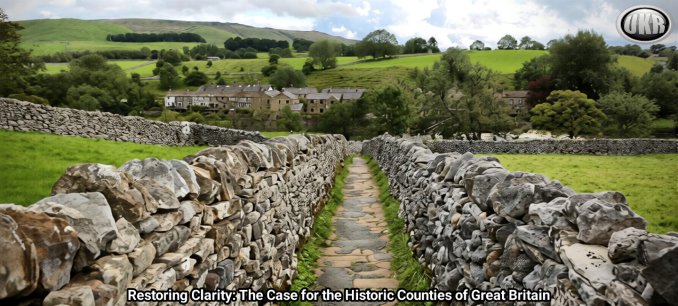
Joshua Malone of The Campaign For Historic Counties writes that historic counties are Britain’s stable cultural makeup – mislabeled as administrative areas. He outlines how they might be restored, without necessarily disposing of modern local government.
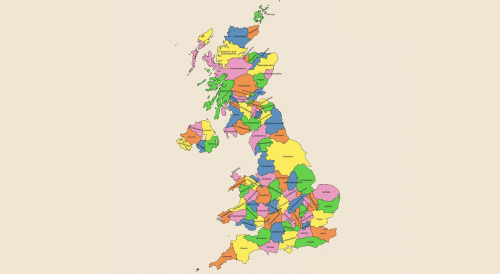 A map, showing the historic counties of England, Wales and Northern Ireland.
GUEST CONTRIBUTOR
Britain’s counties are woven into the very fabric of our national identity. From the rolling downs of Norfolk and the maritime shire of Morgannwg, to the majestic mountains of Inverness-shire, the tapestry of our nation owes much to the enduring presence of our historic counties. Yet, in recent decades, this tapestry has been muddled and frayed – not by neglect, but by confusion sown inadvertently by local government reforms and the inconsistent use of county names.
This confusion threatens the integrity not only of our geographical heritage, but of our cultural story, our sense of place, and even our civic pride. Our Historic Counties are being forgotten – erasing centuries of identity, heritage and pride.
The Roots of Confusion: A Tale of Names and Boundaries
To a visitor or even a resident, the notion of a “county” in Great Britain might seem simple, if not self-evident. Yet, peel back just one layer and the certainty vanishes. You may be welcomed to “Merseyside,” only to discover that Merseyside as an administrative area existed for a mere 12 years, abolished in 1986. Or perhaps you live in “Cumbria,” a council area created in 1974 to provide services to the counties of Cumberland and Westmorland, with part of Lancashire and Yorkshire, which was abolished in 2023.
For centuries, the historic counties served as the primary building blocks of local identity. They provided the backdrop to our histories, the allegiance for our sporting teams, and the structure for everything from locations to census returns. Then, beginning in the late 19th and accelerating in the 20th century, Parliament enacted sweeping local government reforms. ‘County’ councils were created, abolished, enlarged, divided, and renamed. Sometimes new authorities were invented that Parliament called ‘counties’ but which were not counties at all, while *actual* counties were merged, split, or shunted aside for administrative purposes.
This fluid administrative landscape has left the public adrift in a sea of county names, many used interchangeably but with vastly different meanings. Today, local councils may call themselves by names that echo historic counties or, just as likely, by the names of administrative creations with no deep roots in local consciousness. The result: widespread confusion, a dilution of historic identities, and a disservice to both heritage and community.
Why Historic Counties Matter
Some may argue that this is a trivial issue, a quirk of history with little bearing on the present. But the importance of historic counties runs deeper than mere nostalgia. They represent a living link to the past, a framework for belonging, and an organic geography that has shaped local culture for centuries.
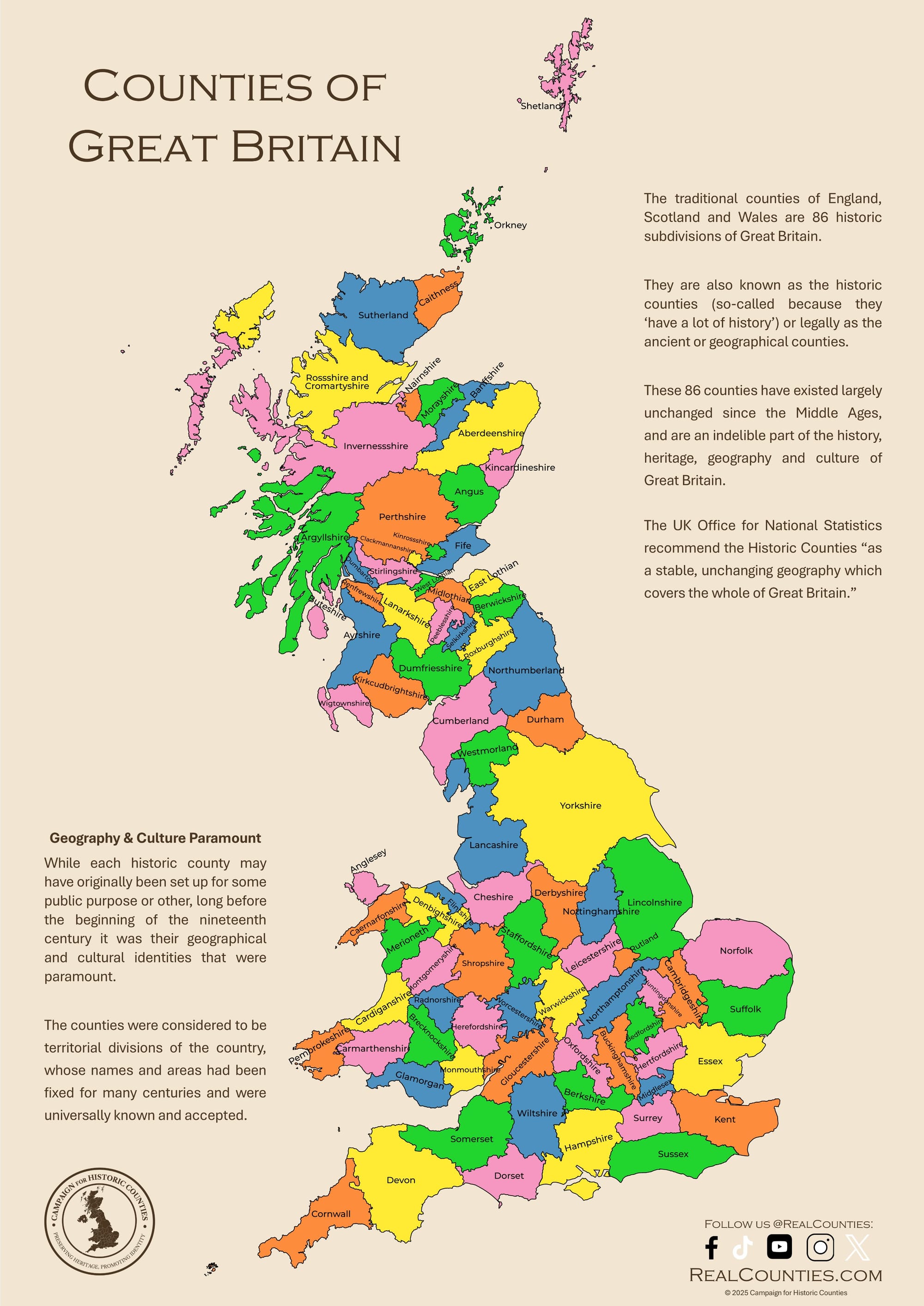
.
Historic counties precede the administrative inventions of the 19th and 20th centuries by many centuries, in fact more than a thousand years in some cases! Their boundaries are time-honoured, reflected in local traditions, dialects, and folklore. They define where we were born, where our ancestors lived, and where communities have flourished for generations.
When local authorities confuse or conflate these historic boundaries with their own, often short-lived administrative units, it severs a link with the past and clouds our understanding of who we are and where we come from. It also complicates the vital work of historians, genealogists, and archivists who rely on stable, well-defined county boundaries for their research.
Most importantly, the historic counties are the geography of our islands – the geography of the past, and the geography of today. They are not council areas or any other form of administration. They describe *where* places are, not who empties the bins.
In fact, while each historic county may have originally been set up for some public purpose or other, long before the beginning of the nineteenth century it was their geographical and cultural identities that were paramount.
The counties were always considered to be territorial divisions of the country, whose names and areas had been fixed for many centuries and were universally known and accepted.
As the notes to the 1831 Census state:
“From the Domesday Book of the Conqueror (AD 1086) it is known that County limits have since that time undergone no alteration; in fact they have been jealously maintained” – a confirmation that those who assert that county boundaries have ‘always changed’ are wrong.
The Current Landscape: An Alphabet Soup of Counties
The confusion is real, and its effects are visible everywhere. Take postal addresses: for decades, Royal Mail insisted that their own invention of ‘Postal Counties’ be used – not always matching historic ones or even administrative ones – leading to the absurdity of places in “Cleveland” (abolished 1996) or “Humberside” (abolished 1996) appearing on letters long after these councils ceased to exist. Sports fans may chant for Lancashire, while living in a place now being called “Greater Manchester.” In some cases, residents born and bred in Middlesex or Rutland find themselves told they live somewhere else entirely.
Even government websites and local authority communications add to the muddle. In one council’s literature, “Nottinghamshire” might refer to the historic county; in another, it means the administrative ‘county’; and elsewhere, it might reference a ceremonial ‘county’ (more properly called a ‘lieutenancy’) with yet another set of boundaries. For many, the result is a persistent uncertainty about where they live in terms of real identity and heritage.
An interactive map of the historic counties, can be viewed at the link below:


••••
The Liberty Beacon Project is now expanding at a near exponential rate, and for this we are grateful and excited! But we must also be practical. For 7 years we have not asked for any donations, and have built this project with our own funds as we grew. We are now experiencing ever increasing growing pains due to the large number of websites and projects we represent. So we have just installed donation buttons on our websites and ask that you consider this when you visit them. Nothing is too small. We thank you for all your support and your considerations … (TLB)
••••
Comment Policy: As a privately owned web site, we reserve the right to remove comments that contain spam, advertising, vulgarity, threats of violence, racism, or personal/abusive attacks on other users. This also applies to trolling, the use of more than one alias, or just intentional mischief. Enforcement of this policy is at the discretion of this websites administrators. Repeat offenders may be blocked or permanently banned without prior warning.
••••
Disclaimer: TLB websites contain copyrighted material the use of which has not always been specifically authorized by the copyright owner. We are making such material available to our readers under the provisions of “fair use” in an effort to advance a better understanding of political, health, economic and social issues. The material on this site is distributed without profit to those who have expressed a prior interest in receiving it for research and educational purposes. If you wish to use copyrighted material for purposes other than “fair use” you must request permission from the copyright owner.
••••
Disclaimer: The information and opinions shared are for informational purposes only including, but not limited to, text, graphics, images and other material are not intended as medical advice or instruction. Nothing mentioned is intended to be a substitute for professional medical advice, diagnosis or treatment.
Disclaimer: The views and opinions expressed in this article are those of the author and do not necessarily reflect the official policy or position of The Liberty Beacon Project.


Leave a Reply