

DR DAVID MCGROGAN
Long ago, I used to enjoy listening to Kevin Smith’s Smodcast. In an early episode, one of Smith’s perennial fall guys, the Canadian documentary film maker Malcolm Ingram, was asked by Smith and another guest to name the Prime Minister of Canada after the topic came up in conversation. Ingram said (this was in, I think, around 2007) that it was Paul Martin, and, when pressed by his doubtful interlocutors, declared with immense confidence that he would “cut off [his] little finger” if it was not. Smith and the other guest looked it up and discovered with great hilarity that the premier in question was in fact currently Stephen Harper – Ingram did not even know who the Prime Minister of his own country was.
What made them laugh harder was Ingram’s excuse: “I’m just really tired right now.” As Smith put it, you could put the average American in a concentration camp and starve him half to death, then release him and ask him who the President of the USA was, and he would be able to say, “If it’s still 2007, it’s George W Bush.” I’m just really tired right now is simply not a valid reason for failing to be able to name the Prime Minister of one’s nation.
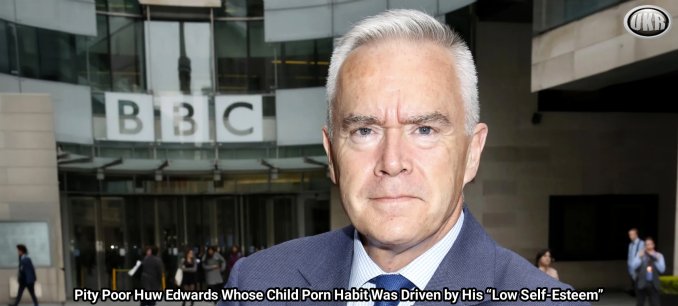
I was thinking about this the other day when reading portions of a statement put out by Huw Edwards in response to a recent Channel 5 docudrama on his downfall. Edwards, for non-British readers, is an extremely well-known former newsreader who for decades was the face of BBC News; he was the main presenter of the flagship daily news programme, News at Ten, and was also typically wheeled out for big televised events, such as the funeral of Queen Elizabeth II. He was something of a trailblazer in his early days as he was perhaps the first BBC newsreader to speak with a notable regional accent (Welsh, in his case) rather than the stereotypical received pronunciation; I have vague memories of this giving rise to comment at the time.
Huw Edwards is now in that category of person who is always referred to in news reports as a ‘disgraced former’, as in disgraced former pop star Gary Glitter, disgraced former film producer Harvey Weinstein, disgraced former comedian Roseanne Barr, disgraced former newsreader, Huw Edwards. This is because in 2024 he was convicted of making indecent images of children, although the word “making” has a slightly odd meaning here that is a curious feature of English criminal law. In this context, “making” can mean to cause to exist, or to bring about, a copy of an existing image. This is what Edwards was held to have done when doing what you or I would call opening images that he received on WhatsApp from a much younger acquaintance named Alex Williams. In opening those images he was causing copies of them to come into being on his phone – and hence “making” them within the meaning of s. 1 of the Protection of Children Act 1978.
The images are described in the sentencing remarks at Westminster Magistrates Court in his case as follows:
The children depicted were both in still and moving images across all categories and all were male, aged between 12 and 15 years with one moving image depicting a child aged approximately seven to nine years…
Edwards had apparently been giving Williams, then 19 years old, ‘gifts’ in return for bundles of pornographic images, some legal and others not, over a period of some 16 months (from December 2020 to April 2022). The indecent images of children were sent at various points between December 2020 and August 2021; at some stage in the process – we can infer that it was in August 2021 – Edwards began to insist that all the images be of boys or men over the age of consent.
Edwards was caught after Williams himself was convicted, but at trial came up with a curious, Malcolm Ingram-style, “I’m just really tired right now” sort of a plea for mitigation: ‘It was my mental elf, guv.’ His team of lawyers had assembled a formidable array of expert statements from a “Forensic Psychosexual therapist” [sic] and a “Consultant Psychiatrist and Neuropsychiatrist”, all providing evidence that Edwards ought to be treated as, in effect, just another victim.
These reports read a little like the lyrics from ‘Gee, Officer Krupke’. Hence, from the Forensic Psychosexual therapist’s report:
Mr Edwards was particularly destabilised through the process of commencing a social media presence which allowed him to interact with people that otherwise he would have never engaged with.
His social media engagement presented as an easy way to manage his low mood and provided him with a number of men and women who were motivated to be sexual with him which not only boosted his fragile self-esteem but allowed him to re-engage with his sexual interest in men which had been managed since 1994.
The feelings of being desirable and unseen alongside Mr Edwards’s unresolved sexual orientation created a perfect storm where he engaged in sexual infidelities and became vulnerable to people blackmailing him. [Emphases added]
You see, Edwards was just feeling a bit down – a bit fragile. He was “destabilised” and led astray by social media. And this had allowed him to become “vulnerable”. It is also apparently important to infer from this that the poor man was wrestling with a “sexual interest in men” that had, it is implied, been suppressed. The report goes on:
There is a tangible risk that Mr Edwards may attempt suicide as he recognises that his life trajectory, both personal and professional, may have been irretrievably damaged by events and he remains concerned about how events have and will impact on his family. Mr Edwards considers that his family’s situation may be improved if he was not alive.
And the blame for this we can, again, infer, would apparently be laid squarely on the court’s shoulders were it to give Edwards a custodial sentence. If he were to kill himself as a result, it would all be the judge’s fault.
The Consultant Psychiatrist and Neuropsychiatrist’s report, meanwhile, digs deeper into Edwards’s psyche to reveal yet more excuses:
Mr Edwards is a complex individual, with a psychologically challenging upbringing, in which his relationship with his father was particularly challenging and probably damaging psychologically. The restrictive, puritanical, but often hypocritical background of growing up in the particular cultural milieu of South Wales, with a father who was highly regarded and lauded outside the family, but was perceived as behaving monstrously within the family, created both an enduring cognitive dissonance and low self-esteem, compounded by a sense of being inferior (by not getting into Oxford and going to Cardiff instead) and being therefore something of an outsider at the BBC.
Again, we are called to sympathise. It is extremely difficult being a famous public figure earning well in excess of £500,000 a year when one has not gone to Oxford and only went to Cardiff. The cultural milieu of South Wales is “restrictive, puritanical and often hypocritical” (Welsh readers will understand that my tongue is in my cheek – no hate mail, please) – so much so that it could turn any innocent BBC newsreader into a sex offender. And, you see, Edwards was so terribly depressed at the time:
I consider that all of this, including and as well as the persistent depressive disorder, with intermittent bouts of clinical depression, though none as severe as the current one, significantly and adversely affected Mr Edwards’s decision making in relation to looking after himself and, crucially in this context, his interaction with co-workers and strangers via social media. His reported conduct reflects this.
Moreover, he also wasn’t getting on well with his wife:
At the time of the offences and over a period of two to three years, Mr Edwards described a deterioration in the relationship. His wife was experiencing high levels of stress as her mother was nearing end of life and the couple became increasingly distant from one another. Mr Edwards recognises that he was also detached and ‘not present’ at a time when she needed his support. Despite having previously been very close, he recalls this period as the most difficult part of their marriage and their levels of intimacy had significantly decreased.
And although Edwards was “currently doing well therapeutically” (thank goodness!) this report also emphasised the importance of the “high risk of suicide” if he were to be sent to prison:
The concern, as he himself touched on, is that outside [of his] protective ‘bubble’, and subject to intimidating public opprobrium, the current state of affairs [in which he is “doing well therapeutically”] will not last.
In summary, in other words, when Edwards did what he did he was just really tired right now. He was depressed, suffering from low self-esteem, going through a difficult phase in his marriage and vulnerable to being led astray. And this caused him to be seduced into accepting pornographic images that he should not have accepted. He was in a sense just an innocent victim of circumstance. And it was further to be taken into account that he had shown some remorse, and that he had – eventually – at least insisted that no illegal or ‘underage’ images be sent to him.
The picture that emerges to the lay reader, of course, is rather less sympathetic: Edwards is revealed as a man who, while his wife was struggling with the care of a terminally ill mother, was busily engaging in “sexual infidelities” with strangers on the internet and nurturing a burgeoning addiction to pornography. He is also revealed as a man with an extraordinarily fragile, narcissistic self-image (as if having gone to Cardiff rather than Oxford would be enough to make anybody with a healthy level of self-respect suffer from low self-esteem into his 60s), and an almost monstrous tendency towards self-pity.
And readers will I hope not have overlooked the timeline of events, and will have noted that Edwards was apparently perfectly happy to receive (or “make”) the unlawful images and videos in question between December 2020 and August 2021 before belatedly putting an end to the practice, and that he never did what anybody with a functioning moral compass would have done and reported the matter to the police as soon as it became clear that Williams was sending him images of the sexual abuse of children – or, at the very least, immediately cut off all contact.
But the important point here is not really that Edwards is an odious man or that his defence was a disgusting insult to the millions of people who suffer from depression or low self-esteem and manage perfectly well never to come within a country mile of accessing images of child sexual abuse. Nor is the point that there is anything wrong with the representatives of a defendant in a criminal case putting the best possible spin on the facts in order to try to get their client a more lenient sentence – that is in part what criminal barristers are for.
The point is in a way more simple, and certainly more important than that: the ‘I’m just really tired right now’ excuse that he trotted out is really to be understood as an attempt to undermine or ‘problematise’ boundaries that most ordinary people in 2026 still consider to be fundamental.
For a long time now a concerted effort has been underway on the part of what one might call ‘norm entrepreneurs’ to cast doubt on whether there should be a bright line age of consent. This type of argument has appeared in surprisingly formal and official-sounding forums, such as UNESCO and the WHO, who have been pushing for a decade or more an agenda of Comprehensive Sexuality Education. This aims among other things to instil the message that “sexuality is present throughout life” and that “education is a major tool for promoting sexual well-being and preparing children and young people for healthy and responsible relationships at the different stages of their lives [emphasis added]”.
And this norm entrepreneurial approach has also become evident in what happens in educational settings: a few years ago Miriam Cates MP indeed compiled a dossier for Parliament on sex education in schools, which found amongst other things (in the interests of not getting too graphic) that in many schools “sexually suggestive content” was becoming normalised by adult teachers under the banner of being ‘informative’.
Meanwhile, in academia similar moves have been afoot for some time. I will not name the individual concerned, but I myself was in attendance at an event a few years ago in which a scholar at an Ivy League university made the case for a legal regime that would embrace “erotic flourishing” through exploring “progressive sexual justice” rather than setting hard and fast limits on sexual contact between adults and children. This is not an entirely unheard-of argument to make in queer theory circles; readers may recall the Jacob Breslow affair, when a PhD student at LSE delivered a paper at a conference in which he implied that there was no necessary “linkage of paedophilic desire to harmful and abusive relationships and acts”.
And this has all been happening in tandem with the popularisation, if this is the right word, of the term ‘Minor Attracted Person’, or MAP, which originated in pro-paedophile activism but has found its way into the academic literature – generally in order to de-stigmatise research subjects who have paedophilic desires. A recent paper by Christina Farmer, Michael Salter and Delanie Woodlock provides a very informative and thorough overview of this trend, making clear that ‘Minor Attracted Person’ (a term perhaps coined in 1998 on a pro-paedophilia internet message board) has always been used as a means by which to perpetuate the view that paedophiles are simply an oppressed sexual minority and to normalise discussion of sexual relations between adults and children. The paper also warns about the dangers that this will normalise or legitimate child sexual abuse, and rather chillingly concludes that “many of the assertions contained in academic scholarship using the term MAPs are congruent with the long-standing political goals of pro-paedophile advocates and activists”.
There is clearly percolating, in other words, somewhere in the darker corners of the culture an idea that there might be some space within which paedophilia can be excused or downplayed in seriousness, perhaps on mental health grounds, and that this may be a path towards normalisation. And we should take note of the fact, then, that Edwards chose, and is choosing, to spin things in that way.
That he felt himself entitled to claim in the courtroom that poor mental health was an excuse for viewing images of child sexual abuse as a way to get more lenient treatment (which, by the way, worked: he escaped a custodial sentence), is one thing. But what is much more concerning is that he clearly seems to want to continue to fight his own corner, and get back into the public eye, by producing his own account of “these terrible events”, centring around the message that:
Mental illness is misunderstood by many but can never be an excuse for criminality. It can, however, at least help explain why people sometimes behave in shocking and reprehensible ways, and why things fell apart for me in the way they did.
It is almost, in other words, as though what is needed for the de-stigmatisation of paedophilia to come of age is for a major celebrity figure – possibly through a “lengthy sit-down interview” – to break cover and normalise the behaviour as a consequence of poor mental health. And it almost seems as though Edwards is willing to try to take on that role.
I do not claim that a conspiracy exists in this regard: it is all readily explainable with the theory that people who chafe against boundaries tend to want to push them back (something which is by no means a bad quality in many cases, of course). But it is important to recognise that, given that this is the case, boundaries have to be actively maintained if they are valued. Complacency will cause boundaries to collapse in the long term by default. They will be pushed at and undermined. Those who want them to stay in place have to keep them there lest they collapse – almost like a battle against coastal erosion.
And it is therefore important, I think, for those of us who do value the innocence of childhood to make clear that, just as being really tired is not an excuse not to know the name of your nation’s premier, being really depressed is not a reason to make immoral choices. We of course have great difficulty, living as we do in what is always called a ‘morally relativistic age’ (TM), to express the view that there are certain things that are simply wrong. Consensus on the underlying basis of morality is thin. But this is, in a sense, all the more reason for explicitly insisting that there are red lines which we continue to hold dear, and which may only be crossed in one direction. Edwards may reach whatever resolution he may with his family and friends – and perhaps with God. But he may not reach it with the rest of us on the terms he is offering. ‘My mental health’ cannot be allowed to be invoked to justify or excuse the making or sharing of indecent images of children.
As a kind of coda to these thoughts, it is worth saying that ultimately, and ironically, it is perhaps Edwards’s own experts’ reports which damn him. For, despite his Consultant Psychiatrist and Neuropsychiatrist laying out in such eloquent terms the laundry list of excuses from which Edwards wished to draw, that expert’s report still concluded that the man remains a “medium risk of causing serious harm to children”. Anyone for whom that is true ought not to be permitted to remain in the public eye. And we should not be self-conscious about saying so – or that we consider social stigma to retain a valuable effect in respect of a paraphilia that is rightfully abhorred.
Dr David McGrogan is an Associate Professor of Law at Northumbria Law School. You can subscribe to his Substack – News From Uncibal – here.
This article (Pity Poor Huw Edwards Whose Child Porn Habit Was Driven by His “Low Self-Esteem”) was created and published by The Daily Sceptic and is republished here under “Fair Use” with attribution to the author Dr. David McGrogan

••••
The Liberty Beacon Project is now expanding at a near exponential rate, and for this we are grateful and excited! But we must also be practical. For 7 years we have not asked for any donations, and have built this project with our own funds as we grew. We are now experiencing ever increasing growing pains due to the large number of websites and projects we represent. So we have just installed donation buttons on our websites and ask that you consider this when you visit them. Nothing is too small. We thank you for all your support and your considerations … (TLB)
••••
Comment Policy: As a privately owned web site, we reserve the right to remove comments that contain spam, advertising, vulgarity, threats of violence, racism, or personal/abusive attacks on other users. This also applies to trolling, the use of more than one alias, or just intentional mischief. Enforcement of this policy is at the discretion of this websites administrators. Repeat offenders may be blocked or permanently banned without prior warning.
••••
Disclaimer: TLB websites contain copyrighted material the use of which has not always been specifically authorized by the copyright owner. We are making such material available to our readers under the provisions of “fair use” in an effort to advance a better understanding of political, health, economic and social issues. The material on this site is distributed without profit to those who have expressed a prior interest in receiving it for research and educational purposes. If you wish to use copyrighted material for purposes other than “fair use” you must request permission from the copyright owner.
••••
Disclaimer: The information and opinions shared are for informational purposes only including, but not limited to, text, graphics, images and other material are not intended as medical advice or instruction. Nothing mentioned is intended to be a substitute for professional medical advice, diagnosis or treatment.
Disclaimer: The views and opinions expressed in this article are those of the author and do not necessarily reflect the official policy or position of The Liberty Beacon Project.


Leave a Reply