

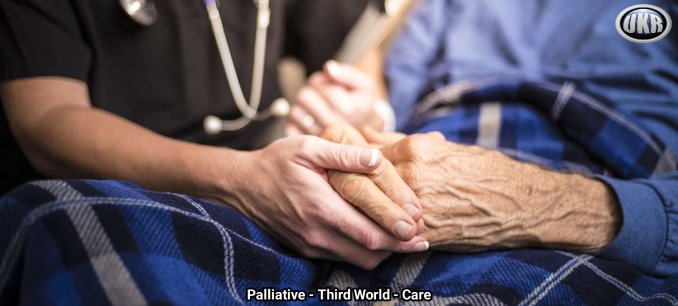
Palliative – Third world – Care
Unmet Palliative Care Need in the UK: A Failing System
CARL HENEGHAN AND TOM JEFFERSON
The Marie Curie Institute’s recent analysis estimates that around 200,000 people a year in the UK die with unmet palliative care needs, roughly one person every three minutes.
About one-third of people who die each year face poorly controlled symptoms and lack adequate clinical support during their final months. If current projections hold, this number is expected to exceed 250,000 annually by 2050.

What Did Marie Curie Actually Measure?
The estimates are based on survey data from bereaved caregivers in England and Wales, combined with national mortality statistics. “Unmet need” was defined as individuals who experienced significant symptoms in the last months of their lives but did not receive adequate support from their general practitioners (GPs).
This approach is valuable because it combines the assessment of symptom burden—using a recognised outcome scale—with access to services. Rather than merely counting hospice beds, it focuses on whether individuals’ suffering was adequately addressed. However, there are limitations to this method. Surveys of bereaved caregivers can be affected by recall bias and subjective interpretations. Additionally, we do not know how non-response might impact the estimates. The 2050 projections assume that current levels of unmet need remain constant, which may not be warranted given the underlying modelling assumptions.
Even with those caveats, the direction of travel is clear: a substantial minority of dying people are not receiving adequate care.
The headline figures are stark:
~46% had significant unaddressed symptoms.
~46% lacked sufficient GP support.
~32% experienced both — qualifying as unmet palliative care need.
The survey also reveals significant inequities. People with multiple health conditions are more likely to face unmet needs compared to those without such conditions. Additionally, individuals experiencing financial hardship tend to have worse outcomes than those who are affluent. The issue of the “postcode lottery,” in which access to services varies by location, persists.
The UK used to take pride in being a global leader in palliative care, historically justified by the origins of the hospice movement here. However, with one in three people dying with poorly controlled symptoms and inadequate support, we must question the reliance on past reputations.
“Third World Care” in a High-Income System?
The language may be uncomfortable, but it is worth examining: how can a high-income country with a tax-funded universal health service allow such widespread unmanaged suffering at the end of life? In many low-resource settings around the world, barriers to palliative care include limited availability of opioids, workforce shortages, inadequate community infrastructure, and weak integration of primary care. Increasingly, similar issues are emerging across the UK: difficulties accessing timely GP home visits, shortages of district nurses, fragmented out-of-hours services, delays in providing anticipatory medication, and an overreliance on acute hospitals for end-of-life care.
When families face difficulties in obtaining basic symptom relief for their dying loved ones, when pain management is delayed, or when caregivers are left without support overnight, these issues represent more than minor service gaps; they indicate a systemic failure. No one would intentionally design end-of-life care in this manner. Yet the UK has drifted into this sorry state of affairs.
Several structural issues underpin the problem:
More people are living longer with multiple health issues and frailty. The need for palliative care is no longer limited to cancer patients; it now includes those with heart failure, COPD, dementia, and various complex health conditions. Community nursing and general practice capacity have not kept pace with need.
The problem is further compounded as palliative care often sits awkwardly between primary care, community services, hospitals, and charities. As a result, too many patients are identified as being in their last year of life too late to allow for meaningful planning. While we obsess over hospital activity in exquisite detail, we measure the quality of dying far less systematically. None of this is inevitable; rather, it is the product of policy choices.
If we take the figures seriously, several changes are needed.
1. Make palliative care core business, not a charitable add-on.
Much of the UK hospice provision depends on charitable fundraising. End-of-life care should be as fundamental as emergency care.
2. Invest in community capacity.
24/7 access to skilled community nursing and GP support is essential. This is not optional. If people are to die at home when that is their preference, the workforce must exist to support them.
3. Universal anticipatory care planning.
Earlier identification of individuals likely to be in their last year of life, supported by structured advance care planning, medication planning, and crisis pathways.
4. Guarantee access to essential medicines.
Timely access to opioids and other symptom-control medications in community settings must be reliable.
5. Measure what matters.
We need routine, transparent reporting of end-of-life outcomes: symptom control, place of death aligned with preference, carer experience, and emergency admissions in the last month of life.
The Marie Curie estimates are not perfect. They carry a degree of uncertainty. However, they are sufficiently credible to warrant attention. If even half of the projected figures are accurate, then tens of thousands of people experience real suffering: unmanaged pain, breathlessness, anxiety, and agitation, with families struggling to cope without sufficient professional support. In any health system that claims to be comprehensive and universal, this situation should be deemed utterly unacceptable.
Civilised healthcare should be judged not only by how it treats acute emergencies, but by how it cares for people when a cure is no longer possible. On current evidence, the UK is falling woefully short in this regard. Unless policy, funding, and workforce planning change substantially, demographic pressure will only widen the gap.
End-of-life care is not an optional extra; it is a litmus test of whether the NHS remains true to its founding principles.
This post was written by two old geezers who would like to remind society PLC that, in ancient Sparta, when the elders arrived in a public place, everyone stood up, as a mark of respect.
This article (Palliative – Third world – Care) was created and published by Carl Heneghan and Tom Jefferson and is republished here under “Fair Use”

••••
The Liberty Beacon Project is now expanding at a near exponential rate, and for this we are grateful and excited! But we must also be practical. For 7 years we have not asked for any donations, and have built this project with our own funds as we grew. We are now experiencing ever increasing growing pains due to the large number of websites and projects we represent. So we have just installed donation buttons on our websites and ask that you consider this when you visit them. Nothing is too small. We thank you for all your support and your considerations … (TLB)
••••
Comment Policy: As a privately owned web site, we reserve the right to remove comments that contain spam, advertising, vulgarity, threats of violence, racism, or personal/abusive attacks on other users. This also applies to trolling, the use of more than one alias, or just intentional mischief. Enforcement of this policy is at the discretion of this websites administrators. Repeat offenders may be blocked or permanently banned without prior warning.
••••
Disclaimer: TLB websites contain copyrighted material the use of which has not always been specifically authorized by the copyright owner. We are making such material available to our readers under the provisions of “fair use” in an effort to advance a better understanding of political, health, economic and social issues. The material on this site is distributed without profit to those who have expressed a prior interest in receiving it for research and educational purposes. If you wish to use copyrighted material for purposes other than “fair use” you must request permission from the copyright owner.
••••
Disclaimer: The information and opinions shared are for informational purposes only including, but not limited to, text, graphics, images and other material are not intended as medical advice or instruction. Nothing mentioned is intended to be a substitute for professional medical advice, diagnosis or treatment.
Disclaimer: The views and opinions expressed in this article are those of the author and do not necessarily reflect the official policy or position of The Liberty Beacon Project.


Leave a Reply