

TOM ARMSTRONG
I first wrote this mid- February, but have changed it a bit at the end as my views are, if not changing, a bit more tentative:-
In the evolving landscape of British politics the emergence of Restore Britain has sparked intense debate about the future of the nation’s governance. Rupert Lowe, the independent MP for Great Yarmouth and former Reform UK member, has launched Restore as a full-fledged political party on amid widespread dissatisfaction with the traditional Labour-Conservative duopoly, or “Uniparty”, that perpetuates globalist policies at the expense of national interests.
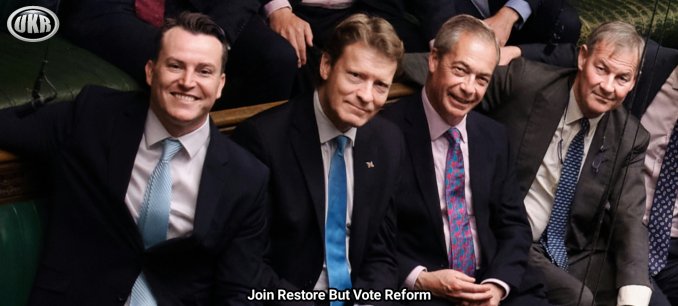
Here, I argue that by joining Restore we can invigorate genuine Right-wing politics, but also that we should strategically vote for Reform UK, currently leading in opinion polls, and the hope of pressuring it to adopt a more Rightist stance and also get it into power, which I view still as necessary. But I now caveat this by saying that we should vote Reform only so long as it has the greater chance of winning. Should Restore overtake it in the polls, dump it and vote restore. That said, I think this is unlikely to happen and we have to be very careful of splitting the Right-wing vote.
Our goal must, as a necessary first step to renewing our country, be to shatter the stranglehold of Establishment Uniparty and create a Right-wing, freedom and sovereignty-focused political environment. To use the jargon, move the Overton window a long way to the Right. Before Restore it was clear how to do this; vote in Reform, warts and all, thereby destroy the foundations of the woke globalist state, built upon the Tory-Labour con trick, and then use a party like Advance as a main opposition party. However, this is not now the best approach, with the rise of Restore and the Tory takeover of Reform.
Any strategy must be examined critically, weighing potential benefits against risks, like vote fragmentation and policy acceptability to the voting majority, The situation is dynamic and we must be prepared to change our minds as facts unfold, drawing on current political data and historical context to assess whether proposed approaches can really smash the Uniparty stranglehold. That’s all that counts. Nothing else. Personal dislike of Farage or mistrust of Islam are irrelevant in this context.
There is no doubt that Restore’s attraction is magnetic, even electrifying to those of us on the robust Right. The 2024 general election saw Labour secure a landslide parliamentary victory with a small percentage of the electorate. Many who voted Labour now suffer buyer’s remorse: approval has plummeted. Polls show Labour’s support between 15-23%, and Starmer’s at a dismal but deserved -47. The Conservatives are irrelevant at 13-21%. In contrast, Reform UK has surged to 25-30%, positioning it as the frontrunner, with projections it could win a majority, over 300, of seats if an election were held now. The question is whether a Reform led by some dodgy ex-Tories and Farage’s ego can be used as a tool to destroy the entrenched enemy or weaken it sufficiently to allow it to be dislodged. I still think it can be, if through shock alone.
A significant factor in this puzzle is whether Reform has a chance of getting into power. At the moment it has, but if splitting the Right-wing vote could bring a combination of the disastrous Establishment-controlled parties, Tory, Labour, Libs, Greens, Scots and Welsh Nats, back into power, we must vote Reform. In this view, getting Reform into power, especially with 300 MPs, gives it no excuse for betrayal. This would be obvious to its membership, most who joined because they felt betrayed. My guess is that a Reform government will mirror Trump’s, doing some good and some bad, winding institutional wokery back a bit, but not so far as necessary. But I think that the shock to the Establishment would be enormous: the British people voting for an outsider party for the first time on a hundred years. The demand for change would be undeniable and, in part, unavoidable. So, even if Reform fails to deliver, the scene would be set for real reform, and with Restore standing by, ready to deliver.
The shift to the Right reflects voter frustration with issues like immigration, economic stagnation, and perceived cultural erosion, themes that both Reform and Restore Britain emphasise, though to a different degree. Restore positions itself as a vehicle for “full-scale national restoration.” Its manifesto outlines aggressive policies aimed at reversing Britain’s decline. On immigration, the party advocates the complete abolition of the asylum system, immediate deportation of illegal entrants, and a policy where “millions must go,” including foreign nationals who do not integrate or contribute economically. Welfare reforms would deny benefits to non-citizens and mandate work or training for able-bodied recipients. Economically, it promises sweeping tax cuts—slashing income, corporation, and VAT rates—while deregulating businesses and scrapping rules like IR35 that burden small enterprises. Culturally, Restore Britain pledges to uphold our Christian heritage, banning practices such as halal and kosher slaughter, the burqa, and Sharia courts, framing these as countermeasures to “creeping Islamification.”
So, what’s not to like? I admit, I find Rupert Lowe’s message far more appealing that Farage’s. But is it a message that will appeal to the majority of the British people? Will it persuade the many disgruntled middle-class middle-of-the-road former Tory voters that we need to win an election? Or is it too much red meat too soon? There is no doubt that Lowe’s message will continue to be met with the ferocious opposition of the MSM that too many still rely on for their opinions? Dismiss this as you like, but to achieve our aim through the ballot box these decent, well-meaning people must be brought onside. In my view, Lowe has a tightrope to walk – the same tightrope that Farge walked down, swaying all the time to the Left.
Restore Britain claims early polling support of around 9-10%, suggesting it could attract voters from Reform, Conservatives, and disaffected Labour supporters in working-class areas. But such figures enhance the prospects of a Globalist coalition, say Labour, Lib and Green, with the tacit support of the Tories. If this happens, we might see all hope of change by the ballot box terminated after 2029, leaving only civil disobedience followed, most likely, by violence, God forbid. So, the weight on us to get this right is very great. In summary, I see it essential that the next government is a Right wing one based on the basic principles embraced by Restore and claimed, however falsely, by Reform.
If, therefore, Reform maintains its polling lead and appears poised for victory in the next general election even if 15% vote Restore, then I’m voting Restore. But if that 15% will result in a continuation globalist government, I’m voting Reform.
Reform’s current status, with over 250,000 members, eight MPs, and significant local council presence, gives it institutional heft that Restore Britain lacks, at the moment at least. Strategic voting and a growing Restore membership could pressure Reform to “adopt genuine right-wing policies,” as suggested. This seems to be happening already, with Reform’s manifesto already echoing Restore Britain’s, including mass deportations. By supporting Restore but being prepared to vote Reform, we might help ensure Reform remains committed to what it says it stands for and at least partially implementing them in power. That, at the moment, is the best we can expect.
Yes, this strategy is not without risks. Fragmentation on the right could cause disaster, so we have to box canny. The first past the post system works against us, so we need maximum support. Historical examples abound: In the 1983 election, the SDP-Liberal Alliance split the anti-Thatcher vote, aiding Conservative dominance. Similarly, in 2019, the Brexit Party’s (shameful) selective standing helped Boris Johnson’s treacherous Tories. Critics of Lowe’s new party, including some Right-wing figures, warn it could act as a “pebble in the shoe” for Reform without achieving scale, and that Lowe’s uncompromising stance will be twisted to scare the easily led. No doubt Restore Britain’s policies of mass deportation will be distorted and distilled into racism and fascism. There’s not much we can do about that except counter it with the truth. Encouragingly, Reform’s Zia Yousuf is also now talking about mass deportations – definition is essential.
In conclusion, joining Restore Britain offers ideological purity and its message is ultimately what we want. It could potentially catalyse a Right-wing renaissance. It might also keep Reform honest, or more honest that it would be otherwise. It could also position Restore well for the aftermath of voting in a non-Uniparty party that will inevitably shake the very foundations of the evil globalist construct. Yet, if Reform has as chance of winning as polls but will need every vote it can get to form a government, then I suggest we should hold our nose and vote Reform, while still energetically supporting Restore. In this case, the end really does justify the means. Smashing the duopoly is the priority, but requires careful navigation to avoid the horror of prolonged Labour rule. Ultimately, voters must weigh passion against pragmatism in this pivotal moment for UK politics.
See Related Article Below
Reform, Reclaim, Restore: The People’s Front of Judea on the Right
ROGER WATSON
Is anyone else losing count of the number of parties we now have to the right of centre of UK politics? Incidentally, I don’t count the Conservative Party among them; they swung to the left a long time ago and never came back.
UKIP – remember them? – still exist, and their Farage-led spinoff Brexit Party morphed into Reform. David Kurten leads the Heritage Party and then Ben Habib formed the short-lived Advance UK which threw its chips in recently with Rupert Lowe’s Restore Britain party. Not forgetting of course, Laurence Fox’s Reclaim.
It’s all getting a bit Monty Python as in that glorious piece of cinematic comedy, Life of Brian and mimicking what used to take place on the left of politics. The People’s Front of Judea versus the Judean People’s Front, indeed, except that we must contend with the New Judean People’s Front and the Judean Liberation Party, or equivalents, as well.
We must be getting near the end of this mad splintering among politicians who claim to stand for British values, a reduction in immigration, toughness on crime, an end to wokery, and a plague on all things socialist. Apart from anything else, we’re going to run out of names for any new parties.
David Kurten defied convention when he named his outfit the Heritage Party and, at least Ben Habib tried a positive slant: ‘Advance’. The rest seem to be stuck on the ‘Re’ prefix: ‘Reclaim’; ‘Restore’; and ‘Reform’. What possible ‘Re’ prefixed names could there be left? ‘Remind’, ‘Rewind’ and ‘Retake’, perhaps?
But, joking aside, this is all getting quite serious. The splintering of former alliances and even friendships leads to a fragmented front. Without some electoral pacts – and that seems incredibly unlikely given the personalities involved and the obvious vitriol between, for example, Farage on the one hand with Habib and Lowe on the other, and the hostile front established by Kemi Badenoch towards all things Reform – then the way is open for a large, united party, even one making a total mess of things.
I am, of course, referring to the Labour Party. The way things are going we are in grave danger of facing another Labour electoral victory at the next election. The Tories are a joke, haemorrhaging MPs to Reform from a very diminished base after the last election. If you are pro-UK values, anti-immigration and fed up to the back teeth of wokery, inclusivity, diversity and women with cocks, then who do you vote for?
In the mix, slightly to the left economically but dry as toast on all the above litmus tests is the SDP. But they only have two MPs, and their leader William Clouston is not one of them. But, as much as I like them and, especially, one of their prominent members Rod Liddle, even the SDP does not think it can win an election.
There was a point at which I really thought that Reform was going to save us. I have never voted for them, although I did vote for its forerunner the Brexit Party. If I thought we could put the Labour Party back on the shelf and give the Tories a further lesson in how they should not have led the country to ruin and oppression during the Covid years, then I’d go for them. But only if I thought they could win.
Now I believe Reform has lost its way, a lot. Farage is less leader than he is ego. Good leaders tolerate a modicum of dissent, and the best leaders surround themselves with people who want and who could just as easily do their job. Farage lacks the humility and, perhaps, the confidence to do that.
Thus, Reform is becoming a refuge for disloyal Tories, complete idiots and Covid vaccine pushers like Nadhim Zahawy. Suella Braverman talked a good talk before, during and after her time at the Home Office, but she achieved the square root of bugger all in terms of stopping immigration and kicking out illegals. Reform is rapidly looking like an alternative Tory Party, except that it is stocked by former Tories the Tory Party was well rid of.
One exception may be Danny Kruger, but who has heard anything from him recently? He is a potential tall poppy in Reform, but we all know what happens to tall poppies under Farage; they go the way of Habib and Lowe.
*
Roger Watson is a retired academic, editor and writer. He writes regularly for a range of conservative journals including The Salisbury Review and The European Conservative. He has travelled and worked extensively in the Far East and the Middle East. He lives in Kingston upon Hull, UK.
If you enjoy The New Conservative and would like to support our work, please consider buying us a coffee or sharing this piece with your friends – it would really help to keep us going. Thank you!

••••
The Liberty Beacon Project is now expanding at a near exponential rate, and for this we are grateful and excited! But we must also be practical. For 7 years we have not asked for any donations, and have built this project with our own funds as we grew. We are now experiencing ever increasing growing pains due to the large number of websites and projects we represent. So we have just installed donation buttons on our websites and ask that you consider this when you visit them. Nothing is too small. We thank you for all your support and your considerations … (TLB)
••••
Comment Policy: As a privately owned web site, we reserve the right to remove comments that contain spam, advertising, vulgarity, threats of violence, racism, or personal/abusive attacks on other users. This also applies to trolling, the use of more than one alias, or just intentional mischief. Enforcement of this policy is at the discretion of this websites administrators. Repeat offenders may be blocked or permanently banned without prior warning.
••••
Disclaimer: TLB websites contain copyrighted material the use of which has not always been specifically authorized by the copyright owner. We are making such material available to our readers under the provisions of “fair use” in an effort to advance a better understanding of political, health, economic and social issues. The material on this site is distributed without profit to those who have expressed a prior interest in receiving it for research and educational purposes. If you wish to use copyrighted material for purposes other than “fair use” you must request permission from the copyright owner.
••••
Disclaimer: The information and opinions shared are for informational purposes only including, but not limited to, text, graphics, images and other material are not intended as medical advice or instruction. Nothing mentioned is intended to be a substitute for professional medical advice, diagnosis or treatment.
Disclaimer: The views and opinions expressed in this article are those of the author and do not necessarily reflect the official policy or position of The Liberty Beacon Project.


