

Britain’s Jews Are Paying the Price for Political Cowardice
HOTTENTOT
There are moments when a country reveals what it truly is. Not in ceremonies, slogans or memorial speeches, but in the treatment of those citizens who most need the protection of the state. Britain is now facing such a moment. A wave of hostility, intimidation and outright violence directed at Jews has exposed a political class that prefers evasion to truth, sentiment to action, and posturing to duty.
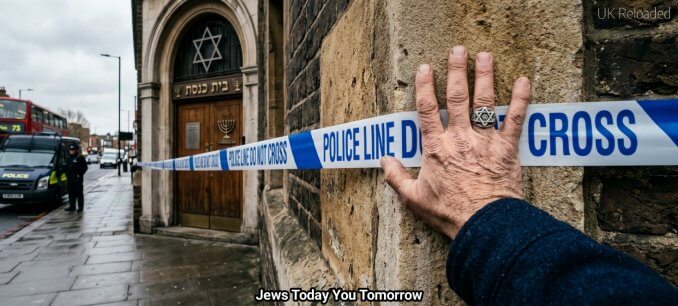
British Jews are told that ministers are “concerned”, that police are “monitoring the situation”, that community leaders are “engaged”. These phrases are the anaesthetic language of evasion, design to give the impression of action, while no action is taken, or contemplated. They are designed to soothe without curing, to acknowledge without acting. Meanwhile, Jews are abused in the street, threatened outside synagogues, harassed on campuses, and targeted simply for being visibly Jewish. The message they receive is unmistakable: your safety is negotiable.
This did not happen by accident. It is the product of decades of establishment cowardice.
The British establishment, and Labour in particular, bears a heavy share of responsibility. Labour spent years mired in its own antisemitism scandal, treating Jewish outrage as an inconvenience rather than a moral emergency. Even after public disgrace, the deeper lesson was not fully learned. Too many within the party still approach antisemitism as a matter of optics rather than principle. If the hatred comes wrapped in causes they find fashionable, they grow hesitant, nuanced and suddenly desperate for “context”.
Yet the Conservatives should not flatter themselves. They often preferred rhetoric to resolve, issuing stern statements while allowing deeper problems to worsen. Britain has been governed by parties that compete in performance and collaborate in avoidance.
One of the avoided truths is that a large portion of contemporary antisemitism in Britain is linked to Islamist extremism and to imported hatreds that some leaders are too timid to confront or are happy to use them for their own agenda. This should not be controversial. It is an observable reality. There are offenders motivated by a worldview that sees Jews not as fellow citizens but as permanent enemies. There are agitators who use Middle Eastern conflicts as licence to menace Jews in British streets. There are preachers and activists who traffic in hatred, glorify violence, and cultivate sectarian grievance. Pretending otherwise protects nobody except the guilty.
To state this is not to condemn Muslims collectively. That lazy distortion is itself part of the problem. The majority of British Muslims are peaceful citizens who want exactly what everyone else wants: security, opportunity, dignity and a decent future for their children. Many are themselves appalled by extremism. Many live under the shadow of fanatics who claim to speak in their name. Many know perfectly well which organisations, influencers and preachers poison minds while respectable society looks away.
The refusal to distinguish between ordinary Muslims and Islamist extremists has served extremists handsomely. It allows them to hide behind accusations of prejudice whenever scrutiny arrives. It allows politicians to avoid difficult conversations. It allows institutions to confuse tolerance with surrender.
Mass immigration, badly managed and paired with almost no serious expectation of integration, has caused and intensified these strains. Britain imported people at scale without insisting on the civic bargain that must accompany migration: one law for all, equal citizenship, loyalty to democratic norms, and acceptance that sectarian vendettas from abroad have no place here. Diversity was treated as a self-executing good. It is not. A society requires common standards, not merely common postcodes.
Worse still, a fashionable ideology took hold in elite institutions: the belief that Western nations are uniquely culpable, that minority grievances are inherently virtuous, and that moral judgement must be distributed according to identity rather than conduct. Under this creed, some groups are presumed victims whatever they do, while others are presumed privileged whatever is done to them. Jews, inconveniently successful yet historically persecuted, fit badly into this childish moral ledger. So their fears are downgraded, explained away, or submerged beneath louder narratives.
If similar scenes of organised intimidation were repeatedly associated with the far right, the response would be immediate and ferocious. Emergency meetings would be convened. Networks would be mapped. Funding streams scrutinised. New powers demanded. Endless commentary would insist that democracy itself was under threat. Yet when the threat emerges from Islamists, all becomes too delicate for action, and the matter is swept – like the rape gang scandal – under the carpet where it festers and grows. Officials plead complexity. Commentators discover ambiguity. Police stress “community tensions”. Plain description of events is treated as the real offence.
This double standard is disastrous. It tells extremists that some forms of menace are more tolerable than others. It tells Jews that their suffering depends on the identity of the aggressor. It tells the public that institutions no longer believe in equal standards.
Policing reflects this paralysis. Officers are placed in impossible positions by political timidity above them, yet the outcomes remain indefensible. Victims feel unprotected. Public order is inconsistently enforced. Open calls for violence are tolerated until they become impossible to ignore, usually after a murder or two. Even then, the root cause is studiously ignored. In some cases, Jews are effectively advised to stay out of sight, alter routes, remove symbols, or avoid provoking mobs merely by existing openly as Jews. No free country should normalise such advice.
The remedy is not hysteria. It is seriousness.
First, the state must name violent bigotry wherever it appears: Islamist or far left. Violence does not become less violent because it arrives under a different banner.
Second, the laws against incitement, serious harassment, violent disorder and advocating terrorism must be enforced consistently. If Muslim organisations or mosques advocate violence or terror, they should face prosecution and closure. No religion or political association should enjoy immunity.
Third, migration and citizenship policy must recover the idea of reciprocity. Those who come legally to Britain are entitled to fairness and opportunity, but Britain is entitled to demand allegiance to its laws and norms in return. Those who preach sectarian hatred or support violence should lose the privileges they abuse and face draconian punishment, including deportation.
Fourth, integration must mean more than slogans. Shared language, civic education, contact across communities, and confidence in national institutions matter. Segregation—social, educational or psychological—breeds resentment and manipulation.
Fifth, political parties must stop courting communal blocs as though Britain were a patchwork of sectarian vote banks. Citizens should be addressed as citizens, not as tribes to be bargained with. Labour has particular questions to answer here.
None of this is anti-Muslim as such. On the contrary, it would benefit Muslims who are tired of being represented by the loudest fanatics and embarrassed by those who turn religion into a weapon. Liberal Muslims, secular Muslims, women resisting coercion, and young people trying to live ordinary British lives all gain when the state ceases to appease extremists.
The deepest failure of the establishment is moral confusion. It has forgotten that tolerance is not the suspension of judgement. It is the defence of a lawful order in which people may live freely so long as they do not threaten the freedom of others. A society that tolerates intolerance in the name of sensitivity will eventually have neither tolerance nor sensitivity.
Jews often serve as the warning light on the dashboard of democracies. When antisemitism rises, broader disorder is rarely far behind. The people who come for Jews do not stop there. They menace journalists, intimidate dissenters, policewomen, despise gays, threaten reformers, and erode the authority of the state itself. To dismiss attacks on Jews as a niche concern is to misunderstand history and human nature alike.
Britain can still choose a different path. It can abandon euphemism, enforce one standard, and defend those citizens who now feel exposed. Or it can continue with statements, vigils and managed silence until the next outrage arrives. And then next, till we face total breakdown and civil war.
A serious country would know what to do. The question is whether Britain still wishes to be one.
This article (Jews Today You Tomorrow) was created and published by Free Speech Backlash and is republished here under “Fair Use” with attribution to the author Hottentot
See Related Article Below
What Is To Be Done?
DAVE RICH
The current wave of anti-Jewish hatred has been described as a national emergency. It is an unprecedented situation for British Jews, and a crisis for wider society. If the answer cannot be found to repeated, random (but targeted) violent attacks on Jews, than modern Britain has failed. I don’t mean it has failed its Jews – that much would be obvious, if this continues without end. I mean that Britain will have failed itself.
This requires a concerted, sustained effort, by the entire country. So what can be done?
Call it for what it is. This is anti-Jewish hatred that has taken root in parts of British society. Platitudes like “there is no place for antisemitism in this country” are unhelpful because they are simply untrue. There clearly is a place for antisemitism in parts of Britain, and tackling it begins by facing up to that fundamental, if depressing, truth. This is not some unfathomable phenomenon with no rhyme or reason that appears from nowhere and then disappears again into the ether: it is a pattern of behaviour shaped by a set of ideas and beliefs, and driven by activists and movements. It is fuelled by extremist ideologies and actors, principally Islamist and left wing extremism, but by right wing extremism as well. There are a well-established set of causes, slogans, narratives and goals that shape antisemitism today, promoted by an activist street movement and excused or justified by vocal, prominent advocates with big audiences.
The consequence is that a combination of hateful extremists and hostile states have created an environment in which British streets have become unsafe, in a very specific, targeted, deliberate way. That makes it a national security issue and the nation should confront it on that basis.
Get the basics right. Protecting the people is the first responsibility of any government. The police have put a huge amount of resource and officers into Jewish community neighbourhoods in recent weeks, and it looks like they need to find even more. If that requires extra funding from the Home Office then I fully expect that funding to be provided. I know that a lot of people in the Jewish community feel let down by police and government. Whatever mistakes have been made in the past, right now they throwing everything they have at this, and are doing more than most in wider society to try to tackle this problem.
However, there is much more that could be done. The legal cases in relation to the recent arsons, and other prosecutions for antisemitic hate crimes, should be expedited through the courts just as they were after the Southport riots. This would send a message to would-be offenders, to the Jewish community, and to the country as a whole, that tackling antisemitism is a national priority. Sentencing should reflect this, and some recent sentences for antisemitic hate crimes have been very weak. Two years ago a man who threatened Jewish people in Golders Green with a knife, just down the road from Wednesday’s attack, was given a suspended sentence. That’s hardly a deterrent.
Additionally – and this has been a bugbear of mine for years – while we know how many antisemitic hate crimes are reported to police each year, we have no way of knowing how many of them result in prosecutions and convictions, because the CPS cannot produce that data. Without that, we can’t accurately measure CPS performance, so we simply don’t know, at the most basic level, whether justice is being done. That can’t continue.
Recognise who our enemies are. A lot of people have tried to dispense with the whole concept of an enemy. Surely anyone who dislikes us is just someone who we have upset or who we misunderstand? Well, no. The West has ideological enemies, Britain has enemies, and Jews definitely have enemies. Right now, the Islamic regime in Iran fits all three descriptions and its supporters here should be recognised and treated as such. It is highly likely that the Iranian state has been orchestrating attacks on British streets, targeting Jewish, Iranian dissident, and other targets in London (and elsewhere in Europe) since early March, and they may be behind this week’s stabbing attack as well. Yet there are demonstrations in our country where people carry placards of Ayatollah Khamenei and wave the flag of the Islamic Republic. They are effectively supporting Britain’s enemies. They have the right to do that – we are a liberal democracy, unlike Iran – but supporters of the Iranian regime should be recognised for what they are: a subversive fifth column at a time of conflict.
There have been significant efforts to restrict Iranian state activity in the UK in recent years. Laws are in the pipeline to enable the proscription of the IRGC, and HAYI should be banned along with it. The regime’s most important mosque in London has been subject to Charity Commission enforcement of sorts, and Press TV lost its Ofcom licence. Both are still operating though, and there are other institutions that remain untouched, including a school and some student societies, despite plenty of evidence that they are used to promote extremist propaganda. Meanwhile, Press TV still produces viciously antisemitic programmes in the UK, and plays a central role in Iran’s efforts to stir up antisemitism in Britain, with noticeable and harmful effect. The UK-registered companies that produce this racist incitement should be closed down and the individuals involved should be prosecuted. If the existing laws against inciting racial & religious hatred are not able to address their hateful output then they are not fit for purpose.
Develop a proper counter-extremism strategy. This country has neglected extremism for years, under successive governments, and now we are paying the price. It is not as if governments weren’t warned: research was done, reports written, recommendations made – and mostly still gathering dust. Last month the government corrected this omission with a Social Cohesion strategy that contains a lot of counter-extremism measures. It has 91 recommendations, policy ideas, and other commitments and promises. It isn’t the final word on countering extremism, but it’s much better than the big policy gap we had previously. It needs to be properly resourced and supported, not just in the short term, but as a long term commitment.
The flip side of countering extremism is building social cohesion, and with it, bolstering the strength of our democracy. Extremism, by definition, divides communities and undermines democratic norms. Reducing the impact of extremism opens the space for more positive engagement between communities, for authorities to constructively address grievances, and for a sense of normalcy to return. Most people want this – even people who are fearful and angry and distrust everybody and everything (except the latest video they watched on YouTube). It’s a truism that antisemitism is a threat to wider society, and this is why: it is the most potent form of hateful extremism, with a deep well of cultural resonance going back centuries, and has more power to divide society than any other form of hate. If antisemitism takes hold then the country as a whole suffers; and if antisemitism is successfully tackled then democracy is strengthened. That’s what is at stake.
Tackle Islamist antisemitism. This is the part where people get nervous, but it can’t be ducked. Islamist antisemitism, whether from jihadists like Jihad Al-Shamie or an Islamic regime like Iran, is the engine that drives the most violent end of antisemitism in Britain. Islamist movements like Hizb ut-Tahrir and CAGE have repeatedly pushed out antisemitic content while violent jihadists incite the murder of Jews. Several mosques hosted antisemitic sermons after October 7, and there have been no prosecutions of the preachers involved and little action by the Charity Commission or any other public authority as a result. Beyond the political Islamists is a hinterland where opinion polls repeatedly show that antisemitic attitudes are much more prevalent amongst Muslim communities in Britain and other European countries than in the surrounding population. It’s important to put this in proportion. The problem relates to sections of the Muslim community, not the community as a whole, and there are Muslim leaders who speak out strongly against antisemitism. Plus, there are more people in Britain with antisemitic views who are not Muslims than those who are. Islamist extremism is not an excuse to let everyone else off the hook. But it’s a significant part of the problem and can’t simply be ignored because it is inconvenient or discomforting.
This is sensitive and difficult because anti-Muslim hatred is also a real and present danger in this country. Mosques have been burnt and Muslims are attacked. Right wing extremists are quick to exploit this issue to push their own divisive, harmful narratives, with Jews as the pawns in their nasty game. That doesn’t mean the issue should be ignored: in fact, it is the opposite. It needs to be taken up properly by responsible voices, assessed in an evidenced, proportionate way, and constructive solutions found in partnership with Muslim organisations and leaders who recognise this problem and want to find a positive way forward.
Hold protest organisers accountable. The anti-Israel marches that have become a feature of our city centres and university campuses for the past two and a half years have created a permissive environment for violent incitement. This is plain to see, no matter how much the organisers and their outriders deny it. As the Prime Minister said today: “If you stand alongside people who say globalise the intifada, you are calling for terrorism against Jews and people who use that phrase should be prosecuted. It is racism.” He’s right, of course: there is a fundamental difference between calling for Israel to stop bombing Gaza, and calling for people in Britain to start an Intifada. But too many people do stand alongside, and march alongside, people using that slogan. They say nothing, the organisers of the protests do nothing, and that is how violent incitement becomes normalised. Since December last year, if you chant “Globalise the Intifada” at a protest in London or Manchester, you are likely to be arrested for it. That’s progress, although it shouldn’t have taken two years after October 7 for this to happen. But there are still police forces around the country who won’t arrest anyone for it. We can’t have a postcode lottery over whether or not it is a crime to call for terrorism against Jews, and those forces that have not yet followed the lead of the Met Police and Greater Manchester Police should be forced into line.
It is a truism that many people on the bigger marches are not extremists, but it’s also beside the point. “Globalise the Intifada”, “From the River to the Sea”, “Death to the IDF”, along with support for armed “resistance” and calls for Israel to be eliminated: these are present on every protest, even if they are not in the minds and the mouths of every protestor. The marches have become a mass movement that enables violent extremism towards Israel and “Zionists”; and as experience shows, what starts with hatred of Israel and Zionists often ends with violence and harassment of Jews. Maybe the obsessiveness of people who really hate Israel means they don’t behave rationally in restricting that hatred; or maybe its down to the antisemites who use anti-Israel protests as a socially legitimising cover for their prejudice. It’s probably both.
The leaders of this country’s anti-Israel movement have done nothing to tackle this. The fact that they went ahead with their protest on Whitehall on the day of the Heaton Park Synagogue attack says all you need to know about how little care they have for Jewish lives. Either they are irresponsible and complacent, or they are knowingly complicit, and it doesn’t really matter which it is. Violent language leads to violent acts, and now we have reached that point, the anti-Israel movement that has helped to incubate this extremism should be policed in the same way that any extremist demonstrations are handled. If that means banning their marches for a while until this immediate crisis is over, then so be it.
Take a whole-society approach. The period since October 7 has seen antisemitism appearing in parts of society where it was never a feature previously. Schools, hospitals, work places, music festivals, art galleries: it generates a sense of overwhelming paralysis when you see the breadth of it. There are measures in hand to tackle this, with inquiries into antisemitism in the NHS and in schools already underway. But it needs to be more joined up. This shouldn’t be a job for government alone, and everybody needs to play their part. But where people or organisations won’t get on board, there is usually leverage in some part of the state, whether national or local government, or some other public body, that can encourage them.
To take one example, Bob Vylan is due to play at two music festivals this summer. This is a band that is famous for one thing: inventing the slogan “Death, death to the IDF”. They are also on the record calling for “Death to every single IDF soldier out there”, at a concert at Alexandra Palace in London; saying “F*ck the Zionists! Get out there and fight them! Get out there and meet them in the street” at a concert in Amsterdam; and telling the crowd “We do support the right to an armed resistance, ‘Cause we ain’t no f*cking pacifists, we ain’t the nonviolent type” at a gig in Spain. Bob Vylan say that they do not mean harm to anyone, and that it is a metaphorical call for the military institution of the IDF to be dismantled. Make of that what you will, but one thing is for sure: calling for death made Bob Vylan a celebrity in certain quarters. Rather than festivals shunning them, they became a major attraction. This is how a subculture that accomodates violence, that treats it as progressive if the violence is directed at the ‘right’ targets, takes shape. If music promoters can’t see the problem then licencing authorities should step in. Similarly, if art galleries insist on putting on antisemitic exhibitions, the Arts Council or local authority should deny them future funding. Wherever part of the state has leverage, it has a role to play.
We need a new civil society. A generation ago, or certainly two, the big anti-racist campaigning groups of the left would stand shoulder-to-shoulder alongside Jewish communities. In the 1970s mass movements like the Anti-Nazi League or Rock Against Racism mobilised a generation who considered fighting antisemitism to be part of their remit. Today, their equivalents are silent and absent. You might get the occasional tweet of sympathy from Amnesty International or Stand Up To Racism after a synagogue gets petrol-bombed, but you will never get an actual campaign against this kind of antisemitism. These are organisations whose entire purpose is to campaign for human rights, but you’ll be waiting a long time for any major human rights organisation to lead a campaign for Jewish rights against antisemitism. Even if sometimes they say something about antisemitism, they will never do anything about it. It has been a long time since any of these organisations have seen antisemitism as their issue, or Jews as people who need and deserve their support. Instead, the likes of Amnesty or Liberty are more interested in defending the rights of Palestine Action to smash up any building they think is “Zionist”.
Instead, we need a new anti-racist movement in civil society, not led by the tired old institutions of the hackneyed left but one that meets the challenges of how antisemitism actually operates in today’s Britain, and that is willing to build campaigns in partnership with the mainstream of the Jewish community. I know several people who are willing to do this, from different communities and backgrounds, some of whom are already thinking and acting along these lines. More will probably contact me after they read this and offer their support. They are wonderful people, putting themselves forward and taking on the work, but they are still too few in number. There is a vital role to be played by the heads of our national institutions, the cultural weathermakers in modern Britain – museums, theatres, media organisations, religious bodies, trades unions, sporting associations and others – who as yet have not stepped up to the challenge.
Keep calm and carry on. I know, it’s a cliche. But in the horror of the Golders Green stabbing attack, there is one detail that has not garnered much attention but is the shining light in all of this gloom. After the assailant was tasered and handcuffed by police, he required medical attention before being transferred to hospital, and that medical care was provided by the volunteers of Hatzola who had arrived as first responders to the stabbings.
That’s right: the same Jewish volunteer ambulance service whose ambulances were burnt out by arsonists a few weeks ago, ended up treating a terrorist who, for all they knew, may well have been sent by the same people who orchestrated the burning of their ambulances. And of course, they treated him with all the professionalism and care that you would expect of any paramedic in that situation. Despite all the ‘false flag’ conspiracy theories about that arson, and all the spiteful posts about why the Jewish community has its own ambulance service, those Hatzola volunteers showed the best of British and the best of the Jewish community. It’s something for us all to be proud of. This is a moment of crisis, and there is no guarantee that the worst is behind us. But we have the strength and the smarts to get through this. All we need is the will.
This article (What Is To Be Done?) was created and published by Dave Rich and is republished here under “Fair Use”

••••
The Liberty Beacon Project is now expanding at a near exponential rate, and for this we are grateful and excited! But we must also be practical. For 7 years we have not asked for any donations, and have built this project with our own funds as we grew. We are now experiencing ever increasing growing pains due to the large number of websites and projects we represent. So we have just installed donation buttons on our websites and ask that you consider this when you visit them. Nothing is too small. We thank you for all your support and your considerations … (TLB)
••••
Comment Policy: As a privately owned web site, we reserve the right to remove comments that contain spam, advertising, vulgarity, threats of violence, racism, or personal/abusive attacks on other users. This also applies to trolling, the use of more than one alias, or just intentional mischief. Enforcement of this policy is at the discretion of this websites administrators. Repeat offenders may be blocked or permanently banned without prior warning.
••••
Disclaimer: TLB websites contain copyrighted material the use of which has not always been specifically authorized by the copyright owner. We are making such material available to our readers under the provisions of “fair use” in an effort to advance a better understanding of political, health, economic and social issues. The material on this site is distributed without profit to those who have expressed a prior interest in receiving it for research and educational purposes. If you wish to use copyrighted material for purposes other than “fair use” you must request permission from the copyright owner.
••••
Disclaimer: The information and opinions shared are for informational purposes only including, but not limited to, text, graphics, images and other material are not intended as medical advice or instruction. Nothing mentioned is intended to be a substitute for professional medical advice, diagnosis or treatment.
Disclaimer: The views and opinions expressed in this article are those of the author and do not necessarily reflect the official policy or position of The Liberty Beacon Project.


Leave a Reply