


Islamic domination of the public sphere is unacceptable
The normalisation of large-scale religious assertions in our civic spaces aligns with a broader pattern of hard-edged ideological aims
The domination of public spaces is, as students of Islamism know, fundamental to the modus operandi of radical Islam. As Ed Husain, the former extremist turned scholar, says, the “total Islamisation of the public space” is an expression of power and intimidation. Islamisation, he explains, includes women in hijab, Islamist posters and open prayers.
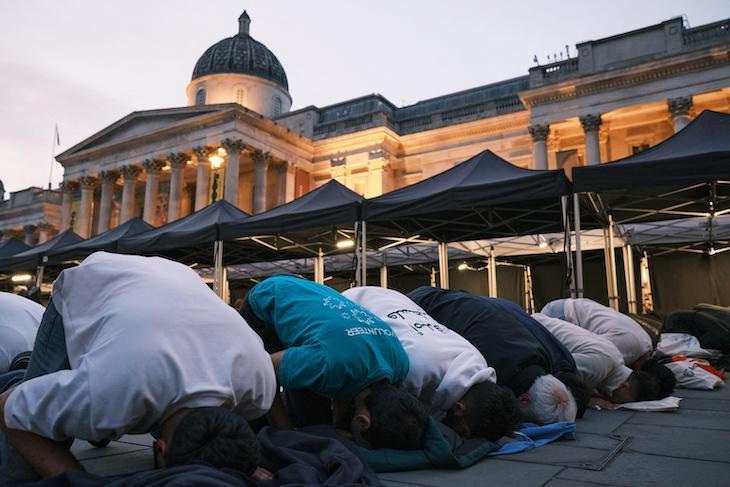
So many were concerned when a Ramadan event in Trafalgar Square saw not only the adhan – the call to Muslim prayer – but the synchronised ritual prayer of Muslim men beside the National Gallery and the old Anglican church, St Martin-in-the-Fields.
Some MPs and commentators say public concern is misplaced. Some have even called it racist or – to use the recent invention – “Islamophobic”. They claim this exhibition of faith is no different from Trafalgar Square hosting dancing Sikhs, drinking football fans, or an Easter Passion Play.
But this is wrong. First, the adhan makes the theological claim that there is no God but Allah and Mohammed is his messenger. That is, by definition, a repudiation of other beliefs. When proclaimed publicly, it is not just private devotion made visible; it is a declaration of dominance.
Some claim the adhan is no different from the peal of church bells, or the recital of the Nicene Creed in church. But this is wrong on three counts. First, church bells simply ring out, and do not assert any theological message or criticism of other faiths. Second, the Nicene Creed is a personal statement of faith that begins, “I believe”.
And third, even if these facts were not true, Christianity holds a different place to other religions in Britain. It is the foundation of our way of life, expressed in laws and norms and our institutional, intellectual and cultural inheritance. Expressions of Christianity here do not seek to challenge or replace anything, because our society rests upon the Christian idea.
The adhan, however, explicitly rejects the Christian belief in Jesus and the Holy Trinity, and asserts the truth of the Islamic faith. Indeed, historically the adhan was not only a communal call to prayer, but a declaration of Islamic control over a territory.
In a pluralistic society like ours, people are free to believe in the unique truth of Islam if they choose. They are free to proclaim it at home, in mosques, and in communities that gather for that purpose. But when such declarations are projected into shared civic spaces – including monuments of national history and identity such as Trafalgar Square – the line between freedom of religion and the imposition of religious rituals blurs.
And it is exactly this kind of gradual occupation of shared spaces that comes – as Ed Husain explained – straight from the Islamist playbook.
The Telegraph: continue reading
See Related Article Below
Feeling uncomfortable about Muslim prayer in Trafalgar Square isn’t racist
.
If you hear ‘allahu akbar!’ shouted in the street, you’ll probably run for cover. If a stranger bellows the Jewish equivalent, ‘Baruch hashem!’ in public, you might guess they’re expressing gratitude for their good health when asked how they are. If the words ringing out from the midst of a crowd are ‘Jesus Christ!’ You’ll probably think someone has stubbed their toe, or seen something ridiculous.
Islam is a proselytising religion, unlike, say, Judaism, which actively discourages conversion
Instinctive reactions matter because they expose deeper dispositions, often aligning with the very intention behind the action that provoked them. There is no true equivalence between the three phrases, even if they appear to cover similar ground across the Abrahamic traditions. Comparing our reactions to these religions, and to others, rarely proceeds on a straightforward like-for-like basis.
When Nick Timothy posted a critical comment on X about the recent public Muslim prayer in Trafalgar Square, which included the participation of London’s mayor Sadiq Khan, opinion split quickly. Many thanked him for articulating what they felt others were unwilling to say, while others responded with sharp criticism.
“Mass ritual prayer in public places is an act of domination,” the Conservative MP wrote. “The adhan – which declares there is no god but allah and Muhammad is his messenger – is, when called in a public place, a declaration of domination.” He went on to call the Trafalgar Square gathering “an act of domination and therefore division” noting the “domination of public places is straight from the Islamist playbook.”
Behind this debate lies the idea that Islam is a religion of dominance, which seeks to confer the rest of us into adherents. It’s a proselytising religion, unlike, say, Judaism, which actively discourages conversion and makes it difficult to achieve. The Islamic concept of Dawah, coupled with the regular manifestations of violent Jihad the UK and the West have had to become accustomed to over recent decades, is one reason why many people feel a genuine and legitimate sense of unease when they hear the same words terrorists shout as they slaughter us, echoing across our nation’s primary public square. It is unsettling.
Many felt equally uncomfortable seeing videos circulate of Islamic prayer echoing through Windsor Castle, and more recently through Westminster Hall in the Houses of Parliament. The very room thousands had shuffled through to pay their respect to her late Majesty Queen Elizabeth II and Winston Churchill, in the heart of our Parliamentary buildings, now appeared to some to have been ‘conquered’. Both venues carry the weight of being iconic, historical settings which represent different branches of power in our nation, as does Trafalgar Square. They represent power through royalty, parliament, and military victory.
Labour MP Naseem Shah – the Labour MP who was once suspended from the Labour Party for antisemitism for sharing posts online before she became an MP which suggested that Israel should be ‘relocated’ to the US (‘problem solved’) and warning that ‘the Jews are rallying’ to skew an online poll – responded by saying Timothy’s comments were ‘beyond awful’ because other faith groups regularly celebrate their religious festivals and holidays in Trafalgar Square, but Muslims were being ‘exceptionalised’.
[…]
Suppressing discussion of the fears surrounding this sensitive subject will only deepen, for some, the sense of being overridden or subordinated.
[…]
Islamic history links public congregational prayer and the adhan, the call to prayer, to shifts in political and civilisational dominance … With the move to Medina and the consolidation of power, this changed. Public prayer emerged as an open expression of authority and presence.
The Spectator: continue reading
Featured image: Reuters


Leave a Reply