
DR NICHOLAS TATE
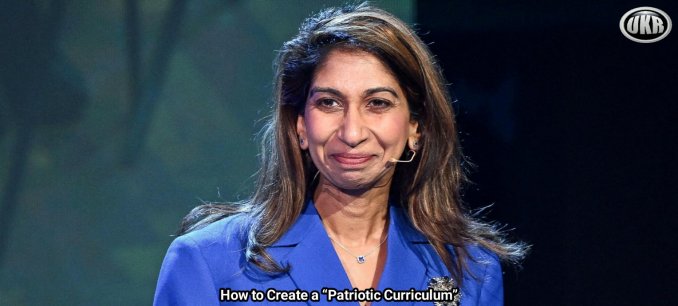
Suella Braverman, newly appointed Reform UK Shadow Education Secretary, recently announced her party’s aim for “a patriotic and balanced curriculum, which fosters a love of this great country”. A few days later Zia Yusuf, newly appointed Reform UK Shadow Home Secretary, introducing a proposal to prevent churches from being turned into places of worship for other religions, added that Reform’s curriculum would also “put Christianity at its heart”. I wish them well. The devil will be in the detail and in the clarity or otherwise of their aims. It will also be in trying to find a teaching force willing to implement such a plan. A 2008 Telegraph survey of 300 teachers found that three-quarters agreed with the statement that it was their responsibility to warn pupils not to feel good about their country. Given the attitudes revealed by the George Floyd hysteria of 2020 it is difficult to believe that these views are any less prevalent today or that we have a hope in hell of them getting any better for the rest of this Labour Government.
The roots of this oikophobia and its linked xenophilia – hatred of one’s own and love of ‘the other’ – go back a long way in this country. George Orwell, a socialist who was also a patriot, made his famous comment about English intellectuals who take “their cookery from Paris and their opinions from Moscow”, snigger at British institutions and are ashamed of their own country as long ago as 1941. Shaped by the ideological currents of postmodernism, ethical, cultural and epistemological relativism, globalism and postcolonialism, oikophobia has become ever more deeply embedded, especially in the worlds of education and the arts and in public bodies. Reform, if and when it comes to power, will have its work cut out in moving attitudes from where they currently are.
The huge irony of Reform’s demand for a “patriotic” and “Christian” curriculum is that we already have one. The 1988 Education Reform Act that established the national curriculum remains largely unchanged on the statute book and has excellent provision for what Reform has in mind. It was the product of a Conservative government headed by Margaret Thatcher who had appointed as secretary of state for education Kenneth Baker, a man she could trust to implement a national curriculum based on the transmission of past knowledge and values. This is a man who for years afterwards tried valiantly but ultimately unsuccessfully (the Blob triumphed once again) to get support for a new Museum of British History and whose heart was clearly in the right place for the project with which Thatcher had entrusted him.
What do we find in the 1988 Act?
First, in the list of “core and other foundation subjects” to be taught, unlike some other countries’ curricula (Scotland for example), we have a requirement for traditional identifiable disciplines, not the progressive inter-disciplinary ‘open borders’ mishmash into which Scotland’s laughably-named ‘Curriculum for Excellence’ has descended. Even Bridget Phillipson in her plans for a revised national curriculum to take effect from September 2028 is keeping this structure in place.
Second, the main requirements needed for the transmission of England’s cultural inheritance are already present in the current subject programmes of study. Most have been there from the beginning of the national curriculum, while some were watered down by Labour governments and reinstated by Michael Gove and Nick Gibb in the 2010s. They include: the chronological study of British history from ancient times to the 20th century; canonical authors in English literature, including at least two Shakespeare plays for 11-14 year olds; canonical artists and composers in art and music; the basic facts of the geography of the British Isles; and the civic knowledge needed by future UK citizens.
Third, the Act requires for all up to the age of 18 religious education (RE) that must reflect the fact that religious traditions in this country are “in the main Christian”.
Fourth, schools must provide an act of daily collective worship which should be “wholly or mainly of a broadly Christian character”.
This looks exactly what Braverman and Yusuf seem to be asking for. Thatcher and Baker’s original aims were similar to theirs. Why then do we hear that pupils are not learning about some of the major developments that have shaped modern Britain, like the Glorious Revolution of 1688 and the Reform Acts, are exposed to very little classical literature, music and art, and are grossly ignorant of anything to do with the Bible and the history of Christianity?
There are many reasons for this. One is schools’ blatant and un-rebuked disregard for statutory requirements. Parents may withdraw their children from RE lessons and 16-18 year olds withdraw themselves, but the subject must be offered. In practice, as Ofsted has reported, it is often dropped altogether from the timetable, especially in the later years. Daily collective worship also died many years ago in most schools. Ofsted reported in 2004 that 76% of secondary schools were failing in their duty to provide it, and has ceased to monitor it since. Where daily assemblies are still held they are often neither worship nor Christian.
These matters have been well-known for years but successive governments and Ofsted have never bothered to enforce the law. The mantra of Britain now being a multicultural society has been used as the cop-out clause for this blatant dereliction of duty.
When it comes to the 12 national curriculum subjects, if they are not assessed through national tests or GCSEs or part of the school’s work closely inspected by Ofsted, all schools have been given enormous flexibility. The Gove-Gibb history curriculum, for example, looks excellent on paper, but most of it is non-statutory and leaves teachers free to omit topics that most historians would feel to be essential.
It is this freedom – theoretically highly desirable and enabling teachers to teach to their strengths – that gives schools the space to slot into the curriculum all the additional topics associated with initiatives like Pride Month, Black History Month and Women’s History Month or to cut back on academic subjects to allow time for topics better left to parents like sexuality and relationship education, sustainability and climate education, being a School of Sanctuary or a UNICEF Rights Respecting School or whatever cause du jour outside agencies, activist teachers and their compliant head teachers have agreed to promote.
If Reform is to come into power and have any hope of achieving its aims it will have to do five things.
First, ensure the requirements of the 1988 Act for RE and collective worship are followed, backing this up with new official guidance, close monitoring and attention to this in all Ofsted school inspections.
Second, lay new Orders before Parliament to make key elements of the national curriculum subject programmes of study relating to cultural transmission statutory if currently non-statutory or, where Labour will have watered these down further (as planned for 2028), reinstate stronger versions and ensure through inspection and other means that the new requirements are met.
Third, identify schools that ministers and their advisers feel best exemplify the purposes of the curriculum which, in the words of the Act, are to foster “the spiritual, moral, cultural, mental and physical development of pupils and of society”, and what they feel these purposes mean, and then to publicise, honour and reward them as exemplars.
Fourth, radically review the arrangements for initial teacher education so that schools are not flooded with lots of young, lively teachers (that’s a good thing) some of whom have been encouraged to see schools as vehicles for the promotion of social justice (that’s a seriously bad thing).
Finally, Braverman and Yusuf will need to explain carefully what they mean by a “patriotic” curriculum. They rightly feel that it is good and moral to be patriotic. The 20th-century’s greatest moral philosopher, Alasdair MacIntyre, said as much, as did the ever-quotable George Orwell. The problem will be in convincing people that facilitating patriotism does not mean indoctrination. In criticising the way the Left uses the curriculum to promote its own causes – gender ideology, social justice, climate change – the Right needs to make sure it does not end up tarred with the same brush.
There is nothing indoctrinating in wishing young people to feel they belong to a nation, are citizens of a nation state and feel positively about this, or in governments and educators striving to facilitate this patriotism through the educational arrangements they put in place. The hyper-liberal idea that each human being is sovereign in deciding who or what they want to be is incompatible with a well-functioning collective, within which as John Gray has put it, we “can never be wholly self-defined”.
We cannot of course, and should not, force pupils to feel patriotic. We also must not present contested political issues to pupils in a partisan fashion or censor views thoughtfully expressed in discussion. But that does not mean that we should not encourage patriotism or be anything but concerned about its absence among both pupils and teachers.
Reform, above all, needs to be clear well in advance of Day One if it comes to power what it wishes to do with the school curriculum. Changing what happens in the classroom can take a long time, but need not take as long as it has done in the past if detailed planning has been done well in advance, elaborate and lengthy consultation exercises are avoided, and the mechanisms for monitoring and accountability are put firmly in place.
Dr Nicholas Tate was chief executive of the School Curriculum and Assessment Authority 1994-1997 and the Qualifications and Curriculum Authority 1997-2000. He is currently Adviser to the Learning Institute, Mathias Corvinus Collegium (MCC) in Hungary.
This article (How to Create a “Patriotic Curriculum”) was created and published by The Daily Sceptic and is republished here under “Fair Use” with attribution to the author Dr. Nicholas Tate


Leave a Reply