
DAVID BETZ AND MICHAEL RAINSBOROUGH
The Age of ‘Isation’ is upon us. It has become a reflex to describe Britain’s current condition through borrowed endings: Ulsterisation, Balkanisation, Brazilianisation, South Africanisation, and, on a bad day, Lebanonisation. They are clichés, obviously. We have used them ourselves, so we are not disparaging the practice. They persist, as clichés do, because they point at something true: the steady hardening of group identities, the waning of a shared public morality and the growing sense that politics is no longer a contest within a common settlement, but a low-grade series of factional struggles conducted through lawyers, broadcasters, charities, quangos and the occasional knock on the door from the police about something you posted online, possibly years ago.
These apocalyptic analogies describe the trajectory contemporary Britain is embarked upon, but the more current, intermediate analogy is less exotic. The country is becoming Sovietised. Not yet the theatrical version of portraits, meat queues and party congresses, but the more insinuating kind associated with late-stage Eastern Europe: a post-totalitarian system that, in theory, talks about democracy while narrowing the ground on which it can be exercised.
In the evolving Sovietised United Kingdom (SUK), speech is rarely banned outright. It is instead surrounded by regulations, legal codes, investigations, complaints procedures and professional consequences, so much so that many people conclude that saying less is the better option. The country still has elections, newspapers and a Parliament. That proves very little. So did the regimes in Eastern Europe. The question is what animates these regimes in the decaying years of their existence. Increasingly, it is a mix of managerial pressure, moral instruction and ritualised observance.
This is Sovietisation, British style: the spread of managed conformity through institutions that regard themselves, in the classic communistic formulation, as ‘progressive‘. Public debate continues, but under conditions shaped by informal sanction. Bureaucracies move from administering to instructing. Advancement within the system comes to depend less on alignment with reality than on alignment with ideology. The aim is no longer to persuade in the older democratic sense, where rival positions contend over facts and priorities, but to shape the ground in advance, so that some conclusions carry a cost before they are even voiced.
The Soviet Union pursued this same discipline of enforced conformity in a cruder idiom. Britain’s governing class has rendered that discipline in the language of compliance, state-licensed propaganda and censorship. These are the tools of putrefying systems, clinging on by managing appearances. They are also a confession: an effort to hold reality at bay for as long as possible.
Ofcommograd
Nothing shows this more clearly than the way dissent is treated, where the pretence of liberal innocence now looks most threadbare. Britain still likes to think of itself as the home of democracy – a “very proud” history of free speech, as Keir Starmer likes to say, though, one notes, with the hint of placing it firmly in the past.
In effect, the British state has assembled a sprawling apparatus for policing speech: the Public Order Act, the Communications Act, the Malicious Communications Act, the Online Safety Act. This lumbering pile of speech-adjacent law and regulation rests on terms that are intentionally elastic and often subjective: “grossly offensive”, “harm”, “distress”, “safety”, “hostility”. Their utility lies in precisely that elasticity: they license intervention without clear limits, bringing far more expression within reach of sanction than older, narrower standards would have permitted.
The epitome is the “non-crime hate incident” – a peculiarly Sovietesque construction: absurd enough to sound like satire, but ominous in practice. Its curtailment, now underway, arrives not as a repudiation so much as a belated correction, prompted by embarrassment and legal challenge rather than a change of instinct. The underlying logic remains instructive. No prosecution, no conviction, yet an official record all the same. The state does not need to arrest you if it can let you know that your views have been noted.
This is how the modern system works. It avoids the theatre of show trials and incarceration and relies instead on administrative friction. You may still speak but, along the way, you may acquire a record, a visit from the police, a mark against your name – enough to shadow a reputation or destroy a career, even for the most trivial of incidents. This is state-backed thought control by another name.
No single agency polices speech in the SUK. Ofcom regulates broadcasters and now extends its reach into the online sphere. Platforms are pressed to monitor and pre-empt. The police are still drawn into adjudicating speech and recording ‘incidents’ reported by somebody, somewhere as evidence of a hateful disposition. Government outfits such as the Counter Disinformation Unit and the Cabinet Office’s Rapid Response Unit keep an eye on non-compliant facts.
Universities, meanwhile, have formal duties to uphold freedom of expression, yet internal cultures that treat it as suspect when it strays from current orthodoxy. No decree announces any of this. It proceeds through guidance, obligation, social cues and the prospect of consequences, with each body doing its bit and no one quite responsible for the whole. The result is a kind of do-it-yourself thought policing across the public sector.
The outcome is that Britain has become a heavily speech-policed society. The Times reported that, on average, around 30 people a day are being arrested for online posts deemed ‘offensive’, a rate that places the UK well ahead of countries like China and Russia. One can argue over classifications and comparisons but the broader pattern is difficult to ignore: comedy writers detained at airports, journalists arrested, citizens disciplined for unguarded remarks about their employers, individuals visited at home over social media posts, sometimes years after the fact. It does not need to be mass repression. It is enough that it happens, often enough and visibly enough, to make the point.
Back in the HSSR (Human Sovietised Surveillance and Resources)
Sovietised systems express themselves in more than legal codes. They take root in institutions and speak through them in bland, compulsory language. The civil service, universities, public bodies, professional associations, large corporations and the swollen borderland between state and quasi-state now share a common grammar: diversity, equity and inclusion; codes of conduct; dignity policies; behavioural frameworks; mandatory or quasi-mandatory anti-racist training and ‘good practice guides‘; anonymous reporting channels; values statements; ‘lived experience‘ as a kind of secular revelation. A country once known for muddle and irreverence now produces moral instruction manuals with a discipline that regards dissent as a problem to be managed.
Taken together, these arrangements amount to a political anthropology. They train people to see disagreement as a conduct issue and the voicing of scepticism as a safeguarding concern or reputational risk. Under such conditions, orthodoxy does not need to argue with its opponents and justify its existence. It arrives pre-installed. To object is not to enter a debate. It is to trigger a process.
The Soviet Union embedded doctrine through the party. Britain embeds it through administration. That looks milder, but the function is the same. In some ways it is more insidious, precisely because the intended outcome is masked behind a veil of supposedly neutral bureaucratic practice. It lacks the bluntness of doctrine. A party functionary gives a speech and sounds like one. A human resources department issues guidance and sounds procedurally anodyne. That is how ideology now travels: disguised as process, enforced as routine.
All the news that fits the narrative
There was an old Soviet joke about the two main newspapers in the USSR. Pravda meant ‘truth’ and Izvestia meant ‘news’. The problem, people said, was that there was no news in the Truth and no truth in the News. Britain has found a way to achieve something similar, without the inconvenience of being explicit. This is where the Sovietisation of the media and cultural production manifests itself.
Superficially, the British media presents a convincing display of pluralism: an abundance of outlets, a blizzard of by-lines, argument everywhere, noise without end. On the questions that actually matter, however, the range of permissible opinion is narrow. Immigration is discussed inside predictable and approved moral frames. The limits are rarely written down because the parameters need only be implicit. Careers, reputations and access take care of enforcement.
While newspapers may not be waiting for the censor’s pencil, the result is not dissimilar: a consensus so tight that formal censorship is unnecessary. Self-censorship ensures that deviations are contained rather than allowed to spread. The occasional heretic, Peter Hitchens for example, is invited onto Question Time to demonstrate how admirably open the system remains. It is the theatre of disagreement, performed to sustain appearances but not to disrupt the official consensus.
What matters more is the way reality is recast within this framework. The totalitarian propaganda technique of inversion, turning truth into falsehood, victim into perpetrator, aggressor into defender, has become a notable feature of the SUK. The American journalist Walter Lippmann, who conducted some of the earliest studies on public opinion, described politics as operating within a “pseudo-environment”, a constructed picture of the world that shapes how events are understood before they are even examined. And as Lippman stated: “Where all think alike, no one thinks very much.”
Something close to that now sits behind much mainstream culture. One moves from something like Yes Minister in the 1980s, a satire that worked because it recognised how the British state actually operates, to contemporary productions such as the BBC’s latest midwit drama The Capture, where reality is rearranged to fit a preferred moral script. The villain is not based on a recognisable truth in modern Britain, say, Pakistani-gangs systematically raping school girls or government and police who cover up or even collude in such scandals, but the figure of an atomised white man whose trajectory runs from filing a Freedom of Information request to shooting a migrant child in the arms of her mother as she comes ashore on a dingy. The premise is preposterous, but it is also illuminating. It shows how little contact politicised narratives now require with anything recognisable as ordinary experience.
As this pattern takes hold, both media and cultural endeavours that once drew their force from identifying basic truths give way to productions that reorder truth and observable reality to suit the moral preferences of the regime. The tone grows more strident, the framing more insistent, the space for deviation expunged or reduced to absurd caricature. This is not creativity but its negation: truth tortured until it flatters power and embarrasses anyone still inclined to notice.
The Southport Public Inquiry’s Phase One report (April 2026) provides a clear example in the case of Axel Rudakubana. Already known to authorities for stockpiling weapons and consuming violent material, he was repeatedly processed through safeguarding frameworks to the extent that “professionals focused far too much on his vulnerability and far too little on the threat he might pose to others”.
Here, in its bureaucratic form, the logic of inversion recasts the predator as the patient, and the system moves from protecting the public to administering a set of approved responses. Events are presented through the categories of vulnerability, care and safeguarding. The obligation to confront danger gives way to maintaining the framework through which it is described, and when consequences arrive, they do so in terms the system has already trained itself not to recognise.
Thus, the old joke about Pravda and Izvestia begins to read less like a historical curiosity and more like a working description of how the modern media function in Britain. There is still plenty of news. The question is what happens to the truth.
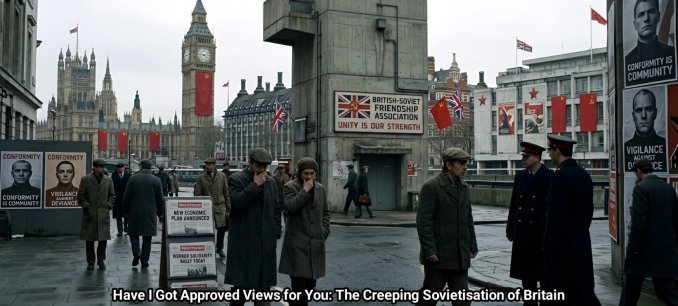
Have I Got Approved Views for You
The creative arts, along with advertising and public information commercials, also offer vivid signs of creeping Sovietisation. Increasingly in dramas and entertainment, from EastEnders to Britain Has(n’t Got Very Much) Talent, the moral temperature is regulated and embarrassingly obvious. Diversity is radiant. Borders are grubby. Tradition is faintly ridiculous unless rebranded as inclusive heritage. The white provincial male appears either as a joke, a fool or a latent security threat.
The ideological content is often so crass that one begins to feel nostalgic for a certain revolutionary chic in inherent in Soviet propaganda, with its Lenin busts and epic posters of cosmonauts.
The current state of mainstream British comedy is especially revealing, not least because it has ceased in any meaningful sense to be comic. A healthy comedy scene takes liberties with prevailing pieties and aims upwards at official narratives and elite pretensions. Contemporary British comedy performs obedience with a smirk, imitating the assumptions of the regime. Rather than disrupt, the joke must reassure that the correct moral furniture remains firmly in place.
The old Soviet term agitprop captures the process whereby entertainment is enlisted to push narratives and close down awkward lines of thought, a fusion of culture and instruction well documented in studies of early Bolshevik propaganda. Alongside it sits the familiar device of demonisation: opponents rendered as fools or moral degenerates so that disagreement can be dismissed rather than answered.
Have I Got News for You is a classic illustration of the genre. Concerns over illegal migration, for example, are caricatured as either opportunism or hysteria, with figures such as Nigel Farage reduced to a vehicle for ridicule rather than a chance to prod the incompetence or complicity of the authorities. The line is familiar: migrants as victims, sceptics as bigots. Once satire is house-trained, it stops being satire.
That is why comic energy has shifted elsewhere. The sharper jokes, the ruder insights, the insolent memes, the willingness to puncture cant and point at obvious absurdities now live outside the curated mainstream. You Tube influencers, dissident meme-makers, anonymous accounts, satirical video clips, outlaw podcasts, independent comics and digital guttersnipes have become a digital samizdat. That does not mean they are noble or wise. But that’s not the point. Good comedy is not about offering moral instruction. And it feels authentic precisely because it is not seeking permission from a funding body or a broadcaster’s diversity editor.
When the best jokes slip sideways into dissident channels, it means the institutional centre has become too insecure to laugh at itself. What it produces instead is not comedy but insufferable subservience to elite norms: an attempt to enforce a version of reality that dies on stage and plays only to those who already know they are supposed to clap, like Soviet audiences at Party congresses, applauding on cue after the General Secretary’s third hour of speaking.
Lanyard Speak
The same instinct carries over into language, where political systems reveal themselves most clearly in the words they insist upon. A great deal of modern Britain’s bureaucratised vocabulary is normatively sanctioned and institutionally reinforced. It thus arrives pre-moralised. “Inclusion”, “harm”, “distress”, “safety”, “allyship”, “misinformation”, “community cohesion” and a hundred similar expressions do not so much describe as assign moral standing. They allocate virtue and vice in advance, marking out who is to be protected, who is to be managed, who may speak plainly and who is expected to watch their step.
It is hardly coincidental that the modern doctrine of ‘hate’ speech possesses Soviet origins. Lenin justified the suppression of press freedom on the grounds that ideas were “more fatal than guns”. The Soviet Union would later seek to embed restrictions on speech within the emerging human rights framework of the late 1940s, ostensibly to guard against fascism but in practice to legitimise the curtailment of political dissent. As Chris Berg has observed, the push to criminalise ‘hate speech’ has never been intended as a shield for the vulnerable but rather as an instrument “to restrain democrats”.
The Soviet system did this more crudely, with the wooden certainties of Party language that announced the conclusion before the sentence had finished. Contemporary British usage achieves much the same effect in a more sanitised jargon. The word ‘harm’ was once tied to something physically tangible, but it now stretches to include offence, discomfort, even the unwelcome encounter with a contrary view.
Hence the spectacle of police recording “non-crime hate incidents”, universities investigating stray remarks for their supposedly harmful impact, and public bodies warning that display of the national flag of England crosses into something “unsafe”. Once ‘harm’ includes disagreement, the complaint is filed, the investigation begins and the speaker discovers that he or she is the offence. From that point on, disagreement is classed as harm, the speaker becomes the problem, the complaint acquires institutional backing and the complainant is placed beyond scrutiny.
Examples now appear in everyday settings. In one case, a mother was banned from her daughter’s school after voicing criticism of gender identity teaching. In an even more Soviet era parody, a toddler was accused of being transphobic and homophobic and suspended from his nursery.
In this way, doubt is recoded as harm, disagreement as misconduct. A child is marked out for ideological correction. A parent is morally sanctioned. What presents itself as safeguarding or inclusion functions, in practice, as a way of fixing the boundaries of acceptable thought while avoiding any direct argument about the substance of the claim.
Your deviation has been noted
All propaganda depends, in the end, on a correspondence between the message and people’s everyday experience. The founder of modern public relations, Edward Bernays, understood that persuasion worked by arranging associations rather than by issuing direct commands. To adapt the memorable line in The Usual Suspects, the cleverest trick modern Western governments pull is to imply that propaganda only happens in countries with military parades and lots of goose-stepping, never in sophisticated democracies with strategic communications teams, public-interest broadcasting, and certainly not Rainbow flags and Pride marches.
Propaganda fails, though, when old slogans continue to circulate yet more and more people notice the gap between official rhetoric and the world in front of them. The governing class continues to assert that “diversity is our greatest strength”, while citizens look instead at demographic dislocation, pressure on public services, ethnically patterned crime, mutual mistrust and the erosion of any serious ideal of national continuity. The sales pitch no longer matches the product.
When that happens, regimes invariably become more censorious and more propagandistic because they sense, correctly, that their legitimacy is fraying. Late Soviet history shows this. After the Prague Spring of 1968 the communist system grew meaner, more watchful and more dishonest because the old faith had leaked away. Arrests of dissidents, increased surveillance, the pathologising of heresy, the dead-eyed insistence that everyone should repeat what fewer and fewer believed: a system in which compulsion set the terms.
Britain is not the Soviet Union, but the same drift towards a psycho-state where dissenting thought is policed is clearly discernible. Hate speech laws, regulatory guidance and institutional codes do not need to abolish democratic debate in order to constrain it. They need only recast disagreement as a form of risk, until ordinary people decide that an awkward truth is no longer worth the knock at the door, the formal complaint or the latter day equivalent of a Stasi file.
Keep Calm and Carry on Collapsing
The Soviet Union collapsed long before the Berlin Wall fell and the hammer and sickle came down from the Kremlin. It ended when millions learned to mouth the words and despise them.
Britain need not become the Soviet Union to arrive at the same condition. Late-stage liberal-progressivism exhibits the same pathologies, borrowing heavily from the older communist convention of enforcing orthodoxy while insisting it is merely administering fairness. Like the Soviet Union, the British state can coerce repetition, but it cannot compel belief. Once its mantras and hypocrisies invite laughter and derision, authority begins to drain away.
A regime that polices speech, censors humour and organises its own applause has already shifted from persuasion to enforcement. This is the point at which the Soviet comparison stops being metaphor. The slogans are still recited, the rituals still performed, but the animating belief has gone, and what remains is a system sustained by pressure and fear. A system, in other words, already well advanced in its own disintegration.
David Betz is Professor of War in the Modern World at King’s College London. Michael Rainsborough is Professor of Strategic Theory and Director of the Centre for Future Defence and National Security, Canberra.
This article (Have I Got Approved Views for You: The Creeping Sovietisation of Britain) was created and published by The Daily Sceptic and is republished here under “Fair Use” with attribution to the author David Betz and Michael Rainsborough


Leave a Reply