
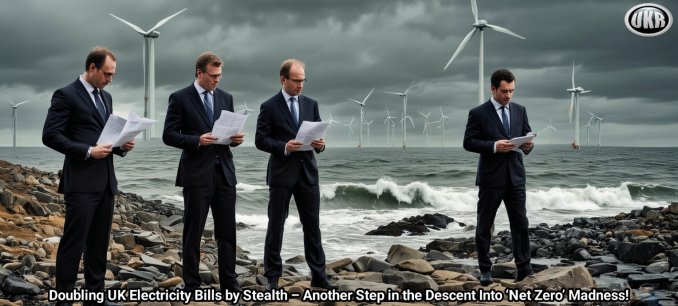
Doubling UK electricity bills by stealth – another step in the descent into ‘net zero’ madness!
a ‘black budget’ that bypasses accountability – stealing from the Crown Estate
PETER HALLIGAN
From here:
Leasing deal agreed for third huge floating offshore windfarm in the Celtic Sea
The claim:
“Once all three are operational, which will be in the mid 2030s, they will have combined capacity for 4.5 gigawatt of clean energy that would generate the electricity needs for more than four million homes and create more than 5,000 direct and supply chain jobs – creating a £1.5bn economic boost.”
In ten years’ time, 5,000 jobs!
‘A leasing agreement for a huge floating offshore windfarm in the Celtic Sea, which would straddle both English and Welsh waters, has been agreed. Ocean Winds, the 50-50 joint venture between Spanish firm EDPR Renewables and French venture ENGIE, has entered into an agreement with the Crown Estate for a 1.5 gigawatt project.’
No British companies involved just Spanish and French.
4 million homes consume around 1.4gigawatt of electricity a year – ‘The average UK household consumes approximately 3,449 kWh of electricity per year, according to the latest government data from December 2024.’
Which means that 3.1 gigawatts of capacity is NOT used because there is insufficient wind – let’s leave that aside for now.
“However, it is not clear how many supply jobs will be Wales and UK-based. All three operators will also be seeking contract for difference support, which will ensure energy produced will be commercially viable, from the UK Government. Turbines could be as high as the Shard building in London at 300 metres on floating platforms similar in size to a football pitch. They will be anchored to the seabed via huge chains.
Creating a huge eyesore and preventing the use of the seabed from any other use – like growing fish stocks and allowing the migration of birds for a huge volume of air space.
‘…seeking contract for difference support?’. Back to the indirect subsidies paid for in UK consumer bills.
“The costs of Contracts for Difference (CfD) support for offshore wind farms are ultimately paid by domestic and most business electricity customers in the UK, through their energy bills.
The Low Carbon Contracts Company (LCCC), a government-owned entity, administers the CfD scheme. It calculates payments based on the difference between the agreed strike price (the guaranteed price for electricity) and the market reference price (the actual wholesale electricity price). If the market price is below the strike price, the LCCC pays the developer the difference. If the market price is higher, the developer pays the difference back to the LCCC.
These payments are funded through a levy on energy suppliers, which is passed on to consumers.
Note the key statement ‘ These payments are funded through a levy on energy suppliers, which is passed on to consumers. – maybe 150 -200 per cent ‘.
How much In costs has been passed on to consumers so far. It could be 15-200 pr cent. No-one is keeping a tab.
The total budget for CfD payments is not a fixed cost but a cap on the amount the government is willing to pay in top-ups, which fluctuates based on market conditions and project performance.
For example, in the recent Allocation Round 7 (AR7), the government set a budget to support 8.4 GW of new offshore wind capacity, with strike prices around £91.20/MWh, funded through consumer bills. This mechanism ensures financial stability for developers while protecting consumers from extreme price volatility.”
What about the role of the Crown Estate? What the hell is it and who ‘bosses’ it?
From Brave AI;
“The Crown Estate is run by an independent board of Crown Estate Commissioners, appointed by the monarch on the advice of the prime minister. This board oversees the estate’s operations and is responsible for managing its vast portfolio of land, property, and marine assets on behalf of the Crown.
- The Chief Executive of The Crown Estate is Dan Labbad, who leads the organization’s day-to-day operations.
- The Commissioners are independent of both government and the monarchy, ensuring the estate is managed commercially and transparently.
- The estate is accountable to Parliament and must submit an annual report, with its profits remitted to the UK Treasury.
- While King Charles III is the official owner of the estate “in right of the Crown,” he does not personally manage or control it.
This structure ensures the estate operates as a public, commercial entity that generates income for the nation while supporting the monarchy through the Sovereign Grant.
Who is Dan Labbad;
‘Prior to joining The Crown Estate, Labbad held senior leadership roles at Lendlease, a global property and infrastructure group, where he served as Chief Executive Officer of Europe and International Operations from 2010 to 2018.
Under his leadership, The Crown Estate has advanced major regeneration projects, including a £24bn joint venture with Lendlease to deliver thousands of homes and jobs across London and Birmingham, and has expanded its role in the UK’s offshore wind sector.
Labbad is known for championing sustainability and long-term stewardship, having previously served as Chairman of the UK Green Building Council and CEO of The Hornery Institute, a not-for-profit focused on sustainable communities. He is also a Trustee of the Raspberry Pi Foundation and a Director of Ark Schools.
the Crown Estate may as well be owned and operated by the prime Muppet Keir Starmer, no doubt easily dominated and controlled by the ‘net zero’ minister ‘Mad Miliband – neither of whom could pass an ‘O’ level in economics for 16 year olds, let alone public finances.
how much money are we talking about.
‘The value of The Crown Estate’s portfolio was £15.0 billion as of the 2024/25 financial year, according to its latest annual report. This represents a decrease from £15.5 billion in the previous year, primarily due to a £1 billion reduction in the Marine portfolio valuation following the receipt of option fees from the Offshore Wind Leasing Round 4. Despite this, the Urban and Rural portfolios saw valuation increases, contributing to the overall resilience of the portfolio.
- London portfolio: Valued at £7.1 billion (up from £6.9 billion in 2023/24).
- Marine portfolio: Valued at £3.4 billion (down from £4.4 billion), reflecting the impact of Round 4 option fees.
- Windsor & Rural portfolio: Remained stable at £1.4 billion.
The portfolio continues to be managed with a focus on long-term value creation, including investments in renewable energy, urban regeneration, and environmental stewardship
‘ …a £1 billion reduction in the Marine portfolio valuation following the receipt of option fees from the Offshore Wind Leasing Round 4A.
Interesting – a one billion pound loss and not a squeak from the MSM.
‘Option fees are payments made by wind farm developers to secure the right to develop a project on a specific site, typically during the early stages of planning and feasibility.
How Option Fees Work
- Purpose: Developers pay an annual fee to reserve land or seabed rights (e.g., for onshore or offshore wind projects) for a set period—usually 5 to 10 years—to conduct studies, seek planning permission, secure grid connections, and raise financing.
- Legal Framework: These fees are part of an option agreement, which grants the developer exclusive rights to lease or purchase the land, but does not obligate them to proceed with construction.
- Payment Structure: The fee is paid annually during the option period. For offshore projects in the UK, developers bid for seabed rights in auctions, with fees ranging from £76/kW/year to £154/kW/year (as seen in Round 4).
- Outcome: If the project moves forward, the developer exercises the option and enters a long-term lease (e.g., 60 years offshore). If not, the developer walks away, and the landowner retains the option fee but loses the exclusive rights.
‘loses the exclusive rights – so who gets the ‘exclusive rights if the landowner loses them.
Key Impacts
- On Developers: Option fees increase the Levelised Cost of Energy (LCOE). For example, a £154/kW/year fee over 6 years can raise LCOE by £20/MWh.
- On Governments: In the UK, option fees go to The Crown Estate, which transfers 100% of the revenue to HM Treasury. These fees contributed to a record £1.1 billion in profits for The Crown Estate in 2024.
- On Landowners: Onshore, landowners typically receive £5,000 to £30,000 upfront, or $50–$200/acre/year, depending on negotiations and market conditions.
Risks and Considerations
- Uncertainty: Developers may not proceed even after paying fees, leaving landowners without a project.
- Market Competition: Multiple developers bidding can drive up fees and improve landowner returns.
- Hidden Pitfalls: Terms in option agreements may extend automatically or carry over into final leases, potentially locking in outdated or unfavorable conditions.
In summary, option fees are a critical financial tool that balances risk and reward between developers and landowners, while also generating significant public revenue—especially in offshore wind auctions.
A little more detail on that pesky device – the ‘cfd’;
‘Consumers indirectly pay for the costs associated with Contracts for Difference (CfDs) for wind farms through a statutory levy known as the CfD Supplier Obligation, which is passed on via their electricity bills.
Low Carbon Contracts Company (LCCC) manages the scheme and collects payments from licensed electricity suppliers based on their share of eligible demand. When the wholesale electricity market price is below the agreed strike price in a CfD contract, the LCCC pays the difference to the wind farm generator. Conversely, when the market price exceeds the strike price, the generator pays the difference back to the LCCC. These net payments (or receipts) are funded by the levy imposed on suppliers.
The CfD Levy is calculated daily based on:
- The volume of electricity supplied by each supplier,
- The difference between the strike price and the reference price (market price) for that day.
Suppliers then pass this cost onto consumers by including it in their energy tariffs.
While this creates a direct cost to consumers, the scheme also reduces overall wholesale electricity prices by increasing the supply of low-cost renewable energy. Analysis shows that, in the long term, the net effect of CfDs can lower consumer bills by reducing reliance on more expensive and volatile fossil fuel generation.
RENEWABLE ENERGY IS NOT low cost – it is HIGH COST if you properly account for all the associated costs and subsidies and back up generation systems required to run it.
All this is as clear as mud and deliberately so, as well. Confuse the punter so he cannot question the scam.
PLEASE take a (paid or unpaid) subscription or forward this article to those you think might be interested
You can also donate via Ko-fi – any amount from three dollars upwards. Ko-fi donations here:
https://ko-fi.com/peterhalligan
This article (Doubling UK electricity bills by stealth – another step in the descent into ‘net zero’ madness!) was created and published by Peter Halligan and is republished here under “Fair Use”


Leave a Reply