

HOTTENTOT
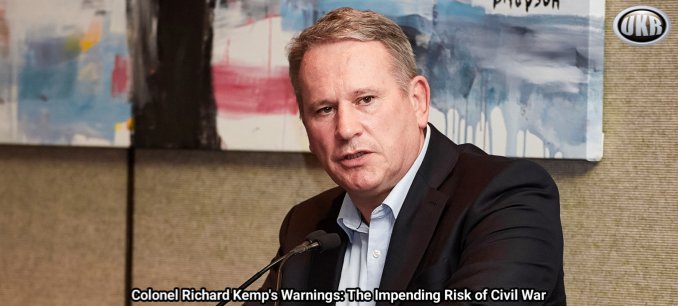
Retired Colonel Richard Kemp, a decorated former commander of British forces in Afghanistan with extensive experience in counter-insurgency and intelligence, has issued a dire warning about the future of social cohesion in Britain and Europe. In interviews with Israeli media outlets, including i24NEWS and JFeed, Kemp articulated concerns that unchecked immigration, the process of “Islamification,” and weak political leadership are propelling the region toward civil war.
He predicts not just unrest but a full-scale conflict, likening it to Northern Ireland’s Troubles but on a “much more intensive scale,” involving indigenous populations, immigrant groups, and governments as opposing factions. These statements, made in 2025 and reiterated into 2026, stem from his observations of demographic shifts, sectarian politics, and an alliance between hard-left activists and Islamist extremists. Far from alarmist rhetoric, Kemp’s views are substantiated by mounting evidence of societal fractures, rising extremism, and governmental inaction. This essay supports and amplifies his concerns, drawing on statistical data, historical parallels, and current events to underscore the urgency of addressing these threats before they culminate in irreversible conflict.
Kemp’s core argument revolves around the “Islamification” of Britain and Europe, a term he uses to describe the growing dominance of Islamic populations through unchecked immigration and cultural integration failures. He notes that over the past two decades, the situation has deteriorated, with more British Muslims fighting alongside the Taliban against UK forces in Afghanistan than serving in the British Army itself. This highlights a profound loyalty divide that undermines national cohesion. Supporting this, UK net migration statistics reveal a sustained influx: in the year ending June 2025, net migration stood at 204,000, driven primarily by 670,000 non-EU immigrants. While down from peaks in 2022-2023, this figure remains comparable to 2010s levels, with non-EU migration continuing to fuel demographic changes. The Muslim population in the UK has risen to 6.5 percent, up from 4.9 percent in 2011, with 84.5 percent under age 50—positioning Islam to shape Britain’s future more profoundly than current figures suggest. In Europe, similar trends are evident: the EU’s migration overhaul, set for 2026, includes expanded detention and deportations, yet irregular, read illegal, arrivals persist, with fatalities dropping but risks of exploitation rising. Kemp warns that without intervention, this “Islamification” will erode Western cultural and political existence, amplified by foreign funding from adversaries like Russia, China, and Iran, who exploit these divisions to weaken the West.
Amplifying Kemp’s concerns, the political landscape in the UK exemplifies how Islamist influence is infiltrating governance. In 2024-2025, Islamist candidates secured seats in high-migration areas on Gaza-focused platforms, signalling a rise in sectarian politics. By 2025-2026, this trend intensified: figures like Sadiq Khan (Mayor of London since 2016) and others in cities such as Brighton & Hove and Leeds represent a consolidation of power in Muslim-majority areas. Organizations linked to the Muslim Brotherhood, such as the Muslim Association of Britain and Muslim Council of Britain, have exerted significant influence over student groups, charities, and mosques, often opposing government anti-terrorism programs. A 2015 review commissioned by then-Prime Minister David Cameron confirmed Brotherhood affiliates’ support for Hamas and their role in shaping UK Muslim communities. Kemp describes this as a “Red-Green Alliance” between hard-left elements and Islamists, using issues like Gaza to rally support while pursuing anti-Western agendas. Evidence supports this: in 2025, Islamist media outlets like 5Pillars openly called for Israel’s delegitimisation, reflecting broader ideological penetration. Foreign investments from Qatar and others have bolstered these networks, turning them into launchpads for extremism, as Kemp observed in his Hungary interview.
Political cowardice exacerbates these issues, as Kemp asserts: “No government… has the guts to stop it.” Politicians, focused on short-term electoral gains, “kick the can down the road,” appeasing extremists to maintain equilibrium rather than enacting radical reforms. This resonates with Britain’s democratic dysfunction, where, as Kemp notes, “whatever party you vote for, you get the same policies” on immigration and Islamic dominance. The Labour government’s 2025 asylum reforms, including stricter visa rules and “one-in, one-out” deals with France, were hailed by right wing groups like Reform UK as insufficiently bold, yet they mainstreamed anti-immigration narratives. In Europe, similar appeasement is evident: EU leaders fortify borders when facing right wing pressure, but policies like off-shoring deportations fail to stem flows, increasing exploitation risks. Kemp’s claim of “no political solution” is bolstered by experts like Professor David Betz, who in 2025 predicted a 95 percent chance of civil war in the UK or France within five years due to immigration-driven ethnic divisions and elite overreach. This paralysis stems from fear: addressing Islamification means “big trouble,” as politicians prioritize votes over security.
Evidence of growing unrest validates Kemp’s predictions. Since March 2025, anti-immigration protests across the UK have escalated into violent disorder, targeting ‘asylum’ hotels and leading to over 180 arrests and 41 injured police officers. In cities like London, Manchester, and Falkirk, demonstrators chanted “send them home” fuelled by fear of migrant camps and associated violence. So-called hate crimes rose 2 percent to over 115,000 in England and Wales by March 2025, with anti-Muslim incidents, sometimes real and involving innocent Muslims, spiking amid Gaza-related tensions. In Europe, similar flashpoints: France’s right-wing gains pushed anti-immigrant policies, while Ireland and Austria rolled back Ukrainian refugee aid amid waning solidarity. Kemp’s warning that “people will feel they have no option but to take action into their own hands” is manifesting: protests in Epping and elsewhere cite safety concerns, like child sexual abuse allegations tied to migrants, eroding trust in institutions. Social media amplified these narratives, with “migrant invasion” posts garnering 1.4 billion views in 2025, up from 600 million in 2024.
Amplifying Kemp’s vision of civil war, historical parallels are stark. He draws from Northern Ireland, where British forces prevented escalation; without similar resolve today, a tripartite conflict—indigenous vs. immigrants vs. government—looms. Other commentators echo this: Rafe Heydel-Mankoo warns of sectarian war due to mass immigration and cultural erasure, predicting Muslims could reach 17 percent by 2051. In Syria’s civil war aftermath, Europe saw refugee crises; now, internal divisions mirror those fault lines. Armed conflict globally rose in 2025, with displacement at record levels, straining host societies. If unchecked, Kemp’s “civil war” could involve nuclear-armed Britain falling to fundamentalists, as warned by former Home Secretary Suella Braverman.
The consequences are existential: Kemp sees this alliance threatening the West’s cohesion, with enemies funding agitators to accelerate collapse. Poverty, inequality, and aid cuts exacerbate tensions, leaving refugees vulnerable and natives resentful. To avert this, bold leadership is essential—suspending high-risk visas, stripping citizenship from extremists, and dismantling networks, as urged in a 2025 parliamentary motion. Kemp insists solutions exist but require will; without it, his worrying prediction may prove prescient.
In conclusion, Colonel Kemp’s warnings are not hyperbole but a substantiated call to action. Evidence from migration stats, political infiltration, and unrest confirms the trajectory toward civil war. Britain and Europe must confront Islamification and immigration failures head-on, or risk the cultural and political oblivion Kemp foresees. The time for appeasement is over; decisive measures are imperative to preserve social cohesion and Western values.
This article (Colonel Richard Kemp’s Warnings: The Impending Risk of Civil War) was created and published by Free Speech Backlash and is republished here under “Fair Use” with attribution to the author Hottentot

••••
The Liberty Beacon Project is now expanding at a near exponential rate, and for this we are grateful and excited! But we must also be practical. For 7 years we have not asked for any donations, and have built this project with our own funds as we grew. We are now experiencing ever increasing growing pains due to the large number of websites and projects we represent. So we have just installed donation buttons on our websites and ask that you consider this when you visit them. Nothing is too small. We thank you for all your support and your considerations … (TLB)
••••
Comment Policy: As a privately owned web site, we reserve the right to remove comments that contain spam, advertising, vulgarity, threats of violence, racism, or personal/abusive attacks on other users. This also applies to trolling, the use of more than one alias, or just intentional mischief. Enforcement of this policy is at the discretion of this websites administrators. Repeat offenders may be blocked or permanently banned without prior warning.
••••
Disclaimer: TLB websites contain copyrighted material the use of which has not always been specifically authorized by the copyright owner. We are making such material available to our readers under the provisions of “fair use” in an effort to advance a better understanding of political, health, economic and social issues. The material on this site is distributed without profit to those who have expressed a prior interest in receiving it for research and educational purposes. If you wish to use copyrighted material for purposes other than “fair use” you must request permission from the copyright owner.
••••
Disclaimer: The information and opinions shared are for informational purposes only including, but not limited to, text, graphics, images and other material are not intended as medical advice or instruction. Nothing mentioned is intended to be a substitute for professional medical advice, diagnosis or treatment.
Disclaimer: The views and opinions expressed in this article are those of the author and do not necessarily reflect the official policy or position of The Liberty Beacon Project.


Leave a Reply