

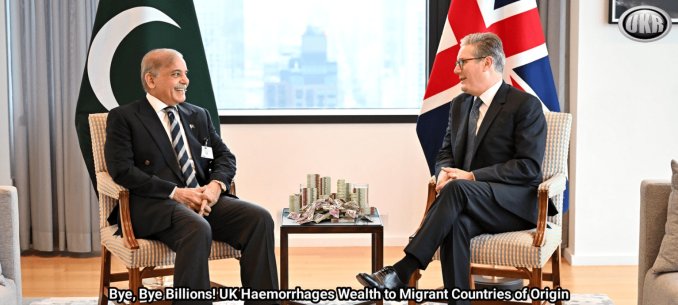
Bye, bye billions! UK haemorrhages wealth to migrant countries of origin
RUSSELL GOUS
IN SPITE of a sharp fall in net migration, new figures have revealed that more money than ever is being channelled in personal remittances from the UK to migrant countries of origin.
In 2025 alone, Pakistan received £4.24billion in remittances, narrowly surpassing India at £4.17billion. Combined, more than £8.4billion was sent to just these two countries, a figure that continues to rise year-on-year as established migrant communities maintain close financial ties back home.
Official figures showed net migration added 204,000 people to the UK population in the year ending June 2025 while a new report reveals that Pakistan has narrowly overtaken India as the UK’s largest remittance destination. Smaller overseas-born communities are also, in some cases, sending significantly large amounts per person.
The findings come from analysis by international money transfer comparison platform TopMoneyCompare, drawing on data from the World Bank, the Office for National Statistics (ONS) and the OECD.
The full report and methodology, Following the Money: The Biggest UK Remittance Corridors and Outliers, is available here.
Although net migration has dropped significantly, the UK still welcomed 898,000 new arrivals last year, the majority arriving on work and study visas. As these new residents settle and earn wages, they fuel a continuous flow of financial support to families overseas.
That is why TopMoneyCompare sought to find out who’s really benefiting from the UK’s remittance outflows.
The research revealed that despite India being the world’s largest remittance recipient globally, Pakistani migrants in the UK are more financially connected to their country of origin.
Kenya stands out as the most UK-dependent remittance destination, receiving around 27 per cent of its total inflows from the UK, a higher proportion than even Pakistan at 5 per cent.
When remittance flows are examined on a per-migrant basis, the picture looks very different. Bermuda tops the list, with an average of £26,609 sent per migrant in 2025. This makes sense given that it is a British Overseas Territory, with no income tax and a tiny UK-linked population base.
Belgium (£15,756) and France (£10,918) also received higher per capita amounts. This suggests that large remittance flows are not limited to developing economies.
In many cases, these transfers reflect property ownership, cross-border families, and wealth being managed across closely linked countries, rather than day-to-day financial support.
On the opposite end of the scale, Afghanistan (£120) and Iraq (£127) received lower amounts per capita, highlighting how lower incomes, stricter risk controls, and disrupted banking systems can suppress recorded transfers, even where humanitarian need is high.
In lower-income countries, money sent from the UK can make a much bigger difference. For Nigerian households, remittances from the UK averaged more than 12.2 times local GDP per capita. The impact is also clear in Pakistan and Yemen, where funds sent from the UK were 5.6 and 8.1 times higher than average local incomes respectively.
The analysis highlights a sharp contrast between private remittances and government support. In the West Bank and Gaza, just £1million in recorded remittances was sent from the UK in 2025, compared with £137.9million in UK government aid, reflecting the severe operational and compliance barriers affecting direct transfers.
It’s fair to conclude that the larger our overseas-born population, the more UK money is being sent abroad.
But these flows don’t just go to developing countries. A decent share of UK remittances is going to wealthier economies, driven by property ownership, cross-border families, and people managing finances across more than one country.
For some countries, these flows play a genuinely important role in household finances and local economies. In lower-income nations, money sent from the UK can be a meaningful share of everyday spending, from housing costs to education and healthcare.
Even with net migration falling, it is expected that remittance volumes will remain high, and potentially continue rising simply because the overseas-born population in the UK is large and well established.
This article (Bye, bye billions! UK haemorrhages wealth to migrant countries of origin) was created and published by Conservative Woman and is republished here under “Fair Use” with attribution to the author Russell Gous
Featured image: Alamy

••••
The Liberty Beacon Project is now expanding at a near exponential rate, and for this we are grateful and excited! But we must also be practical. For 7 years we have not asked for any donations, and have built this project with our own funds as we grew. We are now experiencing ever increasing growing pains due to the large number of websites and projects we represent. So we have just installed donation buttons on our websites and ask that you consider this when you visit them. Nothing is too small. We thank you for all your support and your considerations … (TLB)
••••
Comment Policy: As a privately owned web site, we reserve the right to remove comments that contain spam, advertising, vulgarity, threats of violence, racism, or personal/abusive attacks on other users. This also applies to trolling, the use of more than one alias, or just intentional mischief. Enforcement of this policy is at the discretion of this websites administrators. Repeat offenders may be blocked or permanently banned without prior warning.
••••
Disclaimer: TLB websites contain copyrighted material the use of which has not always been specifically authorized by the copyright owner. We are making such material available to our readers under the provisions of “fair use” in an effort to advance a better understanding of political, health, economic and social issues. The material on this site is distributed without profit to those who have expressed a prior interest in receiving it for research and educational purposes. If you wish to use copyrighted material for purposes other than “fair use” you must request permission from the copyright owner.
••••
Disclaimer: The information and opinions shared are for informational purposes only including, but not limited to, text, graphics, images and other material are not intended as medical advice or instruction. Nothing mentioned is intended to be a substitute for professional medical advice, diagnosis or treatment.
Disclaimer: The views and opinions expressed in this article are those of the author and do not necessarily reflect the official policy or position of The Liberty Beacon Project.


Leave a Reply