
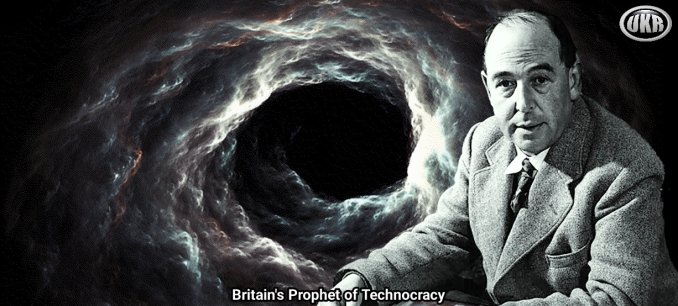
The jaw-dropping prescience of C S Lewis’ science fiction
ALEX KLAUSHOFER
English literature is remarkably rich in dystopian fiction. It’s so deeply embedded in our culture you might think it would give us immunity against dystopian reality.
I read Animal Farm at school when I was about 13, shortly followed by Brave New World and Nineteen Eighty-Four. Decades on, teenagers still study these texts at GCSE and A level and The Hunger Games has been added to the canon of dystopian fiction. And then, as humanity experimented with a global lockdown, a little known novella by E M Forster shot to prominence. The description of humanity confined and isolated, communicating via a centralised network in The Machine Stops had suddenly become reality.
Each of these works of dystopian fiction focuses on different aspects of what can go wrong when Power abuses Modernity: exploitation and domination, surveillance and control, all wrapped up in a wider process of dehumanisation. Together, they provide a graphic illustration of what humanity could become if certain trends and tendencies are allowed to develop to their fullest expression. The novels are a kind of national resource, a thought experiment that should save us the trouble of learning the hard way.
And yet.
I’ll come back to this curious blend of knowing and not-knowing in contemporary Britain later. This month’s essay is about the science fiction novels that make up The Space Trilogy by C S Lewis and takes a different perspective from the conventional Christian interpretation the Narnia author’s work usually attracts. The novels explore where the adventure of life on earth could go next, acting as a lens for threats and choices we are only beginning to understand. With their clear-sighted exploration of transhumanism and extraordinary level of detail about the technocracy being built around us, they have a prescience that is jaw-dropping. And for those of us worried about Britain, the final work in the trilogy, with its quintessentially English people and setting, is the dystopian novel of our times.
***
Published in 1945, That Hideous Strength chronicles the attempt by a cabal to transform the human race into an inorganic species under the rule of a single, immortal leader. “A large, unintelligent population is now becoming a deadweight,” explains Professor Augustus Frost. “The effect of modern war is to eliminate retrogressive types while sparing the technocracy and increasing its hold on public affairs … Only a tenth part of it will now be needed to support the brain. The human race is to become all Technocracy.”
The takeover begins in the heart of England when the National Institute of Coordinated Experiments, an organisation with a vague mission of promoting science and social purpose, establishes itself in the university town of Edgestow. Stealth and deception are key to a strategy which proceeds by capturing institutions and recruiting useful individuals. The Progressive Element of the college – think Oxford, where Lewis taught for many years – makes for easy pickings. The fellows nod through the sale of some land to NICE and junior fellow Mark Studdock, a “sociologist who can write”, is hired to write propaganda.
Mark’s work takes the form of reports and articles with an initial target readership of MPs on parliamentary committees. Carefully-placed opinion pieces in newspapers use the age-old tactic of divide and rule because, NICE police force head Miss Hardcastle tells him, it’s “absolutely essential to keep a fierce Left and a fierce Right, both on their toes and each terrified of the other. That’s how we get things done. Of course we’re non-political. The real power always is.”
When Mark suggests that educated people can’t be manipulated that easily, she quickly puts him straight:
“Why you fool, it’s the educated reader who CAN be gulled. All our difficulty comes with the others. When did you meet a workman who believes the papers? He takes it for granted that they’re all propaganda and skips the leading articles. He buys his paper for the football results and the little paragraphs about girls falling out of windows and corpses found in Mayfair flats. He is our problem. We have to recondition him. But the educated public, the people who read the high-brow weeklies, don’t need reconditioning. They’re all right already. They’ll believe anything.”
Propaganda will only be needed in the early stages until NICE have the power to impose their will through force: “Once the thing gets going we shan’t have to bother about the great heart of the British public,” explains Lord Feverstone, a NICE high-up who also works for the government.
And sure enough, life in Edgestow soon becomes unrecognisable. Local people are turned out of their houses which are then demolished. Trees are cut down and work is begun to divert the river central to its character. The nearby village of Cure Hardy is to be turned into a planned community, its agriculture and architecture abolished. Prices shoot up and a new population of imported workmen dominates life in the town. A heavy fog blankets the whole area.
With the local population confused and frightened, NICE engineers some riots. “You’ll never get the powers we want at Edgestow until the Government declares a state of emergency there,” Feverstone explains. Mark produces articles which argue that strong measures are needed to save democracy. With the laws of England largely suspended, the town is governed by an Emergency Commissioner (Feverstone) and NICE’s private police force.
In a classic example of containment, only a few senior figures are privy to the real aims of a programme which began with the First World War and aspires to global control. As the novel proceeds, the full agenda is gradually revealed through a series of conversations.
The replacement of the natural with the synthetic is central. “There’s far too much life of every kind about, animal and vegetable. We haven’t really cleared the place yet,” says Feverstone. Undesirable humans are to be sterilised or eliminated and a programme of selective breeding introduced. Then the “real education” of the remaining population will begin: psychological at first, it will ultimately involve biochemical conditioning and the manipulation of the brain.
Later, with Mark fully entrapped, NICE physiologist Professor Filostrato describes how human evolution requires the abolition of organic life:“In us organic life has produced Mind. It has done its work … We must get rid of it.” Little by little, natural food – “dead brutes and weeds” – will be replaced with chemical substances and the physical human will be reduced to a brain. For the real purpose of NICE is to bring about “the conquest of death or the conquest of organic life”, creating “the New Man, the man who will not die, the artificial man, free from nature”.
Mark is taken into the inner sanctum to meet The Head which, the transhumanists believe, is the first of these New Men. The severed head of a criminal called Alcasan, hooked up to support system by pipes and tubes, is being kept alive by blood transfusions and other artificial means.
In the Preface, Lewis describes That Hideous Strength as a “tall story about devilry, though it has behind it a serious “point” which I have tried to make in my Abolition of Man.” Those lectures, written around the same time, elaborate on the importance of dominating nature to the transhumanist project. Lewis draws on insights he would later dramatise in the Narnia novels: humans are a part of nature, a species defined by their place on earth and relationships to its flora and fauna. (The word “human” derives from roots meaning “earthling”.)
“Human nature will be the last part of Nature to surrender to Man. The battle will then be won,” he warns. While there have long been humans wanting to dominate others, modern science opens up undreamed-of possibilities: “the man-moulders of the new age will be armed with the powers of the omnicompetent state and an irresistible scientific technique: we shall at last get a race of conditioners who really can cut out all posterity in what shape they please”.
Democracy is no protection against such dastardly plans, and modern science is actively helpful. “The process which, if not checked, will abolish Man, goes on apace among Communists and Democrats no less than among Fascists,” he continues, and “many a mild-eyed scientist” will be willing to play their part.

Fast forward to twenty-first century Britain and the similarity between events in Lewis’ fantasy worlds and current developments is striking.
Agricultural land is being covered with photovoltaic panels as solar “farms” take precedence over growing food. The boy in the above picture on the Tony Blair Institute for Global Change is presumably staring in admiration at the panels which cover the grass. It is a vision, if the TBI gets his way, of his future.
The same alliance of political and commercial interests aims to transform our food systems. From plans to replace meat with bio-engineered proteins to Sainsbury’s dream of injecting us with their breakfast product, the emphasis is on the artificial.
The aspiration to conquer nature is taking very real form in the use of weather modification technologies. The UK is at the heart of experiments that began over a century ago with the first patents and geoengineering is now a multi-billion pound business. The British taxpayer currently funds two programmes in dimming the sun which those in charge hope will be “scaled up and implemented” within the next decade.
Public discourse is overtly technocratic, with politicians, think tanks and powerful institutions discussing fundamental issues as if they were simply a question of manipulating the material world to find the right “solutions”. Many of their ideas form the justification for new restrictions and taxes.
“Managing” the population is key. A multi-billion plan to transform the National Health Service focuses, not on primary care or dentistry, but on new technology. Patients’ health data is to be transmitted by wearable gadgets to health authorities who will use AI to prescribe preventative treatments such as novel vaccines.
Mass surveillance is expanding rapidly. In the wake of the Southport riots, the government announced a national rollout of facial recognition; it now wants the police to use new biometric technologies to predict criminal behaviour from expressions and body language. Facial recognition is increasingly being used in shops and supermarkets such as Sainsbury’s.
Despite the apparent climbdown about a mandatory system, plans to introduce digital ID go on. The government’s digital identity platform OneLogin requires facial biometrics, backing up Silkie Carlo’s statement to a parliamentary committee that digital ID will be linked into a national surveillance system. The recent announcement of a likely ban on social media for the under-16s is one way adults will be pushed into submitting personal data for online access.
Amid ongoing rumblings about the collapse of fiat, Central Bank Digital Currencies loom as a distant threat. (In That Hideous Strength Mark is told that NICE will “take over the whole currency question” because they are the ones who run the financial system.)
I won’t mention the immigrants.
It’s almost as if Lewis had foreknowledge of the technocratic project we see unfolding around us. James Delingpole thinks Lewis was a wrong ‘un, possessed of an insider’s knowledge as a member of the cabal.
I don’t believe that’s so for two, connected reasons. The first is that Lewis’ plots consistently end with the triumph of Good over Evil – not a narrative you create if you’re on the other side. The second is more esoteric: his descriptions of otherworldly beings and altered states are far more suggestive of personal experience than pure imagination.

Before my exposure to dystopian fiction as a teenager, like many English-speaking children, I was steeped in the Narnia books. All seven of them. The main message – I didn’t realise there was a “Christian teaching” until much later – was that we live in a magical world where humans, animals and trees embody the same divine spirit or life force. Narnia existed in my own life: the family cat, a haughty ginger Tom, was Aslan, and the giant cedar outside my bedroom window an avuncular guardian. The powerful force for good of which they – we, since it includes humans – were manifestations could be suppressed for a time but never forever.
In the Britain of That Hideous Strength, the figures who are the countervailing force to the technocrats’ machinations have a recognisable kinship with both the characters of Narnia and Arthurian lore. Jane, the female protagonist and wife of Mark, takes a very different path from her husband. She begins the story as a conventional English woman of her time: narrow-minded and somewhat uptight. But, left alone while Mark pursues his new career with NICE, she is subject to disturbing dreams which lead her to seek help from a mysterious community on a hilltop village. The group immediately recognises her as the “seer” they have been waiting for, someone able to provide vital intelligence about what the technocrats are up to.
The Resistance (my term) is led by Mr Fisher-King, a man possessed of wisdom and authority beyond his youthful appearance. Blond haired and golden-bearded, he is later revealed as the Pendragon of Logres, come to save Britain in its time of need. At first, Jane is reluctant is to join the group, but meeting its leader – a “bright solar blend of king and lover and magician” – banishes all her doubts. In an epiphany which “unmakes her world”, Jane drops the social values and scientific materialism that have made her unhappy and comes into her own.
By contrast, even when confronted with the truth about NICE and offered “a place on the right side”, Mark is unable to make a clear choice. Lewis captures the moral confusion of a weak character perfectly: his mind was “one fluid confusion of wounded vanity and jostling fears and shames” and “he wanted to be perfectly safe and yet also very nonchalant and daring”.
Mark’s lack of self made him vulnerable to predation from the outset: as a student he’d been “a man of straw”, a glib writer who had done well on Essays and General Papers. His transition from academic fellow to NICE insider involved no moment of decision: lured by money and career prospects, he grew to enjoy the role of propagandist while fear, as he was threatened and blackmailed, made him subservient and pliable.
By now, some strong parallels with how differently people have responded to the challenges of our times may well be occurring. So it’s important to make clear that despite the black-and-whiteness of the above account, Jane and Mark’s journeys are not completely separate. At the end of the novel they are still married, each capable of further growth.

To get a full understanding of the spiritual war playing out in That Hideous Strength, we need to enter the cosmological world of the first two novels of the trilogy.
Out of the Silent Planet describes the abduction of a Cambridge don called Elwin Ransom to Malacandra (Mars) by renowned physicist Dr Weston and businessman Dick Devine. The former wants to colonise the planet should the earth become uninhabitable for humans; the latter is after its gold. With their worldview distorted by their own dark agenda, the pair believe a human sacrifice to the indigenous savages is necessary. In fact, Malacandra is inhabited by three intelligent species who live in harmonious coexistence, one of whom hosts Ransom after he escapes his captors. In a meeting with the planet’s spiritual ruler, Ransom learns that earth is in the grip of Dark Lord known as The Bent One. Having become separated from the rest of the cosmos, it “alone is outside the heaven”.
The knowledge makes Ransom the ideal human to be sent on a mission to save Perelandra (Venus) from attack by this same dark force. Perelandra is a paradise planet, peopled only by an archetypal feminine spirit in the form of a green humanoid. The Lady is destined to enter into union with the King and found a new, spiritually evolved race, but for now, she is too “young”. The challenge for this new species is to gain knowledge of evil without being corrupted by it.
This destiny is imperilled by the arrival of Weston who now fully embodies an evil consciousness: “Weston’s body, travelling in a space ship, had been the bridge by which something else had invaded Perelandra – whether that supreme and original evil whom in Mars they call The Bent One, or one of his lesser followers, made no difference.” Weston has become Un-man: an automated psychopath who can talk fluently and persuasively when he needs to, reverting to his real interests of torturing and killing animals in his spare time. Unlike Ransom and The Lady, he needs no sleep.
Un-man sets about corrupting The Lady through manipulative conversations. The combination of her state – the knowledge she needs to become less “young” while lacking any conception of evil – makes her vulnerable. She listens to the Un-man’s stories of triumphant victims and tragic queens with polite curiosity. In fact, they teach the human emotions of vanity and fear. Meanwhile Ransom deploys the typically English tactics of attempting to reason with his enemy and doing nothing in the hope he will stop. But when it becomes clear The Lady will succumb and Perelandra will fall, Ransom realises he must confront evil head-on and kill the Un-man.
It’s a fight to the death in both physical and psychological terms which takes more of Ransom’s agency and courage than he knew he possessed. But in the end The Lady and her King mount their throne, having learnt about the nature of evil without “committing sin firsthand”.
This ending heralds the beginning of a new spiritual battle elsewhere in the cosmos. The King forewarns Ransom that they will both play a part in removing the shadow of darkness from Thulcandra: earth’s false start must be wiped out so “that the world may then begin”. One thing puzzles him: “But can it be, Friend, that no rumour of all this is heard in Thulcandra? Do your people think that their Dark Lord will hold his prey for ever?”
“‘Most of them,’ said Ransom, have ceased to think of such things at all. Some of us still have the knowledge: but I did not at once see what you were talking of, because what you call the beginning we are accustomed to call the Last Things.”
The Arthurian figure of That Hideous Strength, in case you haven’t guessed, is Ransom, transmuted into an avatar by his interplanetary adventures. His final mission will be to lead the earth out of darkness. In this he can call only on fallible humans and the dormant spirit of Britain while, ostensibly, the other side has most of the power and resources.

So here we are, at precisely that point in The Matter of Britain.
This brings us back to the question I hinted at the beginning: what is the point of all this dystopian fiction if it hasn’t helped us to avoid these obviously dystopian times? “Nineteen Eighty-Four is ‘not a manual’” has become a mantra, expressing frustration at the fact we clearly have a collective understanding of what’s at stake while lacking the ability to deal with threats to our humanity swiftly and effectively.
Why aren’t we better at making choices?
During my own time on earth, I’ve noticed that the indigenous humanoids aren’t exactly quick on the uptake. Some of us bear more than a passing resemblance to The Lady, possessed of an innocence that can make us prey, while others have internalised some of the inhumane qualities of the Un-man.
Yet I still have faith that our legacy of dystopian literature has prepared us for these times. The clarity of its vision at least brings us seeing, and its details give us the tools to voice our unease and articulate our objections. As with Ransom, the rest comes down to agency and courage.
This article (Britain’s Prophet of Technocracy) was created and published by Alex Klaushofer and is republished here under “Fair Use”

••••
The Liberty Beacon Project is now expanding at a near exponential rate, and for this we are grateful and excited! But we must also be practical. For 7 years we have not asked for any donations, and have built this project with our own funds as we grew. We are now experiencing ever increasing growing pains due to the large number of websites and projects we represent. So we have just installed donation buttons on our websites and ask that you consider this when you visit them. Nothing is too small. We thank you for all your support and your considerations … (TLB)
••••
Comment Policy: As a privately owned web site, we reserve the right to remove comments that contain spam, advertising, vulgarity, threats of violence, racism, or personal/abusive attacks on other users. This also applies to trolling, the use of more than one alias, or just intentional mischief. Enforcement of this policy is at the discretion of this websites administrators. Repeat offenders may be blocked or permanently banned without prior warning.
••••
Disclaimer: TLB websites contain copyrighted material the use of which has not always been specifically authorized by the copyright owner. We are making such material available to our readers under the provisions of “fair use” in an effort to advance a better understanding of political, health, economic and social issues. The material on this site is distributed without profit to those who have expressed a prior interest in receiving it for research and educational purposes. If you wish to use copyrighted material for purposes other than “fair use” you must request permission from the copyright owner.
••••
Disclaimer: The information and opinions shared are for informational purposes only including, but not limited to, text, graphics, images and other material are not intended as medical advice or instruction. Nothing mentioned is intended to be a substitute for professional medical advice, diagnosis or treatment.
Disclaimer: The views and opinions expressed in this article are those of the author and do not necessarily reflect the official policy or position of The Liberty Beacon Project.


Leave a Reply