

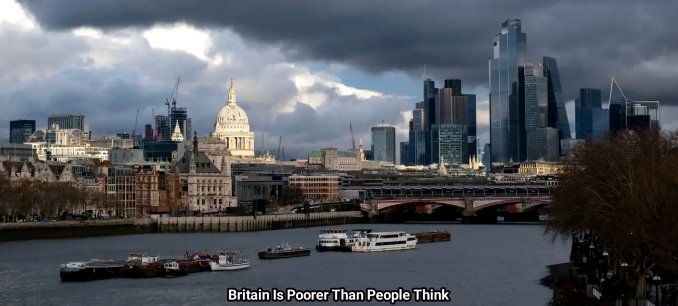
Britain is poorer than people think
MATTHEW LESH
Not too long ago Keir Starmer was banging on about how growth is his ‘number one mission’. Now, with the economy once again faltering – real GDP grew by an anaemic 0.1% in the last quarter of 2025, following an equally disappointing 0.1% in the previous quarter – we are hearing a bit less on this topic.
But have no doubt: the British public still dreams of a more prosperous society.
An expansive new public opinion research project, published by the Institute of Economic Affairs and undertaken by Freshwater Strategy, highlights that despite widespread pessimism, few have given up. When asked whether the UK should focus more on growth, an overwhelming 87% agree, compared to just 9% who say the country is already wealthy enough. This view cuts across the usual political divides, with strong support across genders, age groups, educational levels and regions. We may have a more divided politics than at any time in modern history, but there’s at least one thing pretty much everyone agrees on: growth.
This is a real slap in the face for the degrowthers – the popular idea among some academics in the 2010s that wealthy countries had already achieved enough material prosperity and should instead focus on alternative social and environmental goals. In fact, with a sense that the country is going downhill and pay has failed to keep up with prices, most people’s foremost priority is a higher standard of living. Suffice it to say, even Karl Marx would shed a joyful tear at how much materialist concerns weigh on the British public.
That’s not to say the picture is entirely hospitable for those who advocate for pro-growth measures. Despite the sentiment, there is far from a deep understanding of what growth means, why the economy has slowed or how to get us out of the current predicament.
When asked what caused the low-growth predicament and how to solve it, there appeared to be significant confusion. People were simultaneously willing to accept market-based explanations like high energy costs (85%), high taxes (75%) and red tape (74%), as well as state-centric explanations like lack of public investment (77%) and companies prioritising profit over investment (73%). In focus groups, the confusion came across even more deeply, with few able to say what drives growth and most focusing on the state rather than the role of private enterprise.
There’s also an underlying concern about fairness – or more precisely, whether growth will actually have a meaningful positive impact on their lives. Large majorities believe that government (81%), large corporations (81%) and high-income earners (74%) gain most from growth, while only around half say they (52%) or their family (55%) would benefit to a significant degree.
After many years of false promises from politicians, there is an underlying scepticism. In focus groups in particular, we found that many just didn’t know what growth means and feel caught in the middle, forgotten. Demonstrating that not only is growth possible (with the right choices) but also that it is worthwhile making some sacrifices to get there, will be politically possible only if people truly feel that growth is personally beneficial.
This all leaves pro-market reformers in a bit of a pickle. But this shouldn’t be seen as insurmountable. There is plenty of public sympathy for cutting taxes and red tape. If anything, this all reflects a ‘kitchen sink’ mentality: wanting to throw everything at the problem. If a policy is said to deliver growth, whether through planning reform or by abandoning net zero, most are supportive.
Interestingly, the biggest motivator for change was not just the realisation that Britain isn’t performing at its best. Most people already understood that. What is much less appreciated is just how far the UK is falling internationally.
A majority of Brits wrongly believe that the average person in the UK is as rich, or richer, than those in Switzerland, the United States, Singapore, Germany, Australia and much of Western Europe. In reality, the average Briton is significantly poorer than the average person in all of these countries. According to IMF projections, the UK’s GDP per capita of around $57,000 places it well behind Switzerland ($118,000), Singapore ($99,000), the United States ($93,000), Australia ($69,000) and Germany ($64,000). The UK ranks 21st globally, behind not just these major economies, but also the Netherlands, Denmark, Sweden, Austria and Belgium.
Even more damning is the comparison to the United States on a state-by-state basis. When asked where the UK ranks among US states, the average ranking is 7th, somewhere near the top. In fact, on a per-person income basis, the UK comes dead last – even behind the likes of Mississippi.
When people find out just how far the UK has fallen, the reaction is shock, frustration and anger. This gap between perception and reality creates a ‘burning platform’ for reform. ‘It’s kind of shocking to think actually we’re quite [a lot] lower down than expected,’ said one younger female voter. ‘It suggests that there needs to be change in the UK because we can’t be fifty-first, there’s no way,’ said a man.
For those willing to make the case for pro-growth reform – particularly when linked to material personal benefits like greater financial freedom, higher living standards, and more affordable homes – the ground is fertile. The public doesn’t need to be convinced that something is wrong, that growth is important or even that taxes and bureaucracy are an impediment. What they need is to be shown just how far Britain has fallen, and offered a credible path back up.
‘Attitudes to Economic Growth’ is published by the IEA.
*
Click here to subscribe to our daily briefing – the best pieces from CapX and across the web.
CapX depends on the generosity of its readers. If you value what we do, please consider making a donation.
This article (Britain is poorer than people think) was created and published by CapX and is republished here under “Fair Use” with attribution to the author Matthew Lesh
Featured image: CapX

••••
The Liberty Beacon Project is now expanding at a near exponential rate, and for this we are grateful and excited! But we must also be practical. For 7 years we have not asked for any donations, and have built this project with our own funds as we grew. We are now experiencing ever increasing growing pains due to the large number of websites and projects we represent. So we have just installed donation buttons on our websites and ask that you consider this when you visit them. Nothing is too small. We thank you for all your support and your considerations … (TLB)
••••
Comment Policy: As a privately owned web site, we reserve the right to remove comments that contain spam, advertising, vulgarity, threats of violence, racism, or personal/abusive attacks on other users. This also applies to trolling, the use of more than one alias, or just intentional mischief. Enforcement of this policy is at the discretion of this websites administrators. Repeat offenders may be blocked or permanently banned without prior warning.
••••
Disclaimer: TLB websites contain copyrighted material the use of which has not always been specifically authorized by the copyright owner. We are making such material available to our readers under the provisions of “fair use” in an effort to advance a better understanding of political, health, economic and social issues. The material on this site is distributed without profit to those who have expressed a prior interest in receiving it for research and educational purposes. If you wish to use copyrighted material for purposes other than “fair use” you must request permission from the copyright owner.
••••
Disclaimer: The information and opinions shared are for informational purposes only including, but not limited to, text, graphics, images and other material are not intended as medical advice or instruction. Nothing mentioned is intended to be a substitute for professional medical advice, diagnosis or treatment.
Disclaimer: The views and opinions expressed in this article are those of the author and do not necessarily reflect the official policy or position of The Liberty Beacon Project.


Leave a Reply