


Politics: for want of a plan
RICHARD NORTH
It is more than a little ironic that Tony Blair should pop up at this particular juncture to announce that the Starmer regime’s principal problem isn’t its leader’s personality, or a failure to communicate “our achievements”, or a need to assert more strongly Labour’s “values”.
It is, declares Blair, because we don’t have a worked-out, coherent plan for the country in a fast-changing world and are in the wrong political position from which we can devise one and win a second term.
Labour had won the 2024 election not by acclaim, he had decided, but by being an acceptable default option to a Conservative government the country felt had behaved unacceptably. However, partly because of the intellectual wasteland of the Corbyn years, it had no properly thought-through analysis of how the world was changing and what that meant for policy.
It would be hard to disagree with Blair’s implied theme – that to be successful in government, a political party needs to have worked out a coherent plan on what it intends to do once it gains power.
One could disagree, though, with the idea that Starmer’s lot should have such a plan. Had it developed one, it would have become one of the three most dangerous things in the world, after an officer with a map and a sailor with a gun.
There are few things quite so dangerous as a Labour politician with a plan. Their ilk is bad enough without one but think of the damage they could do if the collective had worked out in advance what they intended to do, to destroy the country.
Nevertheless, the principle stands, that those aspiring to government should have a coherent plan, to which effect his remarks could just as easily have been addressed to Reform UK or, for that matter, Rupert Lowe’s Restore Britain.
Although the media have been slow to join the dots, this is illustrated by a prominent story in today’s Telegraph headlined “Yusuf and Jenrick in row over Reform’s deportation plans”, with the sub-head telling us: “Home affairs spokesman steps in to rebuke colleague’s council house comments”.
This stems from, a claim made on Sunday by Jenrick, who claimed that foreign nationals would not “exclusively” face deportation if they lived in council accommodation.
He had told Sky News that someone born overseas would not be deported “exclusively” for living in social housing. “If they fail to meet our criteria because they are not in work, or they’re not working as many hours, not earning enough money, then they won’t be able to renew their work visa because [indefinite leave to remain] won’t exist and they will be asked to leave”, he said.
The response came yesterday when Muhammad Ziauddin Yusuf – Reform’s home affairs spokesman – rebuked Jenrick for his claim, declaring that his comments were “not Reform policy”.
In a post on X, he added: “As the person responsible for our deportation plan, I want [to] ensure people know where we stand. If a foreign national lives in social housing at taxpayer expense, they automatically fail our economic test and will be deported”.
Actually, if one reads Reform’s deportation policy paper – entitled operation restoring justice – it becomes quickly apparent that it applies only to illegal immigrants. There is no mention of an “economic test”, nothing on social housing, and no reference to legal migration.
Nor were there such references picked up by the BBC in its report of the press conference at which the policy was launched.
It was very clear in the report that the thrust of the policy concerned illegal immigration, with a claim that 600,000 would be deported in the first five years of a Reform administration.
Trawling the Reform policies, it is equally clear that Mr Muhammad had not committed his views on immigrants and social housing in any of the party’s official, published policy documents.
Rather, he chose to introduce what amounted to a new element, after Jenrick had made his comments known – which were correct at the time, it would appear – thus adding to those who are making up policy on the hoof.
Farage himself has been accused of this behaviour, making a shambles of any attempt to devise coherent policy. Generally, in Reform, policy tends to depend on what Farage says it is, on the day that he says it – until something different comes along.
Obviously, this is no way to run a political party, weakening what is already an extremely slender basis, offering aspirations rather than hard policy.
Stung by the Blair commentary, predictably, Labour is enjoying the moment, saying that the row showed that Reform was in “chaos”.
Mike Tapp, a Home Office minister, said: “Reform don’t have a plan and while they squabble amongst themselves, the government is actually bringing down immigration. The Reform rag tag are in chaos, making it up as they go along”.
It has to be said, however, that a political party doesn’t need detailed policies to get elected. But, as Blair points out, without a plan – which in turn reflects the sum total of the policies – it isn’t going to win a second term.
The absence of a plan will ensure that, in the unlikely event that Reform takes power at the next general election, it will suffer the same fate as Starmer, with its leader lasting just about as long.
This article (Politics: for want of a plan) was created and published by Turbulent Times and is republished here under “Fair Use” with attribution to the author Richard North
See Related Article Below
Tony Blair is a Dodgy Salesman
BEN SIXSMITH
I don’t much like responding to an essay by Tony Blair. It strikes me as inherently unseemly that anybody listens to the man who took the UK into Iraq. Once the Madoff investment scandal had been exposed, I wouldn’t have umm’d and aww’d over Bernie Madoff’s financial advice.
Still, people are taking Tony Blair’s recent essay on the state of British politics seriously. Samuel Rubinstein — a writer and commentator I very much enjoy — says it is time for Blair to return to politics.
I disagree. I think it is time for Blair to shut up and go away.
My first problem with his long essay is the suffocating blandness of its prose. There isn’t as much as the breath of wit or eloquence in its 5000+ words. It reads like a pep talk from a middle manager to an office full of bored IT technicians.
But I’m willing to admit that I’d prefer to have an effective policy-maker who can’t write for toffee than a political idiot with sparkling prose. What is Sir Tony recommending?
I want to start by saying that I am not completely biased on the Blair Question. I’m willing to give him credit when he has been right. I used to huff and puff about him being friendly with dictators, despite his broader rhetoric about human rights, but the fact is that you can’t be a world leader without being friendly with unpleasant people. You might as well try to never kill an animal, even down to dust mites.
Blair’s essay, which argues that the British government must step out of its narrow-minded political framework and embrace effective policies for growth, does make some good points. Yes, the UK needs planning reform and to stop net zero from menacing Britons with energy insecurity. Blair is right that it is futile for the government to keep promising growth while maintaining the regulatory and ideological systems that effectively preclude it.
But here the kind words end. Firstly, Blair is an absolutely massive honking hypocrite. He bangs on and on about how the ruling Labour Party has “an almost infinite capacity for self-delusion”. Sure! But who was the PM who attached the UK to futile regime change wars in Afghanistan and Iraq? Who was the PM who massively, unprecedentedly expanded migration from India, Pakistan, Nigeria and elsewhere? Who was the PM who wanted everybody and their dog to go to university?
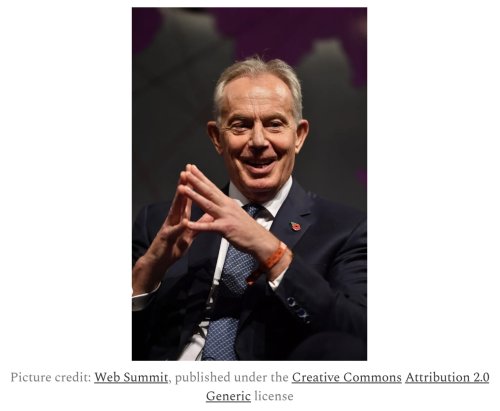
Someone can be right while being hypocritical, of course. But Blair repeatedly confuses rational policy with “things Tony Blair likes”. Not cooperating with the US’s war in Iran, he says, was “not the best way to treat our ally”. “Our ally” had been threatening a reckless and arrogant invasion of European soil — besides which, if our only priority is pleasing the US, agreeing with Donald Trump on everything and anything will hardly be an asset to the UK in two years.
“We went through Afghanistan and Iraq together,” Blair says, rhapsodising about the transatlantic relationship, “But it mattered deeply to America and so it mattered to us also.” Well, firstly, being a good friend can mean being critical if your friends are being reckless. Secondly, though, I dare Sir Tony to go to the parents, spouses, children, and friends of the British soldiers who died in Afghanistan and Iraq and tell them that it “mattered deeply to America”.
What a shameless man.
In partnership with his argument that British politics is delusional is Blair’s argument that it is parochial. This, in fairness to Blair, is often true. People do want to talk about NHS waiting times far more than China or AI — understandably, in a sense, inasmuch as anyone in the UK might find themselves in A&E tomorrow, but misguidedly because British politics does not exist in a vacuum and depends on broader technological, economic and geopolitical trends.
But I think a big problem with Blair is that there’s very little sense of what policy is actually aimed towards. This could sound far too post-liberal. I don’t want politicians to have a comprehensive sense of what a nation should be like because there is so much that its people should be determining for themselves. But Blair seems to have no sense of what a nation is, or of what a people is, or of what values should underpin their collective life.
He talks about economic growth, and that is valid. Pretty much all of your political ambitions, whatever they are, depend on an underlying reality of economic growth. But there is no — and I do mean no — sense of how Blair understand’s Britain’s culture and identity. It almost sounds like he sees it as some kind of corporation, where all that really matters is the bottom line. This is weird, because the man who presided over the creation of reams of stultifying legislation from 1997 to 2007 is no sort of neoliberal fanatic. But it seems very much like it is because Blair, whose think tank has received tens of millions of pounds from Larry Ellison of Oracle, wants the UK to be some sort of playground for Big Tech.
Hey, nations need rich people. They cannot insulate themselves against technological change. I’ll be the first — well, among the first — to oppose petty political obstructionism. I don’t want Europe to be debating the finer details of GDPR reform while China is creating a superintelligence. But the rich have to at least respect a framework of laws and values — laws and values around such things as freedom and privacy — or else you don’t have much of a nation at all. You just have a business park with a suburb attached to it.
So, I don’t think Tony Blair is really selling a meaningful plan for the future as a wise elder statesmen. I think he is making a sales pitch as a glorified B2B salesperson. Hey, the world needs people who sell things. But I don’t think Blair’s product is as sophisticated as it looks — and I’m not sure you should listen to a sales pitches from someone who has scammed you before.
This article (Tony Blair is a Dodgy Salesman) was created and published by Ben Sixsmith and is republished here under “Fair Use”


Leave a Reply