

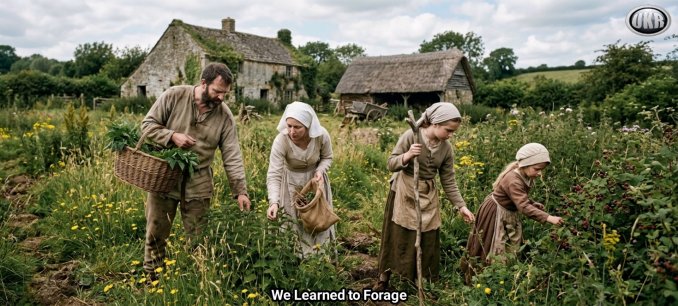
We Learned to Forage
After the UN Agenda 30 economic collapse; A field guide to eating when the world goes wrong
TOM ARMSTRONG
Iain Hunter’s article on the UN’s apocalyptic Agenda 30 yesterday got me thinking. If it all comes to fruition at the same time we could have a catastrophic economic meltdown, all heralded by those novo-four horsemen: The UN; The WEF; Soros & Gates. And as post-apocalyptic films are all the rage, I thought I’d pen my own piece on the subject – and how to survive it. (And by the end of this article maybe I’ll be able to spell Apocalypse properly first time of trying!)
Agenda 31 Triumphs.
The end began, as these things often do, with a shortage of toilet roll and a man on the internet shouting about seed vaults. Soon there were graphs. Then rumours. Then panic. Ships stopped coming. Prices climbed like rats up drainpipes. The world economy collapsed, with the wet fart of a punctured lilo. The supermarkets emptied in hours. Fennel could still be bought in some parts of Surrey, but only because nobody knew what it was. The Apocalypsts, those globalist demons Iain Hunter wrote about a couple of days ago, had won. Even worse, the Apocolyptists, who saw it all coming and who had spent years preparing bunkers full of dried lentils and crossbows, walked about with the grim joy of men whose train set had finally become useful. The rest had to learn quickly. Here’s how some survived.
At first, denial. They queued with brave faces and mild cursing. They shared photos of empty shelves. Then they fought over pasta in Aldi with the quiet rage of people who once considered themselves civilised. And then came a form of acceptance. It had happened, and many wanted to survive.
People began peering at hedges, and a strange thing happened after that. Britain, long buried under car parks and meal deals, slowly became edible again. The old plants were still there. The weeds had waited patiently through centuries of concrete and glyphosate. Nettles still rose behind the bins. Blackberries still tangled through unused railway cuts. Dandelions still shoved through paving stones with the determination of a beaver gnawing at a tree trunk. Nature, it turned out, had not gone anywhere. We had simply forgotten her menu.
Top of the survivalist’s menu is nettles: the food of hard times. I learned this lesson from my old Nan, who had survived wars, strikes, unemployed husband and rationing. “Get nettles,” she said. “Young tops only. Gloves on.” This sounded unlikely. Before the acopolips apocalypse, nettles were what Britain used instead of barbed wire. Children fear them. Dogs leap away from them. They seem designed by nature to punish joy. Yet once boiled, the sting dies. What remains is rich green food full of iron, calcium, magnesium, potassium, vitamins A and C, and enough goodness to shame supermarket lettuce.
Nettle soup became the first true meal of the collapse. It tasted earthy and dark, like spinach raised during wartime. Soon everybody was gathering them. Office workers. Students. Men who once spent two hundred pounds on Japanese knives now hacked at weeds beside canals with scissors from WHSmith. The key is to pick young plants before flowering. Old nettles become tough and may upset the kidneys. Also avoid roadsides unless your dream meal includes diesel and traces of Ford Fiesta. And later on in the year, collect the seeds from the female plant. They are the most nutritious part of the most nutritious plant there is.
And then there are Dandelions: revenge of the lawn. The dandelion may have been the most hated plant in Britain. Entire industries existed to murder it. Yet every part of it can be eaten. The leaves work in salads or soups. The roots can be roasted for a bitter coffee substitute. The flowers can become wine, fritters, or jam if you still have sugar and hope. Young leaves contain vitamins A and C, potassium, and fibre. Older leaves taste like tax forms and disappointment, but you’ll see dandelions differently after hunger arrives. What was once a weed becomes lunch. People began kneeling in parks gathering them with care usually reserved for truffles. The great irony of the collapse was this: Britain had spent decades poisoning perfectly good food because it looked untidy.
Now a surprise: Ground elder: the revenge of monks. Ground elder spreads through gardens with terrifying speed. Gardeners hate it with holy fury. This is because it was brought to Britain by monks centuries ago, as food. The monks, I now suspect, knew exactly what they were doing. Young leaves taste a little like parsley and celery. They are rich in vitamin C and minerals and can be cooked like spinach. After the crash, suburban gardeners experienced the strange horror of discovering the plant they had battled for twenty years was not only edible but quite pleasant with butter. There were stories of neighbours guarding patches of ground elder like medieval peasants protecting wheat. Civilisation is a thin coat of paint indeed
Another hated but edible ‘weed’, Sticky willy: famine salad. Sticky willy, also called cleavers, is the clingy plant that sticks to trousers and dogs. Before the collapse most people knew it only as a nuisance. Children threw it at one another in parks. Dogs carried entire forests of it home in their fur. Then somebody discovered you could eat it. The young shoots are edible raw or cooked. They contain vitamin C and have mild cleansing effects. Some even used the dried seeds as a coffee substitute, though this required optimism on an heroic scale. Sticky willy soup became common during the second year of shortages. It was not good soup. But it was soup.
Blackberries: the king of the hedge. By late August the hedgerows became crowded with people carrying bowls, buckets, and old ice cream tubs. Blackberries were free sugar, free vitamins, and free joy. Rich in vitamin C, vitamin K, fibre, and energy, they were among the best foods available in the wild. Children who once ignored nature entirely now scanned every hedge with the sharp eyes of crows. Arguments broke out over territory. Entire families vanished into woods at dawn like furtive berry smugglers. One old man in Devon was said to defend his blackberry patch with an air rifle and a whistle. Britain adapted quickly. As always. Avoid berries near busy roads or low beside dog paths. Hunger builds character, but dysentery rather ruins morale.
Wild garlic: hope in the woods. In spring the woodlands fill with the smell of garlic. Wild garlic grows thick in damp woods, and once you learn the scent you never forget it. The leaves can be chopped into soups, stews, breads, and pestos. It contains vitamin C and useful minerals, but its greatest value during the collapse was emotional. Food with flavour matters. After months of boiled weeds and root mash, wild garlic reminded people that meals could be enjoyed. Yet caution matters here. Wild garlic resembles lily of the valley, which is poisonous. The rule is simple: If it does not smell strongly of garlic, leave it alone. This rule also applies to garlic mayonnaise bought from motorway services.
Chickweed and wood sorrel. Chickweed became common salad food during the lean months. It grows almost everywhere and contains vitamin C, calcium, and iron. Its taste is mild and green, which is polite language for saying “better than nothing”. Wood sorrel, meanwhile, provided sharp lemon flavour from tiny clover shaped leaves. People grew oddly fond of it. One leaf could lift an entire pan of boiled roots from prison food to something nearly cheerful. Too much wood sorrel is bad for the kidneys due to oxalic acid, but then so is surviving entirely on stress and instant noodles.
Burdock: the root of survival. Burdock is the great forgotten food of Britain. Its long roots are edible when young and contain fibre and carbohydrates. In Japan it remains a respected vegetable. Digging burdock roots is hard work though. The roots go deep, as though the plant itself distrusts humanity. Still, roasted burdock fed many through the winters after the crash. One learns quickly that hunger improves all recipes.
Acorns: emergency bread. The oak tree may yet save civilisation. Acorns contain fats and carbohydrates, though they must be processed first because of bitter tannins. This means soaking or boiling them several times before drying and grinding into flour. It is labour heavy and dull. Still, during the Great Shortage of Year Three, people queued beneath oaks like medieval peasants awaiting divine aid. The squirrels looked furious.
Mushrooms: death in a small hat. No essay on British foraging is complete without mentioning fungi. Every autumn, fresh stories appeared of people poisoning themselves after deciding they possessed “good instincts”. They did not. Britain has edible mushrooms. It also has mushrooms capable of quietly dissolving your liver while you watch television. The problem is that many deadly species look almost friendly. Nature occasionally behaves like a serial killer with gardening skills. Unless trained properly, avoid wild mushrooms. Ignore confident men called Pete who say things like: “My grandad ate these.” Perhaps he did. Perhaps Pete’s grandad also licked batteries.
The strange peace of weeds. Maybe old Herr Schwab, a pox on his memory, had something when he said you’ll own nothing and be happy. By the fourth year of shortages the country had changed. Lawns became vegetable patches. Railway banks became orchards of bramble and rosehip. Children could identify sorrel before they knew algebra. And oddly enough, many people became happier. Not richer. Certainly not cleaner. But calmer. Foraging slowed life down. It returned people to seasons and weather and soil. One began noticing things once ignored: the smell of rain on nettles, the shine of sloes after frost, the first wild garlic leaves pushing through woodland mould. The collapse stripped away many illusions.
Yet the land remained.
Britain, beneath all its roads and adverts and sad retail parks, was still alive. Still growing food in secret. Still quietly feeding birds, foxes, insects, and now desperate accountants from Milton Keynes. Perhaps that is the final lesson. Empires fall. Markets crash. Prime Ministers vanish like startled pigeons. But the weeds return every spring. Patient. Stubborn. Edible.
And somewhere, in drizzle beneath a hedge, a Briton may be found crouching with a bucket, gathering blackberries while muttering the national motto of survival: “Could be worse.”
This article (We Learned to Forage) was created and published by Free Speech Backlash and is republished here under “Fair Use” with attribution to the author Tom Armstrong
Featured image: Free Speech Backlash

••••
The Liberty Beacon Project is now expanding at a near exponential rate, and for this we are grateful and excited! But we must also be practical. For 7 years we have not asked for any donations, and have built this project with our own funds as we grew. We are now experiencing ever increasing growing pains due to the large number of websites and projects we represent. So we have just installed donation buttons on our websites and ask that you consider this when you visit them. Nothing is too small. We thank you for all your support and your considerations … (TLB)
••••
Comment Policy: As a privately owned web site, we reserve the right to remove comments that contain spam, advertising, vulgarity, threats of violence, racism, or personal/abusive attacks on other users. This also applies to trolling, the use of more than one alias, or just intentional mischief. Enforcement of this policy is at the discretion of this websites administrators. Repeat offenders may be blocked or permanently banned without prior warning.
••••
Disclaimer: TLB websites contain copyrighted material the use of which has not always been specifically authorized by the copyright owner. We are making such material available to our readers under the provisions of “fair use” in an effort to advance a better understanding of political, health, economic and social issues. The material on this site is distributed without profit to those who have expressed a prior interest in receiving it for research and educational purposes. If you wish to use copyrighted material for purposes other than “fair use” you must request permission from the copyright owner.
••••
Disclaimer: The information and opinions shared are for informational purposes only including, but not limited to, text, graphics, images and other material are not intended as medical advice or instruction. Nothing mentioned is intended to be a substitute for professional medical advice, diagnosis or treatment.
Disclaimer: The views and opinions expressed in this article are those of the author and do not necessarily reflect the official policy or position of The Liberty Beacon Project.


Leave a Reply