

CHARLIE HOWDEN
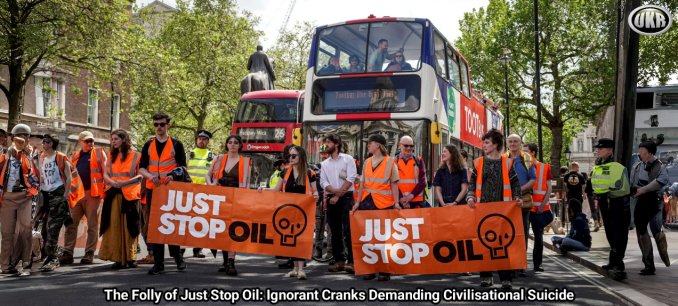
Just Stop Oil protestors are not brave environmental warriors but ignorant cranks and self-regarding fools whose theatrical stunts reveal a profound detachment from reality. Gluing themselves to roads, hurling soup at priceless paintings, and disrupting the lives of ordinary people, they peddle a simplistic mantra: oil is evil, so we must cease its extraction immediately. This is not activism rooted in science or compassion; it is performative narcissism dressed up as moral urgency. These middle-class eco-zealots, often funded by wealthy donors and jetting between protests, display a childlike ignorance of the very energy systems that sustain their comfortable existence. Their demand to “just stop oil” is not a policy proposal but a tantrum against modernity itself. If implemented, it would not save the planet, but it would precipitate the swift and catastrophic collapse of civilisation as we know it. Far from enlightened, these protestors embody a dangerous anti-humanism that romanticises pre-industrial poverty while ignoring the empirical truth that fossil fuels have lifted billions from destitution.
The cranks of Just Stop Oil betray their foolishness at every turn. They rail against oil while encased in petroleum-derived plastics: their banners, high-vis jackets, trainers, and even the glue they use to stick themselves to tarmac are all petrochemical products. Their smartphones, bicycles, and the very paint on their protest signs originate from oil refining. This hypocrisy is not incidental but symptomatic of a deeper intellectual failure. They exhibit zero grasp of energy density or the engineering realities of our world. Renewables such as wind and solar are intermittent and require vast mineral resources and backup systems that themselves depend on fossil fuels for manufacture and transport. Oil, by contrast, is an extraordinarily energy-dense liquid that powers the global supply chains upon which everything else rests. Just Stop Oil’s literature and speeches reduce complex geophysics and economics to cartoonish slogans, as if flicking a switch labelled “stop oil” would usher in a utopia of bicycles and community gardens. History exposes their folly: the Industrial Revolution, powered first by coal and then by oil, doubled global life expectancy, slashed child mortality, and enabled the agricultural and medical revolutions that feed and heal billions. To dismiss this legacy as mere “destruction” is not only ahistorical but also wilfully obtuse. These protestors are not all ignorant of the data; they simply refuse to engage with it, preferring the dopamine hit of viral arrests to the tedium of spreadsheets and engineering textbooks.
Worse, their tactics reveal contempt for the very public they claim to champion. Blocking motorways does not inconvenience billionaires; it strands ambulances, prevents parents from collecting children from school, and halts delivery lorries carrying food and medicine to hospitals. Throwing soup at Van Gogh’s Sunflowers or disrupting sporting events achieves nothing but public revulsion. Polling consistently shows most Britons reject the disruptive extremism of groups like Just Stop Oil. The protestors’ refusal to debate or compromise brands them as ideological zealots, not serious advocates. Their funding from oil heiresses and celebrity backers only underscores the crankery: insulated by trust funds, they demand sacrifices from the working class they profess to represent. This is not environmentalism; it is a luxury belief, a status signal for the affluent that imposes no personal cost.
Yet the true measure of their foolishness emerges when one contemplates the consequences of actually doing what they demand. Suppose, for the sake of argument, governments capitulated tomorrow and halted all new oil extraction and refining. The immediate effects would be apocalyptic. Modern civilisation runs on oil to an extent these protestors cannot fathom. Global oil consumption exceeds 100 million barrels per day, powering not merely cars but the entire logistics backbone of trade, food, and medicine. Within days, petrol stations would run dry. Private vehicles used for commuting, shopping, and emergency travel would grind to a halt. Public transport, reliant on diesel buses and trains, would follow. Supermarket shelves would empty as articulated lorries, the arteries of just-in-time delivery, ceased to move. Perishable goods would rot; staples would vanish. In the UK alone, where food imports constitute nearly half of supply, ports would become graveyards of idle container ships unable to bunker fuel or discharge cargo. Starvation would not be immediate for the wealthy with stockpiles, but within weeks the vulnerable, the pensioners, the disabled, and the urban poor, would face rationing and riots. Historical precedents such as the 1973 oil crisis offer a pale shadow: fuel shortages then triggered inflation and unrest; total cessation would be orders of magnitude worse.
Transportation collapse would cascade into every sector. Aviation would cease almost overnight. Jet fuel has no scalable, immediate substitute; electric aircraft remain confined to tiny prototypes unsuitable for transatlantic or cargo flight. International trade would evaporate. Britain, an island nation, imports 40 per cent of its food and the vast majority of its manufactured goods. Without oil-derived marine bunker fuel, ships would stop. Pharmaceuticals, electronics, clothing, and raw materials would stop arriving. Hospitals would exhaust stockpiles of drugs, many of which rely on petrochemical feedstocks for synthesis. Disposable syringes, IV tubing, catheters, and sterile packaging are all plastic derivatives of oil. MRI machines, ventilators, and even the humble plaster on a child’s knee trace their origins to the refinery. Without these, routine operations would halt, infections would surge, and cancer treatments would become impossible. Life expectancy, which rose dramatically through the twentieth century thanks to oil-enabled sanitation and pharmaceuticals, would plummet. Infant mortality would rebound to pre-industrial levels.
Agriculture, the foundation of civilisation, would fare no better. Modern farming is an oil-powered miracle. Tractors, combine harvesters, and grain lorries run on diesel; without it, fields would lie fallow or revert to horse-drawn inefficiency capable of feeding perhaps one-tenth of current populations. Fertilisers, though primarily derived from natural gas via the Haber-Bosch process, rely on oil for distribution and application. Pesticides and herbicides are petrochemical. Global yields would collapse by 50 per cent or more within a single growing season. The green revolution that fed billions since the 1960s would reverse. Famine would stalk not only the developing world but Britain and Europe, where intensive monoculture and global supply chains have banished the Malthusian trap. Livestock farming, dependent on imported feed transported by oil, would shrink. Malnutrition would breed disease, compounding the medical crisis.
Manufacturing and energy infrastructure would disintegrate in parallel. Steel, cement, and chemicals—the materials of roads, bridges, and power stations—require oil for high-temperature processes and transport. Renewables can never fully replace oil: solar panels and wind turbines have lifespans of 20-30 years and demand rare earths mined and are shipped using… oil. Grid-scale battery storage remains prohibitively expensive and resource-intensive. Even nuclear power, the one low-carbon baseload source, requires oil for uranium mining, enrichment, and plant construction. Blackouts would become routine as gas-fired peaker plants, themselves oil-dependent for maintenance, failed. Homes would freeze in winter; hospitals would lose power for life-support. Digital civilisation, data centres, fibre optics, servers, would flicker out, severing communication, banking, and emergency services. The internet itself rests on an oil-powered supply chain from silicon chips to undersea cables.
The humanitarian toll would be biblical. Billions worldwide depend on oil for survival. Developing nations, where Just Stop Oil’s demands would hit hardest, would see famines dwarfing those of the 1980s. Refugee crises would engulf borders as people fled collapsing states. Conflict over remaining resources would erupt; history shows that energy shortages breed war. In Britain, GDP would contract by perhaps 80 per cent within months, unemployment would soar into the tens of millions, and social order would fracture. The elderly and infirm would perish first, followed by the young as nutrition failed. Civilisation is not a given; it is a fragile, energy-intensive achievement. Remove the 85 per cent of global energy still supplied by fossil fuels, chiefly oil, and we revert not to some bucolic idyll but to the Malthusian horrors of the pre-1800 world: average lifespans of 30-40 years, endemic hunger, and localised violence.
Just Stop Oil’s protestors, cocooned in their ideological bubble, never confront these realities. They offer no credible transition plan, only slogans. Pragmatic net-zero pathways—nuclear expansion, carbon capture, hydrogen research, and yes, continued oil use during a decades-long bridge—exist and are being pursued by serious governments. Abrupt cessation is not virtue; it is suicide. Civilisation’s progress was built on harnessing dense energy sources. To “just stop oil” is to repudiate that progress, condemning humanity to darkness, cold, and hunger. The cranks may glue themselves to roads, but reality will not yield. If they truly cared about the future, they would champion innovation, not collapse. Their ignorance is not just embarrassing—it is lethal.


