

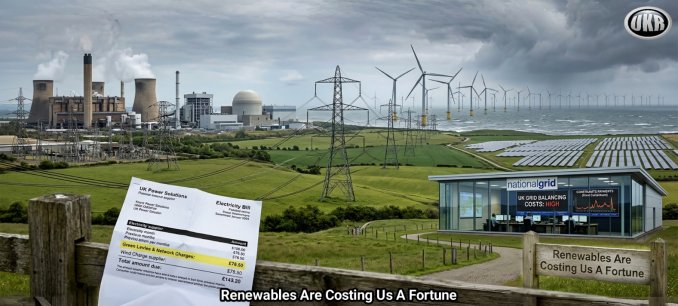
Renewables Are Costing Us A Fortune–Justin Rowlatt
PAUL HOMEWOOD
h/t Ian Cunningham
WOW! Justin Rowlatt has seen the light!

“I’m an early adopter of new technology,” says Gavin Tait, a 69-year-old from Glasgow, with a hint of pride.
So when he received a lump sum on retirement a decade or so ago, he invested in renewable energy: solar panels on the roof, a home battery and a heat pump. “It seemed like a no-brainer,” he recalls. “I could save money and help the environment – why wouldn’t I?”
At first, it worked. His well-insulated home stayed warm and his energy bills fell. But over the past couple of winters, things began to change. “I noticed my electricity bills were going through the roof,” he says.
This winter, he and his wife switched it off and went back to their gas boiler, which they had kept as a backup.
Gavin – who wrote in to BBC Your Voice about his experiences – says he knows what the problem was. At best gas delivers nearly one unit of heat for each unit of energy put in; his heat pump can deliver up to three or four units of heat for every unit of power. But as heat pumps run on electricity, he is now paying around 27p per kilowatt-hour, compared with less than 6p for gas that powers a boiler – more than four times as much.
Gavin Tait and his wife switched off their heat pump and returned to their gas boiler after rising electricity costs made it too expensive to run
“It’s simple,” he says. “Economically, it just doesn’t stack up.”
His experience is not unusual. A survey of 1,000 heat pump owners last summer, carried out by Censuswide for Ecotricity, found two-thirds said their homes were more expensive to heat than before.
For critics of government policy, stories like Gavin’s point to a deeper problem.
Heating and transport account for over 40% of the UK’s emissions but they say that progress on replacing gas boilers and petrol cars is lagging well behind targets because ministers have got the wrong focus.
In their view, the government is obsessed with cleaning up electricity generation, even though it accounts for a far smaller total of our emissions – around 10%. So that obsession is pushing up the price of electricity and making it more expensive for people to switch to a heat pump or electric vehicle.
The issue has taken on new urgency as conflict in the Middle East pushes up oil and gas prices, raising fears that high energy costs could persist.
Conflict in the Middle East, particularly tensions around the Strait of Hormuz, has pushed up oil and gas prices
The government insists that focusing on renewables will ultimately deliver greater energy security by reducing reliance on imported gas, lowering emissions and – crucially – cutting bills.
Are they right? Or by prioritising cleaner electricity while progress on heating and transport lags behind, is the government chasing the wrong targets?
The hidden cost of clean power
The issue is that while generating renewable electricity can be cheap, the system needed to deliver it is not. When I ask Sir Dieter Helm, professor of economic policy at Oxford University, for his definitive answer on the cost of renewables, he laughs.
“It all depends what you choose to measure,” he says. Sir Dieter says focusing only on the cost of generating electricity misses a larger issue: the cost of the system as a whole.
Electricity has to be available all the time – not just when the wind is blowing or the sun is shining. That means back-up generation, additional capacity and a more extensive network.
Sir Dieter gives me a simplified example. The UK’s peak electricity demand is around 45 gigawatts (GW), he says. In the past, this could be met with roughly 60GW of capacity from coal, gas and nuclear power stations.
As the system shifts towards renewables, far more capacity is needed – not just wind and solar, but back-up for when they are not producing. In Sir Dieter’s estimate, the UK is moving towards something closer to 120GW. At the same time, the grid must also be expanded to carry electricity from offshore wind farms to where it is needed.
The exact figures are debated, but the direction is clear: partly because of renewables, the system is becoming larger, more complex and more expensive. Some of those costs are already showing up in bills. Expanding the grid – building new pylons and power lines – is pushing up network charges.
There are also “balancing costs”, including payments to wind farms to switch off when the system cannot absorb all the electricity they produce. And until recently, a subsidy scheme accounted for around 10% of the average household bill.
There is another issue. The UK is richest in one of the more expensive renewable resources – offshore wind.
Solar power has seen dramatic cost reductions thanks to mass production. But Britain’s often dull skies – especially in winter, when demand is highest – limit how far it can carry the system.
Offshore wind is more dependable but it involves large, site-specific engineering projects that cannot be replicated in the same way, and so have not seen the same sustained falls in cost. At the same time, rising prices for materials such as steel and rare earths – along with higher interest rates – have pushed costs up further.
The price of progress
On paper, the UK has made significant progress on going green — the nation’s emissions are down by around 50% since 1990. But that does not necessarily mean the UK’s overall global footprint has fallen by that much.
Many of the goods that were once produced and then used in Britain are now being made overseas and then imported here, and often that production is happening in countries with a higher carbon footprint.
China, for example, still relies on coal for more than half of its energy, meaning emissions simply have shifted abroad rather than been reduced altogether.
This is a point made by leading climate scientists including Prof Kevin Anderson of Manchester University, who argues the 50% figure “excludes international aviation and shipping and our imports and exports”.
He adds: “If you include those, which of course the climate includes, then the reduction’s about 20% since 1990.” The government says it follows United Nations guidelines on emissions reporting.
China still relies on coal for more than half of its energy, raising concerns that emissions linked to UK consumption may simply have shifted overseas
At the same time, the higher system costs do not just show up in household bills – they ripple through the wider economy. UK households face some of the highest electricity bills in Europe. For businesses, the picture is even starker.
https://www.bbc.co.uk/news/articles/c86ey5n9vx9o
Welcome to the dark side, Justin!
This article (Renewables Are Costing Us A Fortune–Justin Rowlatt) was created and published by Not a Lot of People Know That and is republished here under “Fair Use” with attribution to the author Paul Homewood
See Related Article Below
The high cost of Ed Miliband’s ‘cheap’ renewable energy
First the good news. Some commercial users may be enjoying free electricity at some point this summer – or better still, they may even be paid to consume it. Now the not so good news: at other times it will mean us all having to pay even more for our electricity than we already do. The National Energy System Operator (NESO) – the nationalised body which manages the grid in Britain – is reported to be drawing up emergency plans in case it becomes too sunny. Thanks to Ed Miliband, there is now so much installed wind and solar capacity that in sunny and windy conditions it threatens to overload the grid.
Here is the problem. Currently, the UK has 32 gigawatts of installed wind capacity and 22 gigawatts of installed solar capacity. Of course, wind and solar hardly ever run at capacity because the country is not always windy and bathed in sunshine, but the renewables capacity has reached the stage at which it could theoretically overload the grid. Averaged over the year, Britain uses around 37 gigawatts of power, but on summer afternoons, when few people have any need for heating or lighting, this can fall appreciably. Unfortunately, this is also when solar power production reaches a maximum.
We already have periods when the grid is unable to accept all the wind power which could be generated. Unfortunately, this doesn’t usually mean free electricity, because the wind turbines tend to be situated on the fringes of Britain, a long way from where it is consumed, and the grid cannot handle the transfer of power. Instead, wind farm operators are paid handsome ‘constraint payments’ to brake their turbine blades. These cost consumers £380 million last year, plus a further £1.08 billion to switch on gas plants in the south of England to make up for wind energy foregone.
With solar, however, there is no mechanism in place to handle excess power output. This is especially difficult in the case of small-scale solar installations on domestic rooftops, which feed directly into the distribution grid – the local side of the national grid. NESO has no control over domestic solar panels, which continue feeding energy into the grid regardless.
We could theoretically store the excess energy generated on sunny, windy days, but the provision of energy storage is running a long, long way behind the construction of wind and solar farms. Even after a bumper year for construction, we have only 12.9 gigawatt-hours’ worth of battery storage – enough to meet average UK demand for 20 minutes. Even at the height of summer it is a long, long night before the sun comes up again.
There is a good reason why we do not have more energy storage capacity: it is extremely expensive to store energy. Over the lifetime of a battery storage facility, it will cost around three times as much to store energy as it costs to generate it in the first place. As a result, the UK national grid is still turning to gas when solar and wind capacity is short.
But whatever backup we use for intermittent renewables, we run up against an inconvenient fact: that the less frequently we use that backup, the more expensive it becomes when we do need it. If you use a gas plant, say for ten hours a week, you still need to maintain it and pay off the investment – hence the owner of the gas plants will need to charge a higher per-unit cost.
This is one reason why we never seem to get cheaper energy, in spite of more and more ‘cheap’ renewables. Another reason is that wind and solar farms are subsidised.
The Spectator: continue reading

••••
The Liberty Beacon Project is now expanding at a near exponential rate, and for this we are grateful and excited! But we must also be practical. For 7 years we have not asked for any donations, and have built this project with our own funds as we grew. We are now experiencing ever increasing growing pains due to the large number of websites and projects we represent. So we have just installed donation buttons on our websites and ask that you consider this when you visit them. Nothing is too small. We thank you for all your support and your considerations … (TLB)
••••
Comment Policy: As a privately owned web site, we reserve the right to remove comments that contain spam, advertising, vulgarity, threats of violence, racism, or personal/abusive attacks on other users. This also applies to trolling, the use of more than one alias, or just intentional mischief. Enforcement of this policy is at the discretion of this websites administrators. Repeat offenders may be blocked or permanently banned without prior warning.
••••
Disclaimer: TLB websites contain copyrighted material the use of which has not always been specifically authorized by the copyright owner. We are making such material available to our readers under the provisions of “fair use” in an effort to advance a better understanding of political, health, economic and social issues. The material on this site is distributed without profit to those who have expressed a prior interest in receiving it for research and educational purposes. If you wish to use copyrighted material for purposes other than “fair use” you must request permission from the copyright owner.
••••
Disclaimer: The information and opinions shared are for informational purposes only including, but not limited to, text, graphics, images and other material are not intended as medical advice or instruction. Nothing mentioned is intended to be a substitute for professional medical advice, diagnosis or treatment.
Disclaimer: The views and opinions expressed in this article are those of the author and do not necessarily reflect the official policy or position of The Liberty Beacon Project.


Leave a Reply