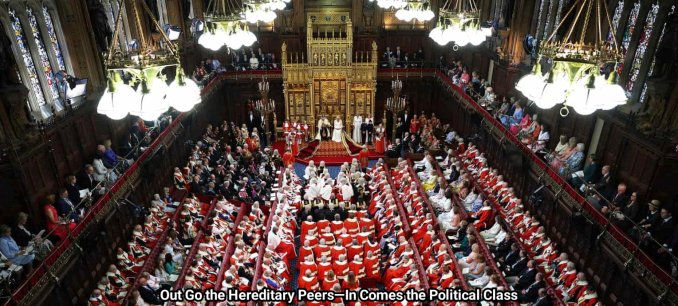
Britain is about to lose one of its oldest constitutional features. Parliament has passed a bill abolishing the last hereditary peers in the House of Lords, removing the remaining 92 members who inherited their seats by title and bringing to an end a parliamentary role that stretches back to the early foundations of the English state.
To an outsider, the reform may look obvious enough. Few modern democracies would design a legislature that includes lawmakers by birth. Yet the British constitution was never designed from scratch, and the real question is whether removing one of its most enduring anomalies will actually make Parliament stronger.
The British statesman Enoch Powell had a useful phrase for this kind of system. Britain, he argued, has a prescriptive constitution—one built on habit, precedent, and centuries of practical experience rather than ideology or theory. Its institutions often look strange to outsiders. But many of those oddities exist because they perform functions that were discovered over time rather than deliberately planned.
As the philosopher Roger Scruton argued in How to Be a Conservative, the institutions that command loyalty are rarely those we design from scratch, but those we inherit.
That matters because the real test of constitutional reform is not whether something appears outdated but whether removing it improves the balance of power. Hereditary peers have one important quality: they do not owe their seats to the favour of a recent prime minister. Once the House of Lords becomes entirely appointed, that independence inevitably shrinks.
Hereditary peers once dominated the House of Lords. But since Tony Blair’s reforms in 1999 reduced their number to just 92, they have been only a small minority in the chamber. Even so, their presence preserved one small but important element of independence in a body increasingly shaped by political patronage.
That distinction mattered. As Powell warned decades ago, once a second chamber depends entirely on appointment, it inevitably becomes more dependent on the executive power it is meant to scrutinise.
The House of Lords has not always been merely a revising chamber. Until the Parliament Acts of the early twentieth century it could block legislation outright and stood much closer in power to the House of Commons. Since those reforms curtailed its veto, the Lords has evolved into a body focused on scrutiny—revising legislation, drawing on expertise beyond party politics, and slowing governments with commanding Commons majorities.
The modern transformation of the Lords began with the Life Peerages Act 1958, which introduced peerages that could not be inherited and were granted by political appointment. The reform broadened the chamber by bringing in figures from politics, academia, business, and public service. But it also marked the beginning of a shift toward a House increasingly shaped by appointment rather than inheritance.
The next decisive change came in 1999, when Tony Blair’s government removed more than 600 hereditary peers from the chamber. As a temporary compromise, 92 were allowed to remain while a more comprehensive reform of the Lords was supposedly negotiated. That wider reform never happened, leaving the remaining hereditary peers as one of the last elements of the chamber not created through political appointment.
Supporters of reform often present the hereditary peers as little more than an outdated curiosity. In practice, many played a distinctive role in the modern Lords. They often took their seats after working in professions outside the Westminster bubble, in fields such as agriculture, the military, finance, and the law. The reduction of hereditary peers in 1999, critics note, was followed by a noticeable decline in members with experience in areas such as farming and defence. Today’s House of Lords, by contrast, is increasingly populated by former MPs, advisers, and party figures whose route into the chamber runs through the political system itself.
The reform also sits uneasily beside the continued presence of bishops of the Church of England in the chamber, an arrangement that rests on appointment by office rather than election or democratic mandate.
Supporters of the change argue that hereditary lawmakers have no place in a modern democracy. Yet Britain’s constitutional arrangements have never followed a single tidy principle. As Edmund Burke famously argued, society is a partnership “not only of the living, but of the dead and the unborn.” Britain’s institutions evolved through compromises that balanced different kinds of authority, and removing one of those elements inevitably shifts that balance.
The result may be a House of Lords that looks more logical in theory but is less able to stand apart from the political class that appoints it. Constitutions, as Scruton often noted, rarely lose their safeguards all at once; they lose them gradually, as inherited restraints are replaced by tidy theory.
The real test of constitutional reform is not whether it makes institutions look modern, but whether it leaves power more effectively restrained.





Leave a Reply