


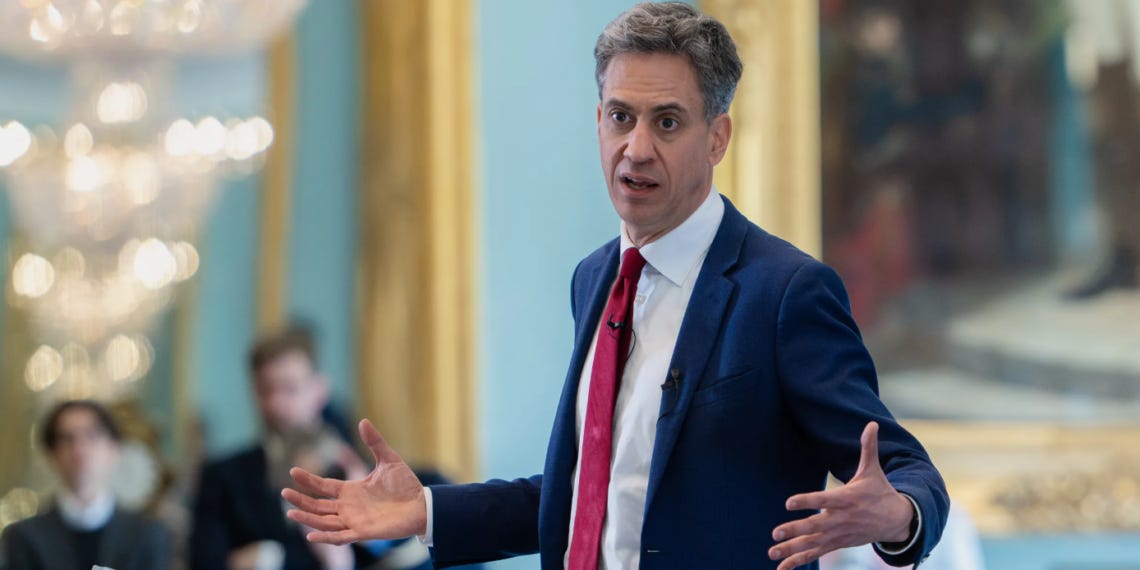
The global economy is battling another global energy crisis but Ed Miliband refuses to be shaken in his convictions.
STEVE DAVISON
Alice laughed. ‘There’s no use trying,’ she said. ‘One can’t believe impossible things.’
‘I daresay you haven’t had much practice,’ said the Queen. ‘When I was your age, I always did it for half-an-hour a day. Why, sometimes I’ve believed as many as six impossible things before breakfast. There goes the shawl again!’
Lewis Carroll
Like most adults, I stopped believing in fairies and Father Christmas a long time ago. Unfortunately, many of our politicians seem unable to throw off their childhood fantasies. Ed Miliband is the prime exemplar of his class. It is astonishing that someone in charge of energy policy can have so little understanding of his brief. It does not help that he is surrounded by people who reinforce his beliefs, in a supercharged echo chamber, formalised in the form of the Climate Change Committee. For comparison similar issues arise constantly in the NHS, which is run by people who have never emptied a bed pan or wielded a scalpel – but I digress.
In this short post I’d like to pick up on the quote from Lewis Carroll and list the 10 impossible Net Zero things that you must believe in order to support decarbonising our economy at breakneck speed.
- Reducing our CO2 emissions will reduce global temperature despite accounting for less than 1% of global emissions.
- Offshoring our manufacturing (and its emissions) will not destroy jobs, particularly in high skilled offshore, steel, aluminium and car-manufacturing sectors. Or green jobs will replace these jobs despite most renewable technology being made in China.
- We can close down all fossil fuel generation despite electricity only accounting for 20% of energy use and being vital to maintain grid security during long gaps in wind and solar generation. Essentially, we need to believe that new physics and economic models can fill the gap, along with massive investments in grid infrastructure and/or carbon capture and storage.
- Battery storage will replace fossil fuel generation and imports, despite the environmental, economic and engineering challenges of delivering grid scale storage that covers many days. None of these challenges have been solved yet but they will be any day now.
- Renewable energy is the cheapest energy available as long as we ignore the massive public subsidies. Just give them long enough and somehow the subsidies will come down, despite having gone up again in AR7 (the latest Contracts for Difference allocation round).
- We will all switch to EVs despite half of us not being able charge at home and the technology being unsuitable for commercial use, such as road haulage. We also need to ignore stagnant sales, plummeting residual values, safety concerns, an electricity grid creaking at the seams, and the cost of replacing batteries.
- Covering agricultural land with turbines, solar panels and batteries is a price worth paying despite the loss of home grown food production and increased reliance on imported food, along with their extra emissions. It is even worth destroying our peat uplands and losing their massive potential as carbon sinks.
- Energy security can be managed by importing oil, gas and electricity whenever we need it, despite what goes on elsewhere in the world and that prices are set globally despite the fact that US energy prices are much lower than ours.
- We can ignore the thousands of things, other than energy, which rely on oil for their existence, including: clothing, medicines, plastics, synthetic rubber, lubricants and fertilisers.
- The astronomical costs, both economic and societal are a price worth paying, despite all of the above.
I could go on but hopefully you get my point. I’d like to think that any reasonably intelligent person would come to the same conclusion I came to 20 years ago. But it appears not.
In my experience, those supporting NetZero believe all these things are going to work or are a price worth paying to save the planet. Others simply won’t engage because these facts do not fit their mental model of how the world is. Overcoming the cognitive dissonance required it just too painful emotionally, and so they avoid any discussions that could help them understand what is really happening.
What is the solution? I have no idea other than to keep plugging away with these articles. If you have any friends who might benefit, please do consider sharing with them – but don’t hold your breath. They will come round in the end but it is going to require an existential crisis. Perhaps one where we experience rolling blackouts, patients dying in operating theatres, public services closing down, flights being cancelled – you get the idea.
Unfortunately, when this happens, I don’t see people sitting back and quietly accepting their new lifestyle. When they realise how much they have been lied to they will probably be outraged. And who knows where that might take us?
This article (Net Zero – the Art of Believing 10 Impossible Things Before Breakfast) was created and published by Steve Davison and is republished here under “Fair Use”
See Related Article Below
Why the UK and EU Keep Doubling Down on Net Zero Dogma in the Face of Spiralling Economic Dysfunction
The Hormuz Blockade and the Triumph of Economic Illiteracy
TILAK DOSHI
On Monday, GB News ran a story on UK Energy Secretary Ed Miliband’s vow to “double down” on the government’s environmental agenda, whilst accusing opponents of the move to net zero of “making up nonsense and lies”. In a “strongly worded statement”, Miliband warned that abandoning the net zero agenda would not only risk “climate breakdown” but would also “forfeit the clean energy jobs of the future”.
The hangman’s noose concentrates the human mind wonderfully, Dr Samuel Johnson once observed. But this evidently does not apply to the government bureaucracies ensconced in Westminster or Brussels. The oil price shock triggered by the closure of the Strait of Hormuz — “the world’s worst energy crisis in history exceeding the combined shocks of both the 1970s oil prices shocks and the Ukraine war” according to the IEA chief Fatih Birol — has led the environmental justice warriors among the ruling elite to yet more muddled thinking.
Econ 101 Anyone?
Instead of applying basic economic principles — comparative advantage in international trade, portfolio diversification to manage risks, and marginal costs in commodity pricing — Europe’s elites have doubled down on their net-zero dogma. The theme is now familiar: the two great energy shocks of the past 5 years — from the 2022 Ukraine war to today’s Hormuz crisis — prompts not a return to economic rationality but a frenzied acceleration of the very policies that created the vulnerability in the first place. Economic illiteracy, it seems, is an incurable condition; those afflicted are immune to intervention by reality or logic.
Start with the fundamentals. International trade operates on David Ricardo’s principle of comparative advantage: nations specialise in what they produce relatively efficiently and trade for the rest of their import needs. In the case of international trade in fossil fuels (as in other natural resources), nations produce what natural endowments they are blessed with. It is an absolute advantage as it were, they exist or they don’t exist: gold and diamonds, copper and other valuable minerals and fossil fuels like coal, oil and natural gas.
National sovereignty over these resources, however, means little if the state cannot exploit these resources. It might lack the technological means of mining and refining these resources itself. In most cases, the state dealt with multinational companies specialized in exploiting natural resources. These multinational businesses earned risk-adjusted rates of return by helping export the country’s resources to international markets. In return, governments received taxes and royalties for allowing such exports.
In world economic history, they have been few cases of governments refusing to exploit the nation’s resources, directly or via private enterprise, to benefit their citizens (and themselves), from the sale of such resources. In the case of the UK and the EU, the higher imperative is to avoid an imminent “climate breakdown” (in Ed Miliband’s words) that supposedly will ensue if fossil fuels are extracted. In Miliband’s view, buying oil and gas from Norway’s offshore oil fields, directly adjacent to the UK’s own jurisdictions in the North Sea, is preferable to Britain having its own vibrant oil and gas sector. Evidently, he does not make too much of the fact that exports add to the gross domestic product while imports subtract.
Most countries in the world, not blessed with energy reserves within their territories, have to make do with exporting goods and services they can offer competitively in world markets to be able to afford imported energy fuels and other goods and services needed for their economies to function. Resource poor does not mean economy poor, to which the examples of Singapore, Hongkong and even China as a whole attest. It should be noted that while China has ample coal resources, it is among the world’s largest importers of fossil fuels including coal, oil and natural gas.
For net energy-importing countries, the basic principle of portfolio diversification is well understood (“don’t put all your eggs in one basket”). Winston Churchill understood this perfectly when, as First Lord of the Admiralty before the First World War, he insisted that Britain’s Royal Navy switch from coal to oil for its advantages in speed, efficiency and manoeuvrability. In the switch to an oil-powered naval fleet, Churchill recognized that diversity of supply was the only true form of energy security, instinctively recognizing the principle of optimal portfolio diversification. After buying a 51% share in the Anglo-Persian Oil Company for the British state, he declared that “[s]afety and certainty in oil lie in variety and variety alone.”
EU and UK policymakers blame dependence on imported oil and gas as the cause of their vulnerability to the energy crisis. Without such dependence, they implicitly claim, the Russian invasion of Ukraine in 2022 or the closure of the Strait of Hormuz since February 28th would not have mattered so much. And their solution? One would have thought that the most obvious one to suggest itself, at least for a start, would be to removing the multiple existing barriers to domestic exploitation of such energy resources – such as the EU-imposed ban on fracking and constraints on offshore drilling.
Yet there is no mention of creating a hospitable fiscal and regulatory environment for private sector development of domestic shale, North Sea oil and gas, or Balkan resources. The rhetoric persists, and the UK and EU’s response has been to double down: more electrification (the EU targets 50% by 2040), more wind and solar, more hand-wringing about “energy sovereignty” while refusing to exploit domestic shale or North Sea resources on anything like Norway’s scale. This is despite the unmitigated disaster of Germany’s Energiewende leading to economic suicide and deindustrialisation on a grand scale.
EU Climate Commissioner Wopke Hoekstra warned that that there is “no workaround” for high energy prices in the wake of the Iran war: “The only way forward is more electrification, more nuclear, more solar, more wind, more battery capacity, more interconnectors in the EU and all of it with much more speed”. The inclusion of nuclear in Mr. Hoekstra’s list is, of course, after both German Chancellor Friedrich Merz and EC President Ursula Von Der Leyen belatedly (by 15 years) expressed regret over Angela Merkel’s decision to shut down Germany’s nuclear plants after the Fukushima incident in Japan, calling it a “huge strategic mistake”.
The words of UK’s own fiery climate warrior Ed Miliband are no less feisty: “In response to recent events, our action must now be faster, deeper and more wide-ranging. That is why we will double down not back down on our mission for clean energy…Unlike the twin fossil fuel shocks of the 1970s, there is now a compelling alternative in the form of clean energy. An alternative that cannot be disrupted by foreign wars because it comes from our own wind, sun and nuclear resources.”
“Breaking the Link” between Gas and Electric Power Prices
Many a professor has spent precious class periods teaching Econ 101 students the concept of marginal cost, a true test of pedagogy. It would seem than many don’t get it, with or without the benefit of economics professors teaching introductory economics.
Nowhere is this clearer than in UK Chancellor Rachel Reeves’s latest pronouncements. Last week, on the sidelines of the International Monetary Fund / World Bank meetings in Washington, Reeves declared she was considering “quite a big change” to weaken the link between natural gas and electricity prices. This was nothing new — such a proposal was first floated by the previous Conservative government Chancellor Kwasi Kwarteng in 2022 who said in words that could have been lifted from the mouth of Ed Miliband:
“The government is also working with electricity generators to reform the outdated market structure where gas sets the price for all electricity – instead, the government will move to a system where electricity prices better reflect the UK’s home-grown, cheaper and low-carbon energy sources, which will bring down consumer bills.”
Reeves plans to raise the windfall tax (the electricity generator levy) on low-carbon generators — nuclear, biomass, and pre-2017 renewables — to shield household bills in the short term while “consulting on long-term wholesale market reforms”. Older renewables obligation projects would be shifted onto newer set-price contracts, guaranteeing fixed prices to consumers. The “guaranteed fixed price” is nowhere specified, and it would be surprising if older renewable generators will settle for anything much less than what they were already being paid. The presumption is that gas-fired power generators which typically set the marginal price in the UK’s merit-order wholesale market are the villains driving Britain’s household and industrial power prices — already the highest in the developed world.
Data from the IEA and UK sources confirm British households pay around 30–40p/kWh, far above US, Chinese or Norwegian levels. Reeves and Miliband argue that by “breaking the link” and ensuring electricity prices are set more often by “cheaper” renewables (now 52.5% of UK generation), bills will fall “in the long run.” This is Alice-in-Wonderland economics. As Humpty Dumpty told Alice, “When I use a word, it means just what I choose it to mean — neither more nor less.” In the topsy-turvy world of net-zero ideologues, “cheaper in the long run” means whatever the DESNZ bureaucrats say it means.
While they wave their arms about the “long run”, they ignore the elementary distinction between unit cost which refers to the low operating cost of wind or solar plants once built, measured at plant level and system cost. The latter includes the cost of grid upgrades required to connect remote solar or wind farms to power demand centres in cities, backup gas plants for when there is no sun or wind, curtailment payments for when there is too much sun or wind, CfD subsidies to attract wind and solar investors, grid balancing services, and policy levies needed to integrate intermittent renewables. As I have argued elsewhere, it is time to stop pretending renewables are cheap.
Power PEnergy analysts Kathryn Porter and David Turver among others have repeatedly demonstrated that once “policy costs” are added — CfDs that guarantee above-market prices for 15–20 years, grid enhancement charges, backup capacity payments and the rest — retail bills soar. Gas plants do not cause high prices; net-zero mandates do.
Remember the 1970s?
The historical parallel is instructive. The 1970s oil crises led to market-driven responses: diversification of supply, efficiency gains, and substitution in power generation. Key government responses in the OECD were focused on building strategic petroleum reserves with coordination by the IEA. The dominant policy response in the U.S. and other OECD countries was not to restrict or curtail international fossil-fuel trade. On the contrary, the focus was on increasing supply diversity and domestic production. No serious move against fossil-fuel trade occurred much beyond President Carter’s ill-fated attempt at controlling domestic prices at the pump and banning oil exports (when the US was a net oil importer).
Today, with only about 20% of primary energy used as electricity (the rest for transport, heating, and industrial heat), the EU and UK propose to “electrify everything” while simultaneously chasing fossil fuels out of the grid. The result? Grids operating with dangerously low reserve margins, over-exposed to fickle, weather-dependent renewables and requiring massive state subsidies. The empirical evidence is unambiguous. Countries and states furthest advanced in renewables penetration — Germany, California, South Australia — suffer the highest electricity prices. Charts plotting wind-plus-solar share against retail prices across jurisdictions show a clear positive correlation.

Germany’s Energiewende has driven deindustrialisation, with firms like BASF, Volkswagen, and Mercedes relocating or cutting capacity. South Australia’s much-vaunted renewable experiment has produced volatile prices and repeated calls for more gas backup. Yet the ideologues insist renewables are “homegrown” and “cheap in the long run”.
Even the windfall tax tweak reveals the absurdity. Older low-carbon plants, already subsidised under the Renewables Obligation, will now face higher levies so the state can claw back profits and offer “guaranteed prices” to households. This is what one (official) hand giveth, the other taketh away. The first-best policy would have been not to hand out the subsidies in the first place. Adam Bell, former DESNZ strategy head, enthuses that removing gas from the market and “holding it in reserve” would represent a “transfer of value from producer to consumer” not seen for decades. This is socialist class-war rhetoric dressed up as energy policy: fossil-fuel providers are now the class enemy blocking the “energy transition.”
The deeper presumption is even more troubling. Bureaucrats and PPE graduates in government departments and quangos claim the wisdom to pick winning “industries of the future” — wind, solar, EVs, batteries — and subsidise them through the “valley of death” (as they call it in business school) until they mature. History says otherwise. Milton Friedman reminded us in a 1977 lecture that the great industries were built by private entrepreneurs — the so-called robber barons who became barons precisely because they delivered goods and services people wanted. Nor, one might add, did Ford need government subsidies for producing the Model T. In the developing countries, import-substituting industrialisation based on the argument that “infant industries” needed temporary protection led to permanent infants that never grew up.
The Afflictions of Learned Illiteracy
Freely chosen economic illiteracy, like other ideological afflictions, appears immune to correction by experience. The hangman’s noose may concentrate some minds, but in Westminster and Brussels, the noose is worn as a fashion accessory.
Until voters demand a return to economic first principles — open trade, competitive markets, prudent natural resource development policies and pragmatic diversification of energy imports — the doubling down on dumb energy policies will continue. And Britain and Europe will pay the price in lost prosperity and diminished security.
A version of this article was first published in the Daily Sceptic https://dailysceptic.org/2026/04/24/why-the-uk-and-eu-keep-doubling-down-on-net-zero-dogma-in-the-face-of-spiralling-economic-dysfunction/
Dr Tilak K. Doshi is the Daily Sceptic‘s Energy Editor. He is an economist, a member of the CO2 Coalition and a former contributor (cancelled) to Forbes. Follow him on Substack and X.
This article (Why the UK and EU Keep Doubling Down on Net Zero Dogma in the Face of Spiralling Economic Dysfunction) was created and published by Tilak Doshi and is republished here under “Fair Use”
Featured image: Steve Davison

••••
The Liberty Beacon Project is now expanding at a near exponential rate, and for this we are grateful and excited! But we must also be practical. For 7 years we have not asked for any donations, and have built this project with our own funds as we grew. We are now experiencing ever increasing growing pains due to the large number of websites and projects we represent. So we have just installed donation buttons on our websites and ask that you consider this when you visit them. Nothing is too small. We thank you for all your support and your considerations … (TLB)
••••
Comment Policy: As a privately owned web site, we reserve the right to remove comments that contain spam, advertising, vulgarity, threats of violence, racism, or personal/abusive attacks on other users. This also applies to trolling, the use of more than one alias, or just intentional mischief. Enforcement of this policy is at the discretion of this websites administrators. Repeat offenders may be blocked or permanently banned without prior warning.
••••
Disclaimer: TLB websites contain copyrighted material the use of which has not always been specifically authorized by the copyright owner. We are making such material available to our readers under the provisions of “fair use” in an effort to advance a better understanding of political, health, economic and social issues. The material on this site is distributed without profit to those who have expressed a prior interest in receiving it for research and educational purposes. If you wish to use copyrighted material for purposes other than “fair use” you must request permission from the copyright owner.
••••
Disclaimer: The information and opinions shared are for informational purposes only including, but not limited to, text, graphics, images and other material are not intended as medical advice or instruction. Nothing mentioned is intended to be a substitute for professional medical advice, diagnosis or treatment.
Disclaimer: The views and opinions expressed in this article are those of the author and do not necessarily reflect the official policy or position of The Liberty Beacon Project.


Leave a Reply