

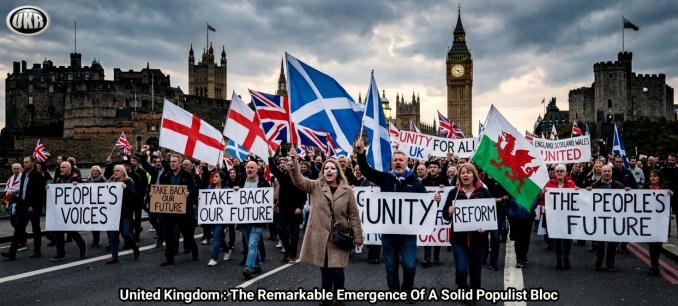
On the significance of the spirit driving populism
FRANK FUREDI
The results of the local council election not only confirmed what virtually every commentator suspected – the end of the era of the Labour-Tory duopoly – it also showed the consolidation of a significant populist bloc throughout the United Kingdom.
It was during the campaign for Brexit in 2016 that a movement which would crystallise into the populist bloc of May 2026 first demonstrated its formidable potential. Supporters of Brexit demonstrated that millions of people were prepared to reject their traditional party affiliations and embrace a cultural orientation that was antithetical to those of the ruling elites. The campaign for Brexit provided an opportunity for millions of British patriots to find their voice. During the decade to follow their voice gained strength to the point that it has become an electoral force that has surpassed the influence of the legacy parties.
At present it is Reform that has succeeded in representing the aspirations of the Populist Bloc. It is the working people who provide the social basis of British populism who have provided the energy and drive that has resulted in Reform’s extraordinary success in the local council elections. The growth in Reform’s share of the vote correlates strongly with the leave vote in the Brexit referendum. That is why in England support for Reform is much higher than in wards that voted heavily to Leave the EU than in those that backed remain[i].
The results of the local council elections indicate that the social weight of populist bloc has steadily extended during the past decade. The relatively impressive gains made by Reform in Scotland and Wales indicate that it can no longer be dismissed as an English protest party. Indeed, compared to Labour and the Tories, Reform can claim to be the genuine national party. Judging by the votes it received throughout the UK it can assume the title of the party of the people.
The consolidation of a populist bloc also highlights the emergence of new forms of social polarisation with British society. There are two social spheres that have proved resistant to the spirit of populism. Reform has made gains almost everywhere outside of the inner urban sectors and in university dominated towns. Outwardly it seems that the traditional political polarisation between left-leaning working-class voters and centrist middle-class ones now assumes the 21st century form of populism versus technocratic managerial centrism. That means that the wealthier and formally educated sectors of society regard Reform with a mixture of hatred and fear.
In passing it should be noted that the animosity directed at Reform by the mainstream media and representatives of the legacy parties is not merely directed at Nigel Farage and his party’s leadership. This hatred also expresses a sense of contempt for the kind of people who support reform. From their perspective the sensibility of patriotism and identification with the British nation’s traditions that animates supporters of Reform is dismissed as manifestations of racism and xenophobia. Hatred for ‘these people’ should be understood as the contemporary manifestation of the classical anti- democratic contempt for the demos.
The Spirit of Populism
In my new book In Defence of Populism, I focus on what is truly inspiring about populism, which is the spirit that drives its quest for a voice and for solidarity[ii]. A simple definition cannot capture the meaning of the spirit of populism. Populism has no doctrinal ambition. Its spirit affirms the life world of people and the everyday dimension of a community’s existence. This spirit is fueled by an egalitarian impulse, which unfortunately its detractors misinterpret as merely anti- elitist and anti-pluralist. One of the most astute understandings of the spirit of populism is provided by Arthur Borriello, Jean- Yves Pranchėre and Pierre- Étienne Vandamme.[iii] These authors characterize populism as ‘an egalitarian impulse against oligarchic tendencies, centered on anti- elitism and the defense of a democratic common sense’. They note that this egalitarian impulse is ‘mainly defensive-reactive in nature and rooted in a democratic commonsense, rather than in a fully- fledged ideological worldview aiming at the establishment of a radically new social order’.
One account of contemporary populism writes of an ‘impulse’, an ‘impetus, a motivating spirit or drive’, one ‘that implies ordinary men and women believe that the government ought to serve the people, not just the special interests’. [iv] Another article notes that this spirit encourages people to be ‘keenly attuned to the distribution not only of resources and opportunities but of honour, respect and recognition, which may be seen as unjustly withheld from “ordinary” people and unjustly accorded to the unworthy and undeserving’.[v] These are people who wish to be taken seriously and not patronised by those who presume that they have the moral authority to lecture them about how to live their lives.
The spirit of populism encourages the valuation of democratic common sense which conveys the belief that citizens possess the capacity to judge issues and policies that concern them. Populism’s affirmation of common sense is not ideological. It represents a taken- for- granted assumption that affirms the common experience – past and present – on which the sensibility of common sense is constructed. Although it lacks a systematic doctrine, there are certain attitudes and ideals that characterize the value orientation that all national populist movements possess. In the current era the populist value system often comes across as directly antithetical to those of the political and cultural establishment. As the political theorist Margaret Canovan pointed out, unlike so-called social movements, populism does not merely challenge the holder of power but also ‘elite values’. Therefore, its hostility is also directed at ‘opinion formers and the media’. Often the challenge posed by populist movements to elite values is expressed through their defiant act of rescue, expressed through their determination to defend the customs and traditions that the technocratic- managerial class have discarded as outdated.
There is little doubt that Reform is the beneficiary of the populist spirit that pervades the United Kingdom. There have been suggestions that the Greens are also populists and that their so-called eco-populism is the leftist alternative to that of Reform. Yet unlike genuine populists who oppose the values of the cultural elites, the Greens affirm them, which is why they are treated so favourably by the legacy media.
Despite predictions of massive gains by the Greens, this alliance of Islamists and identitarians have failed to make the electoral breakthrough that was attributed to them. The Green’s mixture of identitarianism and Islamism bears no relation to populism. Indeed, their views directly contradicts the outlook of the populist bloc. The Green’s base which consists of supporters of political Islam and the middle class young, is fervently anti-patriotic and consciously hostile to the British way of life.
Western societies have become deeply estranged from their democratic values, particularly that of free speech. In such circumstances, people are discouraged from expressing controversial views on issues such as mass migration and multiculturalism. Since the political advance of populism, more and more people have been able to find their voice and express views that run counter to those of the political establishment. The spirit of populism has caught on, creating the potential for creating a vibrant political environment. In this sense, populism has shown that it is democracy in action.
With the emergence of the populist bloc a durable political realignment favourable to the interest of British people has become a very real possibility. Time will tell whether populism’s potential for gaining political hegemony – as shown by last week’s local election – will be realised on a national scale in the coming General Election.
Frank Furedi’s In Defence Of Populism is published by Polity later this month. It provides a comprehensive account of the forces fuelling the spirit of populism
A shortened version of this article can be found on Spiked-online- https://www.spiked-online.com/2026/05/08/reforms-victory-confirms-that-populism-is-here-to-stay/
[i] https://www.ft.com/content/63a73c94-a927-4683-be1a-9ed0e53442de?syn-25a6b1a6=1
[ii] https://www.amazon.co.uk/Defence-Populism-Frank-Furedi/dp/1509571671/ref=sr_1_1?crid=1O18KSDHQM9BY&dib=eyJ2IjoiMSJ9.waDo1kIOnAb1tMP0qFFDqsR-aTYO6-6aj9JgyTbqQ5c.3XCm4WIhfLSS19Bwo-_gRdvM295hKZVbmI-6QSe4DGQ&dib_tag=se&keywords=furedi+in+defence+of+populism&qid=1778252827&s=books&sprefix=furedi+in+defence+of+populism%2Cstripbooks%2C196&sr=1-1
[iii] Borriello, A., Pranchère, J.Y. and Vandamme, P.É. (2024) Populism and democracy: a reassessment. Contemporary Politics, 30(4), pp.416-436, p.416.
[iv] Borriello, A., Pranchère, J.Y. and Vandamme, P.É. (2024) Populism and democracy: a reassessment. Contemporary Politics, 30(4), pp.416-436, p.416.
[v] ‘Why populism’ Brubake, R (2018) in Fitzi, G. et al. (2018) Populism and the Crisis of Democracy, Routledge :London.

••••
The Liberty Beacon Project is now expanding at a near exponential rate, and for this we are grateful and excited! But we must also be practical. For 7 years we have not asked for any donations, and have built this project with our own funds as we grew. We are now experiencing ever increasing growing pains due to the large number of websites and projects we represent. So we have just installed donation buttons on our websites and ask that you consider this when you visit them. Nothing is too small. We thank you for all your support and your considerations … (TLB)
••••
Comment Policy: As a privately owned web site, we reserve the right to remove comments that contain spam, advertising, vulgarity, threats of violence, racism, or personal/abusive attacks on other users. This also applies to trolling, the use of more than one alias, or just intentional mischief. Enforcement of this policy is at the discretion of this websites administrators. Repeat offenders may be blocked or permanently banned without prior warning.
••••
Disclaimer: TLB websites contain copyrighted material the use of which has not always been specifically authorized by the copyright owner. We are making such material available to our readers under the provisions of “fair use” in an effort to advance a better understanding of political, health, economic and social issues. The material on this site is distributed without profit to those who have expressed a prior interest in receiving it for research and educational purposes. If you wish to use copyrighted material for purposes other than “fair use” you must request permission from the copyright owner.
••••
Disclaimer: The information and opinions shared are for informational purposes only including, but not limited to, text, graphics, images and other material are not intended as medical advice or instruction. Nothing mentioned is intended to be a substitute for professional medical advice, diagnosis or treatment.
Disclaimer: The views and opinions expressed in this article are those of the author and do not necessarily reflect the official policy or position of The Liberty Beacon Project.




Leave a Reply