

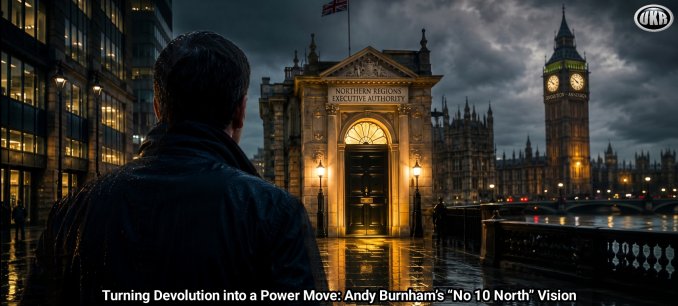
Andy Burnham’s “No 10 North” Plan Has Turned Devolution Into A Prime Ministerial Power Play
The “No 10 North” Plan That Could Redraw British Power
TAYLOR TAILORED
The Northern Office Is Really A Challenge To Westminster
Burnham Has Turned Devolution Into A Leadership TestAndy Burnham has used a major Manchester speech to put “No 10 North” at the center of his pitch for national power, proposing that part of the Prime Minister’s operation should be based in Manchester as part of a wider transfer of authority away from Whitehall. The plan sits inside a broader devolution and economic program built around regional growth, local decision-making, industrial renewal, housing, transport and a promise of “good growth in every postcode.”
That is why this matters now. Burnham is not presenting himself as another Labour manager of the existing system; he is trying to make the system itself the problem. The deeper pressure is that Britain’s political crisis is no longer only about who leads from Downing Street, but whether Downing Street still looks like the right place from which to run the country.
The Speech Was A Manchester Pitch With A National Target
The symbolism of the location mattered almost as much as the policy. Burnham chose Manchester, the city that shaped his modern political identity, to frame his leadership offer around a simple claim: Westminster is too centralized, too distant and too slow to understand the country it governs. His argument is that Britain needs a “circuit-breaker” after years of political instability, weak growth and public frustration with remote decision-making.
That makes the “No 10 North” idea more than a piece of office relocation theatre. It is a deliberate attempt to turn geography into political meaning. Burnham is trying to say that the next phase of government should not merely visit the regions, praise the regions, fund the regions or campaign in the regions, but actually move a visible part of executive authority closer to them.
The risk is obvious. A northern branch of No 10 could become a genuine institutional signal, or it could become another symbolic outpost that changes little underneath. Burnham’s challenge is that voters have heard decades of promises about levelling up, renewal, rebalancing and local empowerment; the public is now much more likely to judge the mechanism than the mood music.
This Is Really About Who Controls The State
Burnham’s pitch is built around the claim that central government has become too controlling and too ineffective at the same time. That contradiction is politically powerful because it speaks to one of the most common frustrations in Britain: people feel decisions are made far away, but the results still arrive badly, late or not at all. The promise of devolution is that places can move faster when they are trusted with money, responsibility and authority.
The proposed model would give regional leaders more power over areas such as housing, skills, infrastructure and local growth. Burnham’s supporters frame that as the biggest rebalancing of power away from Whitehall in modern times, while critics argue that the plan still needs sharper detail on funding, delivery and national trade-offs.
This is where the pitch becomes more serious. Devolution is easy to support in principle because almost everyone likes the sound of power moving closer to people. The difficult question is whether ministers, departments and the Treasury would actually surrender control when the first serious conflict arrives over money, targets, failure or political blame.
That same tension has already run through Andy Burnham’s Data-Driven Path To Labour Leadership, where the central issue was not just Burnham’s popularity, but the way his return to Parliament changed the practical route from regional figure to national contender. The “No 10 North” plan now takes that same logic and turns it into a governing argument.
Burnham Is Selling A Break From Starmerism
The timing gives the speech its edge. Burnham is making his case as Labour’s leadership crisis has moved from private anxiety into open succession politics, with his return to Westminster removing the most obvious barrier to a leadership bid. The confirmed political context is that Burnham has won the Makerfield seat, emerged as the leading figure in the race to replace Keir Starmer, and is using his first major speech to set out an economic and constitutional direction.
That makes the Manchester speech look less like policy development and more like the first draft of a premiership. Burnham’s language about growth, power and place is designed to contrast with a model of leadership that many voters and MPs now associate with caution, central discipline and managerial politics. He is not simply asking Labour to change leader; he is asking Labour to change emotional posture.
The political danger for Starmerism is that Burnham’s pitch attacks it without always naming it directly. If Westminster is broken, then the people who promised to fix it from inside Westminster are immediately weakened. If local power is the answer, then the top-down discipline of the recent Labour machine starts to look like part of the failure rather than the cure.
That is why this moment connects naturally to Starmer’s Monday Reckoning, because the Labour question has moved beyond whether Starmer is under pressure. The sharper issue is whether Labour MPs now believe a different political personality is needed to survive the next phase.
The Northern Brand Is Powerful But Dangerous
Burnham’s greatest asset is also his greatest vulnerability. His “King of the North” image gives him a clear identity in a political system full of blurred managerial figures, and his record as Greater Manchester mayor allows him to speak about transport, local government and regional pride with more credibility than a politician who only discovered devolution in a leadership campaign. But the stronger the brand becomes, the more it invites scrutiny.
A national leader cannot only be the voice of Manchester, the North or the places that feel ignored by London. He has to govern the whole country, including regions that may wonder whether “No 10 North” is a genuine redistribution of power or simply the replacement of one political center with another. The test is whether Burnham can make the plan feel national rather than regional revenge.
There is also the question of delivery. The promises around reindustrialization, housing, transport, skills and regional investment all point toward a more interventionist state, but that requires money, administrative capacity and political patience. Burnham can attack Westminster centralization, but if his own program depends on strong national coordination, he will have to show how power is moved out without responsibility becoming blurred.
That is the hidden difficulty. Voters may like the idea of local control, but they still punish national leaders when trains fail, houses are not built, wages stagnate or services break. Burnham’s devolution pitch therefore creates a new standard for himself: if power is closer to people, failure will need to be explained closer to people too.
The Real Audience Was Not Only Labour
The speech was aimed at Labour MPs, regional leaders, voters outside London and a country tired of hearing that politics is changing while daily life feels stuck. But it was also aimed at financial markets, civil servants and institutional Britain. Burnham is trying to prove that his insurgent mood can be turned into a credible governing architecture rather than just a powerful leadership story.
That distinction matters. A leadership campaign rewards sharp contrast, emotional clarity and symbolic moments. A premiership rewards endurance, cost control, coalition management and the ability to make difficult choices without losing the story that brought you to power. Burnham’s “No 10 North” idea gives him a memorable image, but it also creates a delivery trap: once you promise to move power, every delay looks like the old system fighting back.
For Labour, the attraction is clear. Burnham offers a way to speak to voters who feel economically squeezed, culturally ignored and politically managed from a distance. He gives the party a story about place, dignity and control at a time when conventional Westminster language sounds exhausted.
For opponents, the attack line is just as clear. They will argue that the plan risks more bureaucracy, more spending pressure and more political theatre at the very moment Britain needs hard answers on growth, debt, public services, immigration, defense and living standards. Burnham’s task is to make “No 10 North” look like machinery, not marketing.
The Question Is Whether Power Really Moves
The importance of Burnham’s plan is not that a Prime Minister might have an office in Manchester. Buildings can be opened, plaques can be unveiled and speeches can be staged without power truly moving anywhere. The importance is that Burnham has chosen to make the location of power itself a test of political seriousness.
If he becomes Prime Minister, the question will quickly become practical. Who controls the money? Which decisions leave Whitehall? What powers do mayors actually receive? What happens when local priorities clash with national targets? And when something fails, does blame sit locally, nationally or somewhere conveniently in between?
That is where the rhetoric will either harden into reform or dissolve into familiar British disappointment. The country has heard promises to rebalance power before. What makes Burnham’s pitch different is that he is tying his own authority to the claim that Westminster cannot simply be repaired from within.
The “No 10 North” plan lands as a prime ministerial pitch because it turns Burnham’s personal brand into a constitutional argument. He is not merely saying he should lead the country. He is saying the country has been led from the wrong emotional and institutional place for too long, and if he cannot prove that power can really move, the northern office will become not a symbol of renewal, but a monument to another promise Britain was invited to believe.
This article (Andy Burnham’s “No 10 North” Plan Has Turned Devolution Into A Prime Ministerial Power Play) was created and published by Taylor Tailored and is republished here under “Fair Use”
See Related Article Below
Initial thoughts on the first signs of policy from the putative head chimp of the UK’s Labour ‘government – government by post code and DEVOLUTION away from the Westminster bubble.
There is a complete absence of evidence that devolution works – he should start with fiscal deficits per post code and work from there!
PETER HALLIGAN
Let’s set the scene with lessons learned from other SIGNIFICANT DEVOLTION areas of Scotland, Wales and Northern Ireland..
SCOTLAND population 5.6 million.
From Brave AI:
“Scottish devolution officially began on 1 July 1999, when the Scottish Parliament convened for the first time following the passage of the Scotland Act 1998.
You won’t find any record of GDP for 1999, making analysis over the last 25 years impossible.
“Scotland’s average annual GDP growth rate was 1.4% over the period 2000 to 2019, a significant decline from the 2.4% average growth seen between 2000 and 2007
Fiscal position:
“Based on the provided search context, Scotland’s fiscal deficit in 1999/2000 was -£2,208 million (£-2.2 billion) in cash terms, according to the Government Expenditure and Revenue Scotland (GERS) historical data.
“Scotland’s fiscal deficit has generally expanded since the early 2000s, rising from a negligible balance in 2000/01 to a significant deficit of £26.2 billion in 2024/25. “
“In 2024/25, Scotland’s deficit was more than double the UK-wide deficit of 5.1% of GDP (approximately £14 billion higher per person than the UK average). While Scotland historically benefited from North Sea revenues, its reliance on implicit fiscal transfers from the rest of the UK has increased, with per-person spending in Scotland being 14% higher than the UK average in 2024/25.from 2000, Scotland’s deficit has been around £15 billion pounds- accumulating over the last 20 years to around 300 billion pounds – one tenth of the UK’s 3 trillion pounds debt pile.
“Scotland’s nominal Gross Domestic Product (GDP) was estimated at £223.4 billion in 2024, or approximately £218.0 billion in 2023, including offshore oil and gas extraction. When excluding North Sea revenues (onshore only), the 2024 GDP was £209.5 billion.”
Wales -devolution in 1996, population a little over 3 million.
Wales has similarly run a fiscal deficit mostly in excess of 15% of GDP for the last few decades” which accumulates to another 300 billion pounds over 20 years.
Wales’s Gross Domestic Product (GDP) was estimated at £92.8 billion in 2023, representing 3.4% of the total UK GDP.
Northern Ireland (Ulster) -devolution in 2006 population just under 2 million.
Northern Ireland’s GDP was £63.3 billion in 2023, with a GDP per capita of £32,944
“Northern Ireland has maintained a fiscal deficit every year since 1966, with the gap between local taxation and government spending historically averaging around £10 billion per annum in recent decades. The deficit peaked in 2009–10 at approximately £11.5 billion (in 2014 pounds) and £12.7 billion in real terms by 2010, driven by rising public spending and falling tax revenues. Following the 2008 recession, the deficit fell by roughly 25% in real terms over the subsequent decade, settling at around £9.4 billion to £9.5 billion by the late 2010s.
There is no evidence of the success of devolution in these 3 distinct countries. Instead they have contributed a significant amount to the national debt and deficits of the United Kingdom.
So, on what basis does the new putative ‘head chimp’ claim that DEVOLUTION is the answer for the woes of the UK and its major metropolitan areas?
Remember the UK’s major metropolitan councils are extremely badly run and are corrupt.
From February 2026:
“In the frame are useless and expensive IT systems run by companies like Capita, unregulated LOBO loans and the big 4 Consultancy firms (Deloitte, PwC (PricewaterhouseCoopers), EY (Ernst & Young), and KPMG) who charge £1,500 per day for strategic ‘Treasury’ advice, and charge again to put it right when it fails.
The outcome is failing councils with billions of debt, cutting services because of interest payments on debt that soaks up a huge chunk of ratepayers taxes – half of all councils will be bankrupt within 5 years.
“Nine UK councils have declared effective bankruptcy since 2018.
And from May 2026:
“None of the political campaigns for local authorities campaigned on slashing local taxes by addressing the corruption and inefficiencies or bloated salary/benefits of employees. the Greens even campaigned in Irdu!”
It is unclear why giving such local authorities even more money to mismanage would result in any better outcomes for UK Citizens.
Whitehall may by incompetent and may centralize decision-making, but unless and until monkey brain Burnham can calculate the fiscal deficits for each significant postcode he will risk further widening the gap between the post codes of Britain and also encourage even more corruption.
Does Burnham propose a pro rata allocation of every civil service department and type of civil servant into every postcode? How does he propose to monitor national standards in health, education and housing etc. I suspect that rich local authorities will resent bailing out the ghettos of poorer local authorities!
Please take a (paid or unpaid) subscription or forward this article to those you think might be interested.
You can also donate via Ko-fi – any amount from three dollars upwards. Ko-fi donations here:
https://ko-fi.com/peterhalligan
This article (Initial thoughts on the first signs of policy from the putative head chimp of the UK’s Labour ‘government – government by post code and DEVOLUTION away from the Westminster bubble.) was created and published by Peter Halligan and is republished here under “Fair Use”
Featured image based on original by Taylor Tailored

••••
The Liberty Beacon Project is now expanding at a near exponential rate, and for this we are grateful and excited! But we must also be practical. For 7 years we have not asked for any donations, and have built this project with our own funds as we grew. We are now experiencing ever increasing growing pains due to the large number of websites and projects we represent. So we have just installed donation buttons on our websites and ask that you consider this when you visit them. Nothing is too small. We thank you for all your support and your considerations … (TLB)
••••
Comment Policy: As a privately owned web site, we reserve the right to remove comments that contain spam, advertising, vulgarity, threats of violence, racism, or personal/abusive attacks on other users. This also applies to trolling, the use of more than one alias, or just intentional mischief. Enforcement of this policy is at the discretion of this websites administrators. Repeat offenders may be blocked or permanently banned without prior warning.
••••
Disclaimer: TLB websites contain copyrighted material the use of which has not always been specifically authorized by the copyright owner. We are making such material available to our readers under the provisions of “fair use” in an effort to advance a better understanding of political, health, economic and social issues. The material on this site is distributed without profit to those who have expressed a prior interest in receiving it for research and educational purposes. If you wish to use copyrighted material for purposes other than “fair use” you must request permission from the copyright owner.
••••
Disclaimer: The information and opinions shared are for informational purposes only including, but not limited to, text, graphics, images and other material are not intended as medical advice or instruction. Nothing mentioned is intended to be a substitute for professional medical advice, diagnosis or treatment.
Disclaimer: The views and opinions expressed in this article are those of the author and do not necessarily reflect the official policy or position of The Liberty Beacon Project.


Leave a Reply