

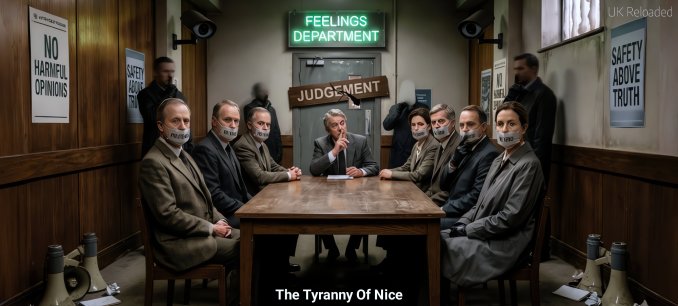
How Britain quietly outsourced judgement to the feelings department — and why decisiveness has become a professional hazard.
THE RATIONALS
One can always tell when a civilisation has taken a wrong turn, not by the volume of its arguments, but by the elaborate emotional scaffolding required before anyone dares to have one.
In Britain today, disagreement no longer begins with a difference of opinion. It begins with a ritual of reassurance. Is the space “safe”? Has everyone been “heard”? Will any stray fact be wrapped in enough cotton wool to prevent it from bruising a sensibility?
Only once these liturgical preliminaries are complete may one proceed—gingerly, of course—to the business of not quite saying what one means.
Nothing is wrong any more. It is “unhelpful”. Or, if the stakes are high, “harmful”. The vocabulary of the therapist’s couch has quietly colonised the boardroom, the classroom, the hospital corridor and the dispatch box.
One observes it in action and marvels, with a certain bleak admiration, at the national capacity for self-delusion dressed up as sensitivity.
Even the most ordinary workplace gathering — the sort that once dispatched a missed deadline or a duff decision in five crisp minutes, back when Britain still made things and expected people to turn up on time — now vanishes beneath layers of acknowledgement.
The situation is “challenging”. Feelings must be “validated”. By the time the problem has been swaddled in so many caveats it resembles a duvet, everyone leaves feeling terribly evolved.
Nothing has been resolved, of course. But no one has been upset — which, one gathers, is the more important thing. How terribly modern.
It is tempting to treat this as mere managerial fashion, the corporate equivalent of beanbags and open-plan offices. Yet fashions rarely spread with such eerie consistency, nor do they survive first contact with reality.
This one does both, because it fits the age rather well. Britain has become, in ways rarely stated plainly, a more thinly structured society, work less secure, communities less binding, expectations less shared.
The old scaffolding has not collapsed entirely, it has simply loosened enough to leave the individual holding more of the weight.
Here the deeper logic of the age reveals itself. When shared roles, expectations and informal authority have quietly loosened their hold, a society can no longer lean on them to regulate behaviour.
Something must take their place — and emotional language, portable, intuitive and requiring no common standard beyond the simple recognition of feeling, fills the gap with rather impressive efficiency.
And when external structure weakens, internal reference takes its place. One begins, almost inevitably, to ask not “what is this?” but “how does this feel?”
That quiet pivot explains a great deal. The dominant norms now shaping British institutions are unmistakably feminised — not in any crude demographic sense, but in their priorities. A risk-averse, harm-minimising, affect-sensitive governance logic in which care is elevated above judgement, safety above risk, and emotional validation above resolution.
One does not, of course, speak here of the mere rise in female personnel — an unremarkable demographic shift — but of a subtler reordering, judgement quietly ceding ground to care, risk tolerance to safety, correction to comfort.
Operating preferences, one might say, that have scaled rather splendidly.
One wonders, in passing, whether this represents progress or merely a new form of conformity dressed in softer clothing. What began as a necessary corrective has hardened into a governing instinct. And like all governing instincts, it does not simply sit alongside reality, it determines which parts of reality are allowed to matter.
Schools have absorbed the logic with particular enthusiasm. A child once called “disruptive” is now “struggling” — as though the real difficulty lay not in the behaviour but in its interpretation.
Behaviour is “communication”. Discipline survives only in apologetic quotation marks, administered with the caution of a man handling unstable explosives.
The intention is humane. The effect is rather less obviously so. Literacy rates wobble, classrooms grow harder to manage, and teachers spend as much time regulating atmosphere as imparting knowledge.
The system has become exceptionally good at understanding why things go wrong. It is less confident about insisting that they go right.
The National Health Service offers an even clearer view of the same pattern under strain. Patients wait on trolleys in corridors — a situation that would once have been described, without ceremony, as a failure.
Now it arrives accompanied by guidance on maintaining dignity and ‘managing experience’ — whatever that may entail. Meanwhile the vocabulary of mental health expands steadily outward, anxiety, overwhelm, distress — each carefully named, each carefully held.
Entire layers of administrative language now sit between the patient and the problem, even as waiting lists lengthen and staff thin out. One begins to suspect that description has, in some cases, replaced resolution.
Public policy follows the same script, only louder.
Climate change is not presented as a set of trade-offs, costs and competing priorities — which, of course, it plainly is — but as a moral imperative.
We must act. We must protect. We must prevent harm.
The tone is urgent, occasionally apocalyptic, and always morally charged.
Once a policy is framed in these terms, disagreement becomes difficult to articulate. One is no longer weighing options but signalling concern.
Question the method and you risk appearing indifferent to the outcome, raise costs and you sound faintly callous.
The argument is not won. It is pre-structured.
Energy costs rise, industrial capacity tightens, households absorb the pressure, and businesses adjust, relocate — or fold. These are ordinary trade-offs, yet they are rarely described in those terms.
Instead, they are reframed — as necessary, responsible, morally required. Which may be true.
But it places the discussion beyond ordinary scrutiny.
The difficulty is not that the policies themselves are mistaken, but that their moralised framing quietly removes them from the ordinary business of trade-offs and optimisation.
Once something has been declared a moral imperative, the real costs and compromises do not vanish — they simply become harder to mention in polite company.
Immigration receives much the same treatment. The language is one of compassion, fairness, responsibility — all perfectly reasonable, all perfectly incomplete.
Questions of scale, pace, integration and long-term consequence tend to enter the room cautiously, as though aware they are trespassing on moral ground.
Housing demand rises, public services stretch, wages and infrastructure come under pressure. These are not moral questions alone. They are structural ones.
But when the conversation is framed primarily in terms of compassion, structural questions begin to sound — if not illegitimate — then at least slightly out of tune. The debate is not shut down. It is pre-shaped.
The result is a debate conducted in two incompatible registers, moral language on the surface, structural reality underneath. The former is publicly permissible, the latter quietly accumulates consequences.
None of this requires coordination. There is no central directive, no conspiracy of therapists operating from a discreet office in Whitehall.
The shift has occurred because it is, in its own way, functional. A society composed of more autonomous individuals, bound less tightly by shared roles and expectations, requires a different kind of operating language — one that travels across contexts and does not depend on agreement about facts, only on recognition of feelings.
Institutions adopt it because it works. It defuses conflict, signals virtue, and allows decisions to be framed in terms that are difficult to oppose. It spreads not because it is imposed, but because it is useful.
And then, inevitably, it begins to shape behaviour. A society highly attuned to discomfort will, quite rationally, attempt to minimise it.
Decisions are hedged. Language is softened. Commitments are delayed. Everything remains, as far as possible, open, flexible, reversible.
One sees it even in the most casual encounters. A friend of ours was recently engaged in a frank but friendly exchange with a Muslim acquaintance over coffee when a woman at the next table leaned over, uninvited, and informed him — with the serene authority of a minor official — that he “cannot say things like this to a Muslim”.
The conversation had been amicable, neither party had taken offence. Yet the stranger felt compelled to police the emotional perimeter anyway. Plain speaking, it seems, now requires a licence — even from passers-by.
Nor is this any longer confined to the voluntary realm. Statute has now joined the chorus with gusto. Labour’s Employment Rights Act — the centrepiece of the much-trumpeted New Deal for Working People — has taken the therapeutic idiom and elevated it to the status of law.
Day-one rights to parental leave, statutory sick pay without the old earnings threshold or waiting days (making anxiety, stress and “overwhelm” as legitimate a reason for absence as any broken leg), strengthened duties to prevent harassment (including from third parties), and a beefed-up Fair Work Agency ready to enforce the new sensitivities with fines and tribunals.
Disciplinary processes have been lengthened and padded with procedural velvet. The consequences are rather more telling than they first appear. Authority becomes conditional, forever hostage to interpretation.
Managers must now govern not only outcomes but the delicate matter of how those outcomes feel. And once perception itself is given the force of law, decisiveness starts to look suspiciously like a professional hazard.
The office, it seems, must first be a “safe space”; only then may it be a place of work. A government that swept to power promising to “make work pay” has instead made work feel safer — and, in the process, made decisive management a good deal more perilous.
The vocabulary of the therapist’s couch is no longer a cultural affectation. It is the statute book.
Emails are rewritten three times. Opinions arrive with pre-emptive disclaimers. Conversations are carefully staged to avoid friction before it has even appeared.
Nothing is ever simply said. And because nothing is simply said, nothing lands with full weight.
You can see it in the larger patterns too: a preference for optionality over decision, for preparation over action, for keeping things open rather than closing them down.
Careers extended indefinitely in the name of flexibility. Commitments delayed until conditions feel sufficiently stable — which they rarely do.
Life becomes something to be managed carefully rather than entered into decisively. This is not irrational. It is the logical outcome of the system as it now operates.
If discomfort is to be minimised, then minimising it becomes a form of competence. If emotional equilibrium is to be preserved, then anything that disrupts it will be treated with caution.
The system is not failing. It is functioning exactly as the logic of the age demands. The question is what it produces.
A society that speaks constantly about wellbeing — does it become more well? A system that prioritises safety — does it become more stable? A culture that avoids discomfort — does it become more capable?
It is difficult to say. But one notices, after a while, that certain kinds of decision begin to disappear. Not the easy ones. Not the reversible ones.
The difficult ones — the binding ones — the ones that impose structure rather than adapt to it. The ones that require clarity rather than calibration. They are not rejected. They are postponed. And postponed. And then, quietly, not taken at all.
Britain has become remarkably articulate about how things feel. It is less clear that it remains as comfortable deciding what to do about them.
And that, one suspects, may be the more consequential shift. Not loud. Not dramatic. But, over time, quietly decisive.
One wonders, in the end, what sort of country quietly accrues from such gentle paralysis, problems that are never quite denied, merely “processed” into irrelevance, structural pressures that mount while the language of care grows ever more elaborate, a nation that finds itself, one unmade decision at a time, less equipped to meet the harder realities of the century ahead.
A system that cannot tolerate discomfort will, in time, become incapable of decisive action — not because it lacks intelligence, but because it has redefined decisiveness itself as harm.
Such is the quiet victory of the tyranny of nice.
The Silent Triad Episode 2 – Propaganda is available to listen to now here
This article (The Tyranny of Nice) was created and published by The Rationals and is republished here under “Fair Use”

••••
The Liberty Beacon Project is now expanding at a near exponential rate, and for this we are grateful and excited! But we must also be practical. For 7 years we have not asked for any donations, and have built this project with our own funds as we grew. We are now experiencing ever increasing growing pains due to the large number of websites and projects we represent. So we have just installed donation buttons on our websites and ask that you consider this when you visit them. Nothing is too small. We thank you for all your support and your considerations … (TLB)
••••
Comment Policy: As a privately owned web site, we reserve the right to remove comments that contain spam, advertising, vulgarity, threats of violence, racism, or personal/abusive attacks on other users. This also applies to trolling, the use of more than one alias, or just intentional mischief. Enforcement of this policy is at the discretion of this websites administrators. Repeat offenders may be blocked or permanently banned without prior warning.
••••
Disclaimer: TLB websites contain copyrighted material the use of which has not always been specifically authorized by the copyright owner. We are making such material available to our readers under the provisions of “fair use” in an effort to advance a better understanding of political, health, economic and social issues. The material on this site is distributed without profit to those who have expressed a prior interest in receiving it for research and educational purposes. If you wish to use copyrighted material for purposes other than “fair use” you must request permission from the copyright owner.
••••
Disclaimer: The information and opinions shared are for informational purposes only including, but not limited to, text, graphics, images and other material are not intended as medical advice or instruction. Nothing mentioned is intended to be a substitute for professional medical advice, diagnosis or treatment.
Disclaimer: The views and opinions expressed in this article are those of the author and do not necessarily reflect the official policy or position of The Liberty Beacon Project.


Leave a Reply