

RICHARD LYON
Clive Pinder’s essay in the Daily Sceptic last weekend on English independence is sharply argued and often very funny. Suppose he’s right.
Suppose the United Kingdom really has become, as he characterised it, “an exhausted multinational holding company held together by inertia, nostalgia, transfer payments and the BBC weather map”. Suppose Scotland really does vote like a Nordic social democracy, Wales like its run by public-sector socialists and Northern Ireland like a theological argument attached to a motorway network. Suppose England really does carry most of the economic weight, only to be lectured by its own governing class for the impertinence of noticing.
Suppose the diagnosis is exactly right: Pinder has pinpointed the rot accurately. He has then drawn precisely the wrong conclusion from it.
The first thing he gets wrong is the confusion of the British state with the British settlement.
The state is the political class, the supranational creep, the regulatory accretion, the judicial activism, the BBC, the Civil Service that signed off tens of billions of pandemic-era fraud and waste without anyone in particular being held to account. The settlement is the 1707 Acts of Union, the shared Crown, the common law, the Parliament, the British identity built across three centuries on top of those. The state has spent the past three decades betraying the settlement. The settlement has held up rather better than the state has — through industrial revolutions, two World Wars, the loss of empire, devolution and Brexit. Its institutions still work. Dissolving the settlement to fix the state is amputation on the theory that a missing leg is less trouble than a sore knee.
The second thing Pinder gets wrong is the confusion of a nationalist administration with a nation.
Independence has not been a majority position in Scotland for over a decade. The latest YouGov tracker puts Scottish opinion at 56% No and 44% Yes — barely moved from the 55/45 of the 2014 referendum. Support has not crossed 50% sustainably since a brief peak during the 2020 pandemic.
But even that statistic massively overstates actual support. Fewer than one in five Scottish voters backed the SNP at the 2024 General Election — about the same share of English voters who backed Labour. The Holyrood administration’s wishes are no more ‘Scotland’s wishes’ than Sir Keir Starmer’s are ‘England’s wishes’. We in Scotland are as repelled by the antics of our nationalist regional administration as anyone in England is. A determined minority would like independence; the country has voted against them every time it has been asked.
Pinder makes much of Sinn Féin, the SNP and Plaid Cymru lining up to break up the UK. Plaid has just become the largest party in the Senedd, it is true — on 35% of the vote, with Reform UK on 29% right behind it. The ‘breakup-the-UK axis’ is a Telegraph splash. Welsh politics has realigned, but the realignment is towards a Plaid-Reform polarity in which the unionist vote is bigger than the separatist vote. That is the opposite of the story Pinder is telling.
His economic case rests on three elegant slips, all of the same kind, namely: take the UK’s strongest number, attribute it to England, and count the maths as victory.
“England already accounts for roughly 85% of UK GDP,” he writes. Four paragraphs later: “84% of the UK population live” in England. The two figures are essentially the same number. A nation with 85% of the population producing 85% of the GDP is producing precisely what its population suggests. That is a population story dressed up as a productivity claim.
Gross Domestic Product per head — what each region produces, per person, in pounds — tells a different story. The UK average was £39,403. London’s in 2023 was £69,077. The North East of England’s was £28,583 — the lowest figure in the UK, below Wales’s £29,316, below Northern Ireland’s £32,944, and well below Scotland’s £37,192. England’s headline ‘lift’ over the other nations is the work of London and the South East alone. Strip those two regions out, and most English regions sit below Scotland. The “engine room of the UK” is London, and London alone. An independent England would still face precisely the same productivity divergence inside its own borders.
Pinder also informs us, with some confidence, that an independent England’s economy would be “around $3.5 trillion to $3.7 trillion”. The whole United Kingdom’s nominal GDP in 2024, on the IMF’s figures, was $3.69 trillion. England alone, on the standard 86% share, is roughly $3.18 trillion. Pinder has used the UK’s GDP as if it were England’s.
His Barnett claim is half-told too.
Public spending per head in 2023-24 — HM Treasury’s own numbers — runs to £15,371 in Northern Ireland, £14,759 in Scotland, £14,424 in Wales and £12,625 in England. These are real differentials. The reasons are mostly geographic and historical — not the one-way English subsidy Pinder’s framing implies: services cost more per head in sparsely populated rural areas; the Barnett formula sets the year-on-year change in devolved spending but inherits a pre-1979 base it does not reset; and the devolved administrations make their own spending choices on top of all that. The conservative answer is needs-based reform with fiscal accountability and a transparent Barnett successor. None of that requires partition. If you don’t believe you can reform Britain, what makes you think you could then reform England?
The real sleight in Pinder’s case is the image of an England liberated to become ‘Singapore-on-Thames’ — low-tax, deregulated, energy-realist, controlled at the borders, free of the ECHR, “rooted in Parliamentary sovereignty”.
Singapore has six million people, no NHS, no welfare state, no ECHR, and 60 years of unbroken industrial policy under a quasi-one-party state. England has 58 million people, an NHS, an ageing population, a judicial activism culture and the same political class everyone else in the UK has. The analogy is doing rhetorical work the underlying facts cannot carry.
Set that aside: every reform Pinder wants is a Westminster decision.
ECHR exit is a Westminster decision. Planning reform is a Westminster decision. Immigration control is a Westminster decision — Holyrood has no power over the borders Pinder is worried about. Corporate tax rates are set in Westminster. The fight against judicial activism is fought against UK-wide courts on UK-wide cases. Energy policy, including the ruinous Net Zero command-and-control he and I both oppose, is set in Westminster. The only obstacle to the policy programme he sketches is the political class in London, the Treasury, the Bar, the judiciary, the Civil Service and the regulators — exactly what an independent England would inherit in full and unchanged.
Pinder has correctly identified the disease. He has then proposed cutting off a perfectly serviceable Scottish, Welsh and Northern Irish limb on the spurious grounds that the disease is mostly localised outside of England. Ten years of constitutional divorce is 10 years not legislating the reform agenda he says he wants. And at the end of it, the Treasury and the Bar will still be where they were.
As for “disputes over debt allocation, military assets, Trident submarines and borders” — Pinder’s parenthetical wave at the inconvenient consequences — the Trident question alone is enough to embarrass the essay. The UK’s strategic deterrent sits at Faslane because the geography of the Firth of Clyde delivers deep, sheltered, stealthy access to the GIUK gap and the North Atlantic patrol areas. There is no equivalent on the English coast. Relocating it is a decade-long project; the original Faslane build took 13 years and £1.9 billion in 1994 prices — at the time the second most expensive works project in the United Kingdom after the Channel Tunnel. Pinder treats the unwinding of all that as “financial markets dislike uncertainty”. Indeed they do.
And while we are on the subject of historical accounting: the Scottish geographic asset called the North Sea has paid into the UK exchequer for five decades. The flows have run both ways. What Britain did with that revenue — saved none of it and spent all of it, leaving the country carrying the largest peacetime national debt in its history — is a Westminster matter. The little-Englander has not earned the right to wash his hands of it.
I write this as a Scot living in Edinburgh. I am proudly Scottish, proudly British.
With under one in 10 of the UK population, Scotland supplied a remarkable share of the people who put the ‘Great’ into ‘Great Britain’: five Prime Ministers across the era when modern Britain was made, much of the imperial administration, the shock troops of our wars, and a great deal of the intellectual and industrial firepower behind Britain’s 19th-century pre-eminence.
To take but two examples. The British settlement built more than Britain. Its contribution to the European Enlightenment was substantially a Scottish one. The settlement built America too. John Witherspoon, born in East Lothian, signed the Declaration of Independence and, as president of what became Princeton, taught James Madison the architecture of checks and balances. James Wilson, born in Fife, signed both the Declaration and the Constitution. Jefferson took “unalienable rights” from Francis Hutcheson, professor of moral philosophy at Glasgow. Andrew Carnegie, born in Dunfermline, founded the American steel industry. The most powerful country on earth has Scottish foundations — and therefore British foundations.
This is not boasting and it is not Scottish exceptionalism. Nor does it deny the real grievances of English readers, who endure a steady drip of nationalist grievance-mongering from north of the border. It is, however, the historical fact that Pinder’s argument has to ignore in order to work. England is great in significant part because of Scotland’s role in making it so. The reverse holds. To frame the relationship as one of English subsidy and Celtic ingratitude is to get three centuries of British history backwards, and to abandon the next three.
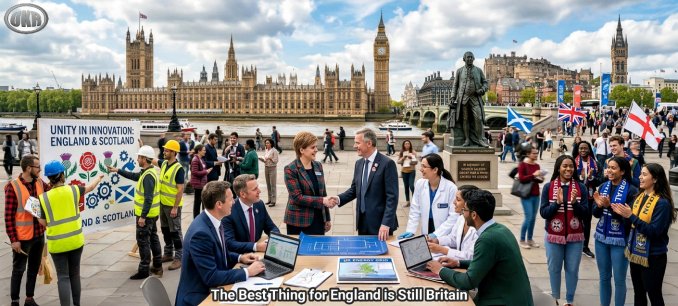
There is a reason Britain is called Great Britain. The supporters of little-England separatism may end up in an England. They will not end up in a Great England. The answer to these problems is to stay joined, to work together and to keep making the case for why separatism is the creed of the small mind — on both sides of the border.
Pinder ends his essay “cheerfully, calmly, amicably”. It is a graceful close and I will return the favour.
Cheerfully, calmly, amicably — no. Or, as we say affectionately in Scotland: awa’ an bile yer heid.
Richard Lyon writes the State of Britain Substack and is the author of The Energy Trap (forthcoming)
This article (The Best Thing for England is Still Britain) was created and published by The Daily Sceptic and is republished here under “Fair Use” with attribution to the author Richard Lyon

••••
The Liberty Beacon Project is now expanding at a near exponential rate, and for this we are grateful and excited! But we must also be practical. For 7 years we have not asked for any donations, and have built this project with our own funds as we grew. We are now experiencing ever increasing growing pains due to the large number of websites and projects we represent. So we have just installed donation buttons on our websites and ask that you consider this when you visit them. Nothing is too small. We thank you for all your support and your considerations … (TLB)
••••
Comment Policy: As a privately owned web site, we reserve the right to remove comments that contain spam, advertising, vulgarity, threats of violence, racism, or personal/abusive attacks on other users. This also applies to trolling, the use of more than one alias, or just intentional mischief. Enforcement of this policy is at the discretion of this websites administrators. Repeat offenders may be blocked or permanently banned without prior warning.
••••
Disclaimer: TLB websites contain copyrighted material the use of which has not always been specifically authorized by the copyright owner. We are making such material available to our readers under the provisions of “fair use” in an effort to advance a better understanding of political, health, economic and social issues. The material on this site is distributed without profit to those who have expressed a prior interest in receiving it for research and educational purposes. If you wish to use copyrighted material for purposes other than “fair use” you must request permission from the copyright owner.
••••
Disclaimer: The information and opinions shared are for informational purposes only including, but not limited to, text, graphics, images and other material are not intended as medical advice or instruction. Nothing mentioned is intended to be a substitute for professional medical advice, diagnosis or treatment.
Disclaimer: The views and opinions expressed in this article are those of the author and do not necessarily reflect the official policy or position of The Liberty Beacon Project.


Leave a Reply