
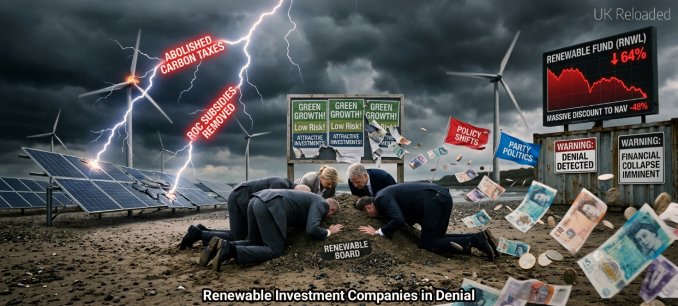
Renewables investment companies are not fully evaluating the risks of abolishing carbon taxes and removing ROC subsidies.
DAVID TURVER
Introduction
It has been a while since we covered the performance of some of the renewable energy investment companies. Last year, we looked in varying levels of detail at Greencoat UK Wind (UKW), Octopus Renewables Infrastructure Trust (ORIT) and The Renewables Infrastructure Group (TRIG).
Recently, the Labour Government have made announcements that make life difficult for funds like these such as reducing the indexation rate of Renewables Obligation Certificates (ROCs) and removing the Carbon Price Support (CPS) from wholesale electricity prices in April 2028. These announcements have been somewhat offset by the even more recent announcement of a consultation on introducing Wholesale Contracts for Difference (WCfDs) for the market prices received by ROC-funded generators.
However, these changes are relatively minor compared to the changes proposed by the Tories and Reform if they were to form the next Government. Reform have promised to abandon Net Zero. The Tories have gone further and announced specific plans to remove the CPS (as above) as well as removing the Emissions Trading Scheme (ETS) which imposes even larger carbon costs on wholesale electricity prices. The Conservatives have also said they would abolish the ROC scheme early which would obviously have a far greater impact than just indexing the value upwards by a smaller value each year.
In the light of the green fund SEIT throwing in the towel, the question then arises, how well are these investment companies evaluating risk and what would the impact be of a new anti-Net Zero government headed by Reform or the Tories.
Investment Performance
All three companies describe themselves in glowing terms in their annual reports. UKW says:
“Greencoat UK Wind PLC is the leading listed renewable infrastructure fund, invested in UK wind farms. The Company was designed for investors, from first principles, to be simple, transparent and low risk.”
ORIT says its investment objective is to:
“Provide investors with an attractive and sustainable level of income returns, with an element of capital growth, by investing in a diversified portfolio of renewable energy assets in Europe and Australia.”
TRIG says it represents a “robust investment proposition” and:
“Develops, constructs and operates a portfolio of renewable energy infrastructure that creates value for its shareholders and generates secure, clean electricity that benefits both society and the environment.”
Now let us compare the rhetoric to the actual performance of these trusts since their share prices peaked as shown in Figure 1.

The UKW share price is down over 40% since peaking in September 2022, ORIT is down over 48% over the same period and TRIG down over 52%. According to Hargreaves Lansdown, UKW shares trade at a 25% discount to Net Asset Value (NAV), ORIT trades at a 39% discount and TRIG 35%. The NAV for all three companies was down in 2025.
None of these investment companies are living up to their marketing flannel. UKW has shown itself to be anything but low risk. ORIT has provided the opposite of capital growth and TRIG’s performance has been anything but robust and it has not created value for its shareholders. It is clear the fund managers are in denial and the large discounts to NAV demonstrate the market does not believe the hype.
Short Term Risks and Opportunities
Recent news from the government has demonstrated that investing in renewables is becoming riskier. In January, the Government changed the inflation measure that Renewables Obligation Certificates (ROCs) and Feed-in-Tariffs (FiTs) are indexed by from RPI to CPI. This had the effect of lowering the expected revenue paid to generators subsidised by these schemes. All three of these companies reported they had taken a hit to their NAV as a result of this change. UKW reported the change reduced its NAV by 2.6p per share (or about 1.9%). ORIT said the ROC indexation impact was 0.93p per share (1%) and TRIG stated the impact was 0.6p per share (0.6%).
In April, the Government also announced that the Carbon Price Support (CPS) scheme will be removed in April 2028. The CPS sets a tax on carbon that increases the wholesale price of electricity generated from gas and coal. However, because ROC-funded generators receive the wholesale price of electricity in addition to their certificates, the CPS also acts as a hidden subsidy to these generators. All three companies put a brave face on this announcement. UKW claimed they already assumed that CPS would be phased out in their NAV calculation but nevertheless admitted bringing forward this move would impact their NAV by a further 3-5p per share. ORIT said the impact of early CPS removal would be about 0.5p per share and TRIG also expected NAV reduction of 0.5p per share.
The combination of these moves was clearly unsettling prompting Ed Miliband to announce “decisive action to break the influence of gas on electricity prices.” The detail of the announcement does not quite live up to the headline. At its core, ROC-funded generators will be offered voluntary long-term contracts called Wholesale Contracts for Difference (WCfD) which will offer a fixed price for the electricity they generate. In effect, ROC-funded generators would be offered a fixed price for the whole of their output, a fixed WCfD plus their ROCs. The government is also wielding a stick by saying they will increase the Electricity Generators Levy (EGL), a tax on profits if electricity prices rise above a certain level. UKW is unconcerned about changes to the EGL but tried to face both ways on WCfDs by claiming they would offer savings to consumers and “attractive index-linked cashflows” to generators. ORIT was also unconcerned about changes to the EGL but was licking its lips at the “opportunity to secure additional long-term fixed revenues” from WCfDs. Unsurprisingly, TRIG was unfazed about changes to the EGL and looks on WCfDs favourably after lobbying Government for such a mechanism to be introduced.
The Elephants in the Room
The changes to ROC indexation and removal of CPS in 2028 are relatively small changes compared to what might be coming down the line after the next election. CPS is levied at £18/t of carbon per tonne of carbon dioxide. The price of carbon in the UK Emissions Trading Scheme (ETS) varies with futures prices rising as high as £70/t in mid-January 2026 then falling to about £36/t in mid-March before rising again to about £48/t in early May. ETS carbon costs increase the wholesale price of gas-fired electricity by much more than CPS.
The Conservatives are committed to removing both the CPS and ETS if they come to power and they have also committed to ending the ROC scheme early. Reform have been less specific, but they too are committed to ending Net Zero, so it would be unsurprising if they were to mimic Tory policies on carbon taxes and ROCs. The impact on investment companies like UKW, ORIT and TRIG of removing ETS will be much larger than phasing out CPS. Ending the ROC scheme entirely would have a much bigger impact than reducing the rate of indexation. These policies are the elephants in the room the investment companies are reluctant to talk about.
Now let us look at how the companies are evaluating risk and their sensitivity analysis.
Greencoat UK Wind (UKW)
In its latest annual report (p33) UKW acknowledges there is a risk of “further retrospective changes” to ROCs and carbon prices that may render the portfolio “less commercially viable”, the company says “it considers the likelihood of any further material retrospective policy to be low in the short term (less than 5 years)”. We can see why they might be reluctant to fully quantify the risks of an anti-Net Zero government in Figure 2.

Earlier this year, carbon costs made up about a third of the cost of gas-fired electricity. A considerable proportion of UKW’s portfolio (p15 of their 2025 annual report) relies on ROC subsidies. The combination of removing carbon taxes and ROC subsidies would be devastating for their power price assumptions and their revenue, likely much more than the maximum 10% reduction contemplated in their sensitivity analysis. Such a reduction in power prices would likely also lead to a significant reduction in their assumed asset life of 30 years. They say a 10% reduction in the power price, would knock about £299m off their asset value. Reducing asset life by 5 years would result in a £350m reduction in asset value. Taken together they represent a 22.5% reduction in NAV. Abolishing carbon taxes and ending ROCs early would likely have a much bigger impact.
Octopus Renewables Infrastructure Trust (ORIT)
ORIT’s annual report (p27) gives a clearer indication of the impact of ending ROCs early (see Figure 3).

From 2026 to 2031, the total power price including green certificates is about £90/MWh. The power only price is around £60/MWh. This means green certificates (we should note that some of these will be from overseas) make up about a third of revenues. ORIT notes that a 10% reduction in power prices would reduce NAV by 9.2p per share or about 9.9%. They do not quantify the impact of a reduction in asset lives as a result of lower power prices. ORIT reckon (pp49-51) the risk from “asset valuation sensitivity” is moderate. They do recognise a future Reform government as a risk to asset economics and operating model, but again they are not contemplating the full impact of abolishing carbon taxes and ROCs in their sensitivity analysis.
The Renewables Infrastructure Group (TRIG)
In their 2025 annual report, TRIG mentions the risk of Reform’s manifesto pledges to scrap Net Zero and stop further subsidy contracts. They also highlight the risk of changes to regulation, mentioning a possibility of index-linked ROCs being replaced by Fixed Price Certificates. They say that over the next 10 years, 65% of their revenue will come from government subsidies such as FiTs, ROCs, CfDs and fixed price power purchase agreements. They go on to say that 19% of 2026 revenues will come from ROCs and FiTs. Yet, their sensitivity analysis (p43) only considers a 10% reduction in power prices that will lead to a 7.3p/share reduction in NAV. A reduction of one year in average asset life would have a 1.1p/share reduction. TRIG fails to mention the Tory policies of abolishing carbon taxes and scrapping ROCs which will have a much bigger impact on NAV. However, they do note that “withdrawal of specific subsidy income from retroactive government action, should it manifest, may threaten the solvency of individual projects.”
Conclusions
Despite the marketing flim-flam claiming to create value in low-risk attractive investments, the performance of these companies has been dreadful for the past four years, despite receiving generous subsidies. These subsidies are now at risk from political parties awakening to the impact high energy prices are having on businesses and households. These companies are not fully evaluating the risks to their asset value of abolishing carbon taxes and removing ROC subsidies. The boards of these companies are in denial and have their heads firmly stuck in the sand. No wonder they are trading at massive discounts to NAV.
Eigen Values now has over 5,300 subscribers and is growing fast. If you enjoyed this article, please share it with your family, friends and colleagues. Please consider signing up for or gifting a paid subscription.
This article (Renewable Investment Companies in Denia) was created and published by David Turver and is republished here under “Fair Use”

••••
The Liberty Beacon Project is now expanding at a near exponential rate, and for this we are grateful and excited! But we must also be practical. For 7 years we have not asked for any donations, and have built this project with our own funds as we grew. We are now experiencing ever increasing growing pains due to the large number of websites and projects we represent. So we have just installed donation buttons on our websites and ask that you consider this when you visit them. Nothing is too small. We thank you for all your support and your considerations … (TLB)
••••
Comment Policy: As a privately owned web site, we reserve the right to remove comments that contain spam, advertising, vulgarity, threats of violence, racism, or personal/abusive attacks on other users. This also applies to trolling, the use of more than one alias, or just intentional mischief. Enforcement of this policy is at the discretion of this websites administrators. Repeat offenders may be blocked or permanently banned without prior warning.
••••
Disclaimer: TLB websites contain copyrighted material the use of which has not always been specifically authorized by the copyright owner. We are making such material available to our readers under the provisions of “fair use” in an effort to advance a better understanding of political, health, economic and social issues. The material on this site is distributed without profit to those who have expressed a prior interest in receiving it for research and educational purposes. If you wish to use copyrighted material for purposes other than “fair use” you must request permission from the copyright owner.
••••
Disclaimer: The information and opinions shared are for informational purposes only including, but not limited to, text, graphics, images and other material are not intended as medical advice or instruction. Nothing mentioned is intended to be a substitute for professional medical advice, diagnosis or treatment.
Disclaimer: The views and opinions expressed in this article are those of the author and do not necessarily reflect the official policy or position of The Liberty Beacon Project.


Leave a Reply