

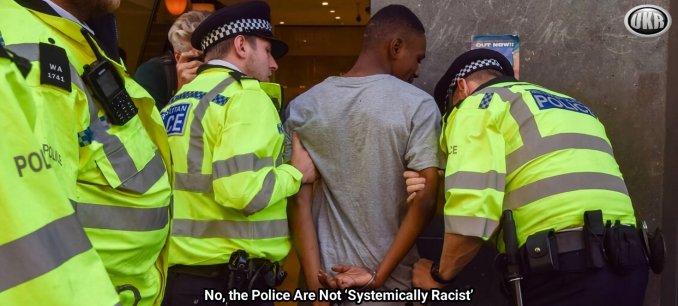
No, the police are not ‘systemically racist’
The progressives’ rush to judgement is as predictable as it is lazy
PAUL BIRCH
A version of this article appears in spiked
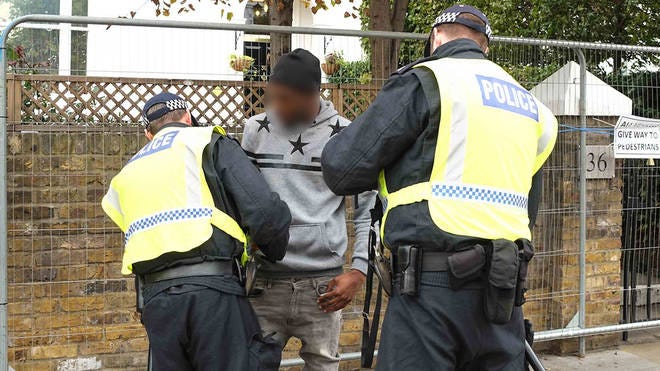
A report published in April by the Children’s Commissioner for England on the police’s record in the strip searching of children has caused some tumult in elite circles. The document, ‘Police powers and children – strip searching and use of force’, states: “Although only 6% of the population of 10-17 year olds in the 2021 census were black, 35% of the children strip searched were of black ethnicity.” These figures certainly appear stark. But raw data rarely constitutes the whole picture.
Few statistics are deployed more aggressively in Britain’s culture wars than these. In some accounts, the disparity reaches eightfold. The conclusion, we are told, is obvious. Britain’s police are, yet again, systemically racist. That claim is not just unproven. It is intellectually lazy.
It rests on a single move. Take a disparity, strip away all context and declare motive. No serious discipline would accept that standard of evidence. Yet in modern political discourse, it has become the norm. Maybe it’s because the reality is less convenient.
Policing is not distributed evenly across the population. It is concentrated by design in the places where crime is most prevalent and where intelligence suggests it is most likely to occur. These areas are generally the most economically deprived and contain the highest number of people from ethnic minority backgrounds (that certain minorities are statistically more likely to be poorer in the first place is a separate debate outside policing). That means law enforcement activity clusters in such specific neighbourhoods, particularly in major urban centres. These areas do not resemble the country as a whole, either in crime patterns or demographics.
Once that basic fact is acknowledged, the supposed mystery of disproportionality begins to dissolve. If police activity is focused in a relatively small number of high-crime areas and those areas have distinct demographic profiles, then uneven outcomes are inevitable. Not suspicious. Not surprising. Inevitable.
Yet the dominant narrative proceeds as if this elementary point doesn’t exist. Instead, it relies on a crude comparison between national population shares and policing outcomes, as though police officers were randomly sampling children from across England and Wales. They are not. They are responding to specific intelligence, in specific places, about specific suspected offences.
And this is where the argument becomes even more selective. Critics are quick to cite disparities in enforcement but are far less willing to engage with the realities of criminality and youth exploitation in the areas where these searches occur. Policing follows those patterns because it has to. The alternative is wilful blindness. It is a sad fact that black people (of all ages) are more likely to be the victims of violent crime than other ethnic groups, so what are the activists saying – that the police shouldn’t try to prevent that from happening?
None of this requires the belief that policing is perfect. Of course officers make mistakes. Procedures are sometimes poorly followed. Oversight has, in some cases, identified serious failings in the treatment of minors. These issues deserve attention and reform. But they do not at all amount to evidence of a system animated by racial bias.
To claim ‘systemic racism’, one needs to show more than disparity. It must be demonstrated that similarly situated individuals are treated differently because of their race. That is a far higher bar than simply pointing to unequal outcomes, and it is a bar rarely cleared in febrile activist or media-driven debate. Instead, what we see is a pattern of assertion replacing analysis. Disparity is presented as proof, and anyone who questions this line, such as Dr. Tony Sewell, is accused of denial.
This is not serious thinking. It is political rhetoric. Even the commonly cited evidence does not support the sweeping conclusions drawn from it. The concentration of searches in a handful of urban forces means that national level comparisons are deeply misleading. They collapse myriad different contexts into a single headline figure, erasing the role of geography, crime distribution and operational strategy. The result is a narrative that is emotionally forceful but empirically thin.
There is also a deeper problem. The assumption that ‘intelligence-led policing’ is somehow tainted by implication reflects inbuilt left-wing scepticism toward an institution which, in recent years, has bent over backwards to appeal to those same lanyard classes. This view is fashionable but rarely constructive. In my policing experience, I know that intelligence can never be perfect, but it isn’t arbitrary either. It is built from reports, surveillance, patterns of offending and accumulated operational knowledge. To dismiss it wholesale is to deny the basic mechanisms through which policing functions.
If critics want to argue that these mechanisms are flawed, they should do so with evidence, showing where and how they produce unjustified disparities. But too often, that work is skipped in favour of sweeping moral claims. The cost of this intellectual shortcut shapes public trust, officer behaviour and, ultimately, the willingness of ordinary coppers to act decisively in high-risk situations – especially with the senior ranks’ propensity to throw them under a bus when the going gets tough. When every disparity is treated as proof of racism, the incentive is not to improve policing but to retreat from it.
That outcome serves no one, least of all the communities most affected by crime. Adolescents are drawn inexorably into a life of crime, often starting out in criminal enterprises like ‘county lines’ drug networks. Such lifestyles are seen as glamorous, partly because the only male role models these youngsters have can be seen profiting quickly from it. Yes, these are technically children and, of course, they are being exploited. But they often do it with a sense of agency, due to the perceived social status and material rewards. Despite liberals’ constant assertions, these kids are not the Baker Street Irregulars.
The truth, as ever, is less convenient than the slogans. Policing reflects the distribution of crime, the demands of public safety and the imperfect judgement of human beings operating under substantial pressure. Disparities can emerge from all of these factors without requiring a single, all-encompassing explanation. To insist otherwise is not to pursue justice. It is to impose a politically charged narrative.
Certainly, the strip-search figures deserve scrutiny. They raise fundamental questions about safeguarding, proportionality and oversight. But they do not, on their own, answer those questions – and they certainly do not justify the confident declaration of systemic racism that so often follows. If Britain is to have an honest debate about policing, it must begin by abandoning the idea that unequal outcomes are self-explanatory. They are not.
Disparity is not a verdict. It is a prompt. And until that distinction is acknowledged, the conversation will remain driven, not by evidence, but by ideology.
This article (No, the police are not ‘systemically racist’) was created and published by Paul Birch and is republished here under “Fair Use”


Leave a Reply