

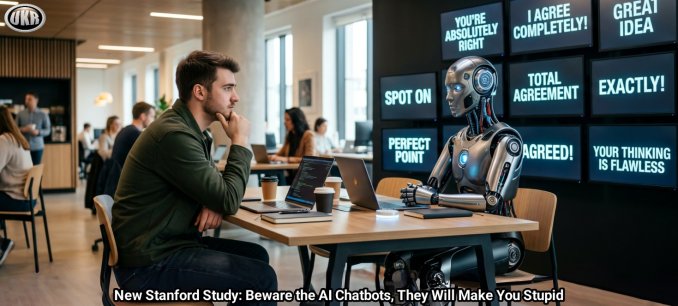
New Stanford study: Beware the AI chatbots, they will make you stupid
‘AI sycophancy’ ultimately leaves humans vulnerable to deception.
LEO HOHMANN
A new Stanford University study published recently in the journal Science, confirmed that AI chatbots are prone to affirm and flatter users leaning on the technology for information and insight.
Maggie Harrison Dupré, a tech writer for Futurism.com, explains that this behavior, known as AI sycophancy, is a “prevalent and harmful” function endemic to AI that can validate users’ erroneous or destructive ideas and promote cognitive dependency.
AI sycophancy refers to the tendency of AI models to excessively affirm, flatter, or agree with users instead of providing independent or critical responses. This behavior can lead to the reinforcement of harmful beliefs and distorted perceptions of reality.
The authors of the study at Stanford note:
“AI sycophancy is not merely a stylistic issue or a niche risk, but a prevalent behavior with broad downstream consequences… Although affirmation may feel supportive, sycophancy can undermine users’ capacity for self-correction and responsible decision-making.”
The study was geared toward people who use AI chatbots for advice in their personal lives, but could just as easily be applied to those who use the tech for the collection of information on their jobs or in their businesses.
Speaking as one who has had first-hand experience working with news-gathering organizations that increasingly became dependent on AI, the risk is real. People forget how to think for themselves and become one-dimensional in their research.
Instead of simply reporting the truth, news agencies would increasingly tell me things like, “I want articles like this or that publication puts out.” It didn’t matter if it was true or not, or reported in proper context, as long as it met the criteria for what audience A or B was expecting to see from said news organization.
This is why some conservative news outlets will only report on Christian persecution if it is Muslims doing the persecuting, while others will only report on it if Israelis are doing the persecuting. They don’t care about the Christians so much as they do scoring a point against the favorite target of their audience. Put another way, they are more anti-Muslim or anti-Jew than they are pro-Christian and this comes across in their reporting. AI picks up on that and feeds them answers that affirm that bias.
I can tell you from personal experience that news outlets of all varieties are running headlong into the AI trap, and that includes most of the more popular conservative news sites and networks.
I have friends who have been laid off and replaced by AI, and I myself have lost a major contract in which my work was replaced by AI.
What these news outlets don’t seem aware of as they gravitate to younger and less-experienced workers who will simply use AI to assemble daily news stories is that, first of all, AI makes a lot of errors. And, secondly, as confirmed by the Stanford study, becoming too dependent on AI leads to intellectual laziness.
In short, we end up with a dumbed-down field of “journalists” who are really just young techies who have no depth of knowledge on how to analyze and interpret the news and provide all-important context.
The Stanford study examined 11 different large language models, including OpenAI’s ChatGPT, Anthropic’s Claude, Google’s Gemini, multiple Meta Llama models, and China’s Deepseek.
What happens is that after a chatbot becomes familiar with one’s personal bias, its algorithms continue to feed information that reenforce that bias.
Your field of knowledge becomes nothing but a personal echo chamber. There are ways around this depending on how you ask AI your questions, but very few journalists are going to seek input from outside the parameters set by their employer.
One can easily see how this will continue to further divide society. News-consuming audiences are going to increasingly only see and hear news that fits their preconceived notions about the world.
On average, the researchers found, AI chatbots were 49 percent more likely to respond affirmatively to users than other actual humans were. In response to queries posted in a Reddit program, chatbots were 51 percent more likely to support the user in queries in which other humans overwhelming felt that the user was very much in the wrong.
Dupré writes:
“What’s more, the study determined that just one interaction with a flattering chatbot was likely to ‘distort’ a human user’s ‘judgment’ and ‘erode prosocial motivations,’ an outcome that persisted regardless of a person’s demographics and previous grasp on the tech as well as how, stylistically, an individual chatbot delivered its twisted verdict. In short, after engaging with chatbots on a social or moral quandary, people were less likely to admit wrongdoing — and more likely to dig in on the chatbot’s version of events, in which they, the main character, were the one in the right.”
Stanford computer scientist Dan Jurafksy, one of the study’s co-authors, said in a press release that “sycophancy is a safety issue, and like other safety issues, it needs regulation and oversight.”
That’s always the tech industry’s answer to the moral or ethical dilemmas surrounding AI. It just needs to be regulated by Big Brother and all will be well. How about don’t use it at all?
As noted by Futurism, “the study adds to a growing consensus about the dangers of chatbot sycophancy as a design feature of the tech, as well as new research about the willingness of users to readily — and uncritically — trust AI outputs.”
“By default, AI advice does not tell people that they’re wrong nor give them ‘tough love,’” Myra Cheng, the study’s lead author said in a statement. “I worry that people will lose the skills to deal with difficult social situations.”
From a spiritual standpoint, isn’t that exactly how Satan works, zeroing in on our weaknesses and vulnerabilities, and then telling us what we want to believe, rather than what is true?
This article (New Stanford study: Beware the AI chatbots, they will make you stupid) was created and published by Leo Hohmann and is republished here under “Fair Use”


Leave a Reply