

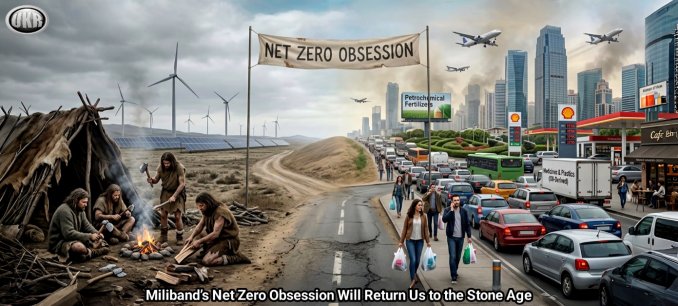
Miliband’s Net Zero obsession will return us to the Stone Age
JOHN FANNON
UNTIL recently we were constantly faced with people who glued themselves to the road and caused enormous traffic jams, clambered on top of tube trains, threw tomato soup at Van Gogh paintings and trashed snooker tables.
‘Just stop oil’, they said, on the assumption that if we stopped driving cars with internal combustion engines or heating our homes with oil or gas and relied on this wonderful new world of ‘clean’ energy sources of wind and sun, everything would be right and the planet would be saved.
They showed no awareness of the benefits of oil that extend beyond transport and heating. Our dependency on the petrochemicals that result from refining oil is such that if there were no oil, there would be a lack of most of the products that impact on modern life. In addition to petrol, diesel, jet fuel, shipping fuel, heating oil and kerosene, oil refineries produce the building blocks of industry and modern life such as asphalt, various types of plastic and PVC, sulphur, ammonia used in fertilisers, rubber, chemicals, pharmaceuticals and bleaching agents.
The benefits of oil are just one aspect of a wide-ranging study by Catherine McBride OBE, David Turver and Brian Monteith. Their paper Premeditated Industrial Destruction was published at the end of March by the Great British Business Council to bring to the notice of the public the industrial consequences of the UK’s journey towards Net Zero. McBride has written about aspects of the paper in TCW here and here.
The word ‘premeditated’ in the title of the paper deserves more attention. The authors show that there has been a steady destruction of UK industry – a fact that will not be news to Labour, Lib-Dem or Conservative politicians. They and the civil servants who advise them regard this as perhaps an unfortunate but necessary consequence of the steps necessary to achieve Net Zero for the UK. Thousands of ‘green’ jobs are constantly promised in compensation but no politician has ever detailed what these jobs might be and whether such jobs will provide a living wage to support British families. Litter-picking is a job, but this will not support a family.
All civilisations depend on the availability of energy. In the past, this energy was supplied by animal and human muscle power – and by slavery. The industrial revolution benefited from the energy locked up in coal and later oil with developments in electricity and magnetism to produce the machines that took away most of the drudgery of labour. All modern-day living is based on energy, from the bricks used to build houses and the cement to bind to bind them together to the glass for the windows and ceramics for kitchen and bathroom. Steel, aluminium, copper and other metals need energy for extraction from ores and even more energy to refine them.
The authors note that the UK’s largest export industry, measured by value, is machinery and transport equipment. Both require large amounts of steel and aluminium and the energy to separate them from their ores, or import them from countries which do not subscribe to the Net Zero policy. The UK is also the world’s largest exporter of aircraft parts including jet engines, wings, seats and landing gear. The production of these parts also requires ample aluminium supplies. Unfortunately, the UK’s larger aluminium smelters have been forced to close due to the cost of the energy to run them.
The car industry, while still a major exporter, has been crippled by government mandates to produce electric vehicles, backed by fines if they do not make enough. The whole idea of government commercial mandates in a time of peace is intolerable, and the paper shows the economic results of such an insane policy.
McBride and co also detail the bountiful natural resources the UK is blessed with, and how it is one of only 40 countries with ample hydrocarbon reserves: coal, oil and gas. Oil reserves in the North Sea have declined, but they still constitute a substantial resource base requiring further exploration and production. It is madness not to take oil from the North Sea while importing it from countries in unstable areas of the world. Moreover, since oil was discovered in the North Sea in the early 1970s, British engineering has evolved the important skills needed to develop the infrastructure for offshore exploration and production in a harsh environment.
When every home in Britain was burning coal with consequent smoke and smog, coal fires attained a bad reputation. But coal-fired electricity generation today is cleaner than ever. The US National Energy Technology Laboratory’s research shows that a new coal plant with pollution controls reduces nitrogen oxides by 83 per cent, sulphur dioxide by 98 per cent, and particulate matter by 99.8 per cent compared with plants that do not have controls. And, as the authors point out, coal is a dense energy source and more than just a fuel. It can provide industrial heat to produce glass, ceramics, cement and other chemicals, and be a source of critical minerals such as rare earths and advanced materials such as graphene and carbon fibres.
The paper makes a strong technical and economic case for building new coal-fired power stations as the quickest way of getting us out of the looming energy crisis. A coal-fired power station can be built and commissioned much more quickly than a gas-fired station. Coal is plentiful and cheap; moreover, a coal stockpile represents the cheapest long-term energy storage. If the issue of CO2 is set aside, the pollutants (particulates and oxides of sulphur and nitrogen) can be removed in modern design of coal-fired power stations.
The paper’s authors are right. Meeting the UK’s domestic and industrial energy demand is dependent on multiple energy sources – gas, wind, solar, biomass, hydro, pumped storage hydro, imports and nuclear. The electricity supply must meet the demand within the very small deviations in voltage and frequency allowed. To achieve this, the National Energy Systems Operator must juggle these disparate energy sources 24 hours a day throughout the year. Gas-driven turbines in power stations provide the necessary back-up when wind and solar sources fail. But as the paper points out, these power stations are at the limits of their service life, and to build new ones would take about eight years.
What are the other measures that a future government must adopt if the country is to be rescued from its industrial demise? Given that a large proportion of the population has succumbed to the continual barrage of half-truths about man-made global warming fed by the Government, UN and MSM over the past 20 years.
An immediate and acceptable approach, they believe, would be for the Government to admit that the 2030 timescale (four years hence) is unachievable and move it back to 2050. This would buy time for the development of small modular nuclear reactors which present the best way forward; that pending the introduction into service of such new sources, we will continue to need oil and gas and perhaps coal to satisfy interim needs. While this sounds like the prayer attributed to St Augustine, ‘Lord make me chaste, but not yet’, it could be a pragmatic way back from a looming energy catastrophe.
This article (Miliband’s Net Zero obsession will return us to the Stone Age) was created and published by Conservative Woman and is republished here under “Fair Use” with attribution to the author John Fannon

••••
The Liberty Beacon Project is now expanding at a near exponential rate, and for this we are grateful and excited! But we must also be practical. For 7 years we have not asked for any donations, and have built this project with our own funds as we grew. We are now experiencing ever increasing growing pains due to the large number of websites and projects we represent. So we have just installed donation buttons on our websites and ask that you consider this when you visit them. Nothing is too small. We thank you for all your support and your considerations … (TLB)
••••
Comment Policy: As a privately owned web site, we reserve the right to remove comments that contain spam, advertising, vulgarity, threats of violence, racism, or personal/abusive attacks on other users. This also applies to trolling, the use of more than one alias, or just intentional mischief. Enforcement of this policy is at the discretion of this websites administrators. Repeat offenders may be blocked or permanently banned without prior warning.
••••
Disclaimer: TLB websites contain copyrighted material the use of which has not always been specifically authorized by the copyright owner. We are making such material available to our readers under the provisions of “fair use” in an effort to advance a better understanding of political, health, economic and social issues. The material on this site is distributed without profit to those who have expressed a prior interest in receiving it for research and educational purposes. If you wish to use copyrighted material for purposes other than “fair use” you must request permission from the copyright owner.
••••
Disclaimer: The information and opinions shared are for informational purposes only including, but not limited to, text, graphics, images and other material are not intended as medical advice or instruction. Nothing mentioned is intended to be a substitute for professional medical advice, diagnosis or treatment.
Disclaimer: The views and opinions expressed in this article are those of the author and do not necessarily reflect the official policy or position of The Liberty Beacon Project.


Leave a Reply