

CP
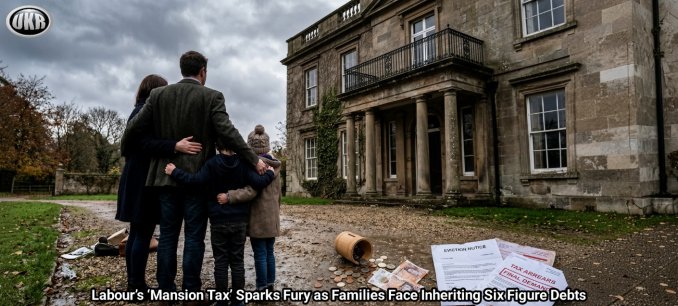
Labour’s latest tax raid on homeowners has triggered accusations that the party is reviving the politics of envy, after ministers confirmed that families could inherit massive tax debts under the Government’s new “mansion tax” scheme.
Treasury documents published this week revealed that owners of properties worth more than £2 million will be charged an annual surcharge of between £2,500 and £7,500 from 2028. While ministers insist the policy is aimed only at the wealthiest households, critics warn it will increasingly hit ordinary families living in areas where property prices have surged over decades.
Under the proposals, homeowners who cannot afford the levy immediately will be allowed to defer payment until they die or the property is sold. But the debt will continue accumulating interest in the meantime, potentially leaving bereaved relatives with enormous bills on top of existing inheritance tax liabilities.
Calculations cited in the consultation documents show that someone postponing the maximum annual charge for 10 years could ultimately owe more than £115,000 once interest is added. The Government has indicated interest may be linked to HMRC’s current late payment rate of 7.75 per cent.
The plans have reignited accusations that Labour is steadily expanding Britain’s already heavy tax burden in pursuit of ideological wealth redistribution. Opponents say the policy punishes homeowners who may be asset rich but cash poor, particularly elderly residents who bought homes decades ago and now face escalating valuations entirely outside their control.
The surcharge will apply after homes are revalued into the highest council tax bands, with reassessments scheduled every five years. Treasury papers acknowledge that renovations or extensions could push more households into higher bands over time, fuelling fears that the tax will gradually spread far beyond the original target group.
Labour ministers argue the measure ensures owners of expensive properties “pay their fair share”. Yet critics note that the party has simultaneously refused to raise inheritance tax thresholds, which have remained frozen since 2009 despite years of house price inflation. In last year’s Budget, Chancellor Rachel Reeves also confirmed plans to bring unused pension pots into inheritance tax calculations from April 2027, deepening concern among retirees and wealth advisers.
The wider economic consequences are already causing alarm in financial circles. Wealth managers and tax specialists have warned that repeated tax increases under Labour risk accelerating the departure of high net worth individuals from Britain. Many affluent families are reportedly restructuring holdings, moving assets offshore, or considering relocation to lower tax jurisdictions amid fears that further levies could follow.
Britain has already seen rising concern about the competitiveness of its tax regime, particularly in London’s prime property market. Estate agents and investment advisers have warned that persistent hostility toward wealth creation is discouraging both domestic and international investment. Treasury forecasts themselves suggest the surcharge could reduce receipts from stamp duty, inheritance tax and capital gains tax as property owners sell homes, downsize, or move assets elsewhere.
The Office for Budget Responsibility estimates around 165,000 homes will initially fall within the scope of the levy. However, critics believe the real number could rise sharply as future revaluations drag more properties above the threshold.
The proposal also revives a long standing ambition on the Left for a so called “mansion tax”, an idea repeatedly championed by senior Labour figures over the past decade. Previous versions proved politically toxic, with opponents branding them stealth taxes on family homes and inherited wealth.
Worth reading in full here:
https://www.telegraph.co.uk/money/tax/news/labour-plots-mansion-tax-to-raid-inheritances/
This article (Labour’s ‘Mansion Tax’ Sparks Fury as Families Face Inheriting Six Figure Debts) was created and published by Conservative Post and is republished here under “Fair Use” with attribution to the author CP
See Related Article Below
UK property taxes highest in the world after Labour raid
Levy now equals 3.9pc of GDP amid fears of a new Government leader raising rates
ELEANOR HARMSWORTH, HANS VAN LEEUWEN
Britain’s property tax burden is the highest of any major economy, new analysis shows, amid fears a new Labour Prime Minister could raise rates even further.
Taxes on property paid each year are now equal 3.7pc of gross domestic product (GDP), according to a study by advisory firm Ryan Tax Services.
The burden is the highest among major economies, topping the tax take even in France (3.4pc), Canada (3.4pc) and Belgium (3.2pc).
It follows a slew of increases to stamp duty, business rates and council tax during Sir Keir Starmer’s two years in office.
The Telegraph: continue reading

••••
The Liberty Beacon Project is now expanding at a near exponential rate, and for this we are grateful and excited! But we must also be practical. For 7 years we have not asked for any donations, and have built this project with our own funds as we grew. We are now experiencing ever increasing growing pains due to the large number of websites and projects we represent. So we have just installed donation buttons on our websites and ask that you consider this when you visit them. Nothing is too small. We thank you for all your support and your considerations … (TLB)
••••
Comment Policy: As a privately owned web site, we reserve the right to remove comments that contain spam, advertising, vulgarity, threats of violence, racism, or personal/abusive attacks on other users. This also applies to trolling, the use of more than one alias, or just intentional mischief. Enforcement of this policy is at the discretion of this websites administrators. Repeat offenders may be blocked or permanently banned without prior warning.
••••
Disclaimer: TLB websites contain copyrighted material the use of which has not always been specifically authorized by the copyright owner. We are making such material available to our readers under the provisions of “fair use” in an effort to advance a better understanding of political, health, economic and social issues. The material on this site is distributed without profit to those who have expressed a prior interest in receiving it for research and educational purposes. If you wish to use copyrighted material for purposes other than “fair use” you must request permission from the copyright owner.
••••
Disclaimer: The information and opinions shared are for informational purposes only including, but not limited to, text, graphics, images and other material are not intended as medical advice or instruction. Nothing mentioned is intended to be a substitute for professional medical advice, diagnosis or treatment.
Disclaimer: The views and opinions expressed in this article are those of the author and do not necessarily reflect the official policy or position of The Liberty Beacon Project.


The idea that families could inherit massive tax debts under the new scheme has triggered accusations that the party is reviving the politics of envy. I’ve been thinking about this in the context of other European countries, where taxation and government deficits are a constant topic of discussion. The parallel between taxation policies and government debt is something I have been thinking about because it seems that high taxes don’t always translate to lower deficits. In fact, I’ve noticed that some countries with high taxes still struggle with significant government debt. As someone who’s lived in several EU countries, I’ve seen how taxation policies can affect people’s lives, especially when it comes to inheriting property. It’s worth considering how these policies might impact not just the wealthy, but also ordinary families who may be caught off guard by unexpected tax debts. I wonder if the authors have given thought to how this might play out in the long term, and whether there are lessons to be learned from other countries’ experiences.