

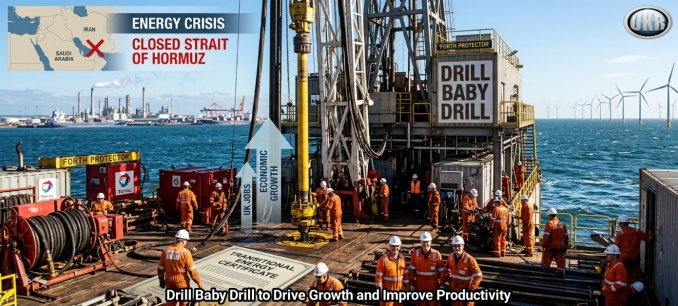
Oil and gas extraction is one of our highest productivity industries so it makes sense to restart drilling.
DAVID TURVER
Introduction
The energy crisis driven by the closure of the Strait of Hormuz as a result of the war in Iran has caused much debate about whether we should be drilling in the North Sea to extract more oil and gas. Much of the debate has centred on whether more domestic supply will reduce energy bills and ignored the impact of the hydrocarbon industry on productivity and growth. Last week’s King’s Speech has indicated that Labour will enshrine in law a prohibition on new exploration licenses and a ban on fracking.

Labour’s pre-election promise to cut energy bills by £300 has been watered down to a vague notion of cutting bills from a higher base by £20-40 by 2040.
New laws to ban drilling and fracking amount to energy suicide in the face of an energy crisis because oil and gas extraction is one of the highest productivity. For a Government supposedly focused on growth, it would make much more sense to drill, baby, drill to drive the economy and solve the productivity problem.
The Importance of Energy to Growth
The UK has seen a decline in overall energy consumption and domestic electricity generation as shown in Figure 2, using data from OWID.

The impact of expensive, scarce energy has caused a drag on growth is demonstrated in Figure 3, again using data from OWID. The chart compares the change in per capita energy consumption to the change in GDP per capita over the period 2008 to 2024.

The UK has reduced energy consumption by 2.4% per annum. This is more than Canada, the EU27, Japan and the United States. As a result GDP per capita has virtually stagnated, growing at just 0.4% per annum, lower than the EU27 and all the other G7 countries except Canada. By contrast, world GDP per capita has been growing at close to 2% per year and energy use per person has increased by about 0.5% per annum. Asian countries like South Korea and China have increased energy use even faster and have accordingly grown much faster. The UK’s energy consumption per person is much lower than many other poorer countries such as Belarus, Bulgaria, Kazakhstan, Malaysia, Poland and Turkmenistan. The UK economy will at best stagnate if the current energy austerity policies are maintained.
Solving the Productivity Problem
It is often said that the UK has a productivity problem. However, these analyses often miss the vital role that energy plays in the so-called productivity puzzle. They instead blame low investment, lack of sharing productivity enhancing practices and a lack of joined-up policymaking.
However, analysis of sector and industry-level productivity data from the ONS shows that cheap and abundant energy is a vital ingredient to drive productivity and growth as shown in Figure 4.

The chart analyses the absolute level of productivity and the change in Gross Value Added from 2008, the date of the Climate Change Act to 2024. The x-axis shows the relative growth rate of different industry sectors over the period. The mid-point of 100% represents the whole economy growth rate over the period. The y-axis shows the relative productivity of each sector in 2024 on a log-scale, with the mid-point of 100% representing the whole economy.
The chart is divided into four quadrants. In the white quadrant we can see sectors like wholesale and retail, agriculture, forestry and fishing and transport and storage are all growing more slowly than the whole economy and have below average productivity measured by gross value-added per hour worked.
The yellow quadrant shows low energy sectors like accommodation and food service, health and social care, arts and entertainment are growing faster than the whole economy yet have lower than average productivity.
The green quadrant shows sectors like real estate and information and telecommunications growing faster than the whole economy with above average productivity.
Finally, the red quadrant shows sectors with above average productivity growing more slowly or shrinking in absolute terms compared to the whole economy. The manufacturing sector has grown at two thirds the rate of the whole economy, but the sector’s productivity is 122% of the whole economy. Included in this segment is mining and quarrying that contains oil and gas extraction where GVA has fallen in absolute terms by 7% over the period, yet productivity is 637% of the whole economy average. Energy production is a high-productivity sector in its own right, so it makes sense to grow it as fast as reasonably possible.
The red quadrant also includes energy intensive sectors like oil refining, chemicals and pharmaceuticals, which have much higher productivity, 384% and 292% of the average, respectively. Transport manufacturing, which includes making cars and buses is also a relatively high productivity sector at 141% of the whole economy average. All these sectors have grown more slowly than the whole economy.
Looking in more detail, hours worked are down 9% in mining and quarrying. High taxes on domestic oil and gas producers, coupled with the effective ban on new exploration drilling have led to estimates of 1,000 jobs per month being lost in the oil and gas industry in the North Sea. The economic impact of these job losses is far greater than the headline job losses because this sector creates more than six times the value added per hour worked than the rest of the economy.
There are also additional impacts further downstream in refining and petrochemicals, where hours worked are down 14%. Grangemouth oil refinery closed about a year ago, with the loss of 400 jobs. The oil refining sector produces about four times the GVA per hour worked than the whole economy so again, the economic impact of these job losses is amplified. Grangemouth produced fuels like petrol, diesel and kerosene that now must be imported. This is becoming a critical issue as shortages of fuel are emerging because of the closure of the Strait of Hormuz. Grangemouth also produced essential feedstock for the petrochemicals industry including ethylene, propylene and polymers polyethylene and polypropylene. The chemicals and pharmaceutical industries create about three times the value added per hour worked than the whole economy, but total hours worked is down 2%.
The loss of North Sea oil and gas production has a large economic impact on its own and even more impact further along the value chain, hollowing out industries producing vital building blocks that society depends upon.
Low-energy, low-productivity sectors have been growing faster than the economy as a whole and high-energy, high productivity sectors have been growing more slowly. It is hardly surprising there is a productivity problem. Moreover, these industries tend by their nature to be capital intensive. Expensive energy, high taxes and an onerous regulatory regime has led companies such as Ineos to abandon new investment in the UK. As these companies move abroad Britain also loses out on investment that would lead to further growth.
Conclusions
Energy is the foundation stone of modern economies. The UK has imposed a swathe of legislation that has increased the regulatory burden and made energy scarce and expensive. In addition, new exploration drilling in the North Sea is effectively banned which is leading to job losses in one of our highest productivity industries. There is also a moratorium on fracking that means the UK is missing out on another source of energy and the associated jobs. Jobs and investment are also being lost in vital downstream refining, chemicals and petrochemicals industries producing the vital building blocks of a modern economy.
It should be obvious to all but the most brainwashed zealot that instead of banning new drilling we should be restarting the UK oil and gas industry. More exploration and development will reverse energy austerity, deliver more highly productive well paid jobs, higher growth, improve energy security and begin to solve the dual productivity and investment problems. In other words, drill baby drill.
Eigen Values now has well over 5,300 subscribers and is growing fast. If you enjoyed this article, please share it with your family, friends and colleagues. Please consider signing up for or gifting a paid subscription.

••••
The Liberty Beacon Project is now expanding at a near exponential rate, and for this we are grateful and excited! But we must also be practical. For 7 years we have not asked for any donations, and have built this project with our own funds as we grew. We are now experiencing ever increasing growing pains due to the large number of websites and projects we represent. So we have just installed donation buttons on our websites and ask that you consider this when you visit them. Nothing is too small. We thank you for all your support and your considerations … (TLB)
••••
Comment Policy: As a privately owned web site, we reserve the right to remove comments that contain spam, advertising, vulgarity, threats of violence, racism, or personal/abusive attacks on other users. This also applies to trolling, the use of more than one alias, or just intentional mischief. Enforcement of this policy is at the discretion of this websites administrators. Repeat offenders may be blocked or permanently banned without prior warning.
••••
Disclaimer: TLB websites contain copyrighted material the use of which has not always been specifically authorized by the copyright owner. We are making such material available to our readers under the provisions of “fair use” in an effort to advance a better understanding of political, health, economic and social issues. The material on this site is distributed without profit to those who have expressed a prior interest in receiving it for research and educational purposes. If you wish to use copyrighted material for purposes other than “fair use” you must request permission from the copyright owner.
••••
Disclaimer: The information and opinions shared are for informational purposes only including, but not limited to, text, graphics, images and other material are not intended as medical advice or instruction. Nothing mentioned is intended to be a substitute for professional medical advice, diagnosis or treatment.
Disclaimer: The views and opinions expressed in this article are those of the author and do not necessarily reflect the official policy or position of The Liberty Beacon Project.


Leave a Reply