

DAVID BETZ AND MICHAEL RAINSBOROUGH
On March 9th the Government published its social cohesion strategy, ‘Protecting What Matters: Towards a More Confident, Cohesive, and Resilient United Kingdom‘. Leaving aside the document’s dissonances, anyone of a certain age might regard this as somewhat curious. Thirty years ago, there was no need for a strategy on “social cohesion”, nor much awareness of the concept. Britain was a cohesive society, not an “island of strangers”. What changed?
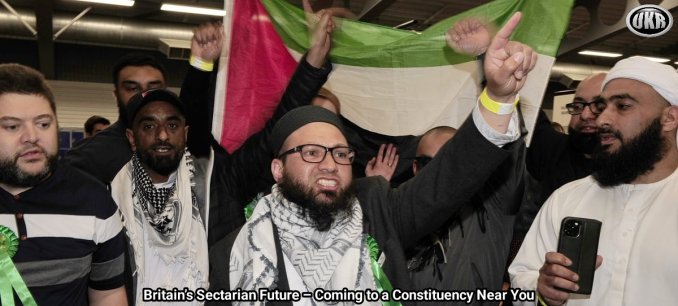
The answer, of course, is that Britain is now, after two decades of unconstrained and mismanaged immigration, a fracturing society. The by-election in Gorton and Denton in February signalled the direction in which British politics is moving. The Green Party’s victory was widely lamented as a triumph of sectarian politics. Lamentable, but hardly surprising. It is the natural working out of the politics of multiculturalism.
The Greens ran a campaign directed explicitly at mobilising the constituency’s large Muslim electorate. The Labour Party accused the Greens of “whipping up hatred”. Election messages circulated on social media in Urdu and Bangla, highlighting images of Keir Starmer shaking hands with Benjamin Netanyahu and Narendra Modi – figures widely associated in the minds of many Muslim voters with the conflicts in Gaza and Kashmir.
Whether such tactics are judged as “shameless” or as “ugly, grubby and divisive” is beside the point. The Greens were responding to the political imperatives that now shape British elections, which incentivise appeals to group identity: in the case of the Greens, addressing voters not as independent citizens but as members of religious, ethnic or diasporic communities whose political sympathies often reside beyond Britain.
This is the culmination of state-sanctioned multiculturalism, the premise of which is that distinct communities can maintain their cultural and religious identities while participating within a shared civic order. In reality, it encourages and rewards political mobilisation along ethnic and racial lines.
The electoral consequences are unmistakable. At the 2024 General Election five Members of Parliament were returned as “pro-Gaza independents”, forming a parliamentary bloc larger than several established minor parties. In parts of northern England and the Midlands with sizeable Pakistani-heritage populations, this electorate increasingly functions as a voter base: candidates who align themselves with its priorities prosper, while those who do not struggle to compete. The result is that MPs cease to act as representatives of territorial constituencies and instead emerge as advocates for identity-based interests.
In London the repeated electoral success of Sadiq Khan also reflects the consolidation of a political coalition rooted in the city’s transformed demographics. Further afield, in New York, the election of Zohran Mamdani as mayor illustrates a similar tendency within American urban politics.
The growth of identity politics is visible in electoral results, voting patterns and campaign strategies. However, once politics begins to organise itself around group identity, sectarianism is the inevitable result. Nor is this unprecedented. The United Kingdom has seen this story before.
Troubled times: a warning from history
For many Britons of an older generation the word sectarianism (understood as the intense attachment to particular group or identity) evokes the Northern Ireland crisis. During the three decades of violence known as the Troubles (1968-1998), the term entered common usage to describe the struggle for power, legitimacy and political recognition between Protestant unionists and Catholic nationalists.
Throughout the conflict, the IRA consistently denied that its violence was sectarian in nature, presenting its campaign as a war against the British state and its security forces. In practice, however, much of the bloodshed served as a proxy for inter-communal hostility. Paramilitary organisations on both sides targeted civilians identified with the opposing community. Northern Ireland was, in essence, a sectarian war. Again and again that truth revealed itself in its most brutal form.
By 1972 the IRA campaign had escalated, contributing to the dissolution of Northern Ireland’s devolved government at Stormont in March of that year. The momentum of republican violence deepened fears among many Protestants, accelerating the growth of loyalist paramilitary organisations such as the Ulster Volunteer Force and the Ulster Defence Association.
From the spring of 1972 onward the violence assumed an overtly sectarian character. Catholics were targeted because they were Catholics and Protestants for being Protestant. Sectarian massacres became appalling markers of the conflict at its most pitiless. One of the most notorious occurred in January 1976 near the village of Kingsmills, when gunmen stopped a minibus carrying textile workers, separated the passengers by religion, and shot the Protestant men at close range, killing 10. It was this atrocity that led to the formal deployment of the SAS to Northern Ireland.
Despite the IRA’s denials, many of the sectarian attacks in the 1970s were carried out under cover names such as the “South Armagh Republican Action Force” and the “Red Flag Avengers”, which were little more than flags of convenience for local IRA units. Loyalist paramilitaries responded with reprisals against Catholic civilians. These cycles of retaliation became a defining feature of the conflict until the cessation of the principal paramilitary campaigns in 1994.
The history is grim but well documented. It reveals something political theory rarely grasps. Once politics hardens along sectarian lines, violence between communities ceases to appear extraordinary. It becomes the more ruthless continuation of the same logic. Northern Ireland was the future, come early.
The warning ignored: the end-of-history delusion
The most striking aspect of the Troubles is how little it taught Britain’s governing class. The conflict produced decades of hard evidence about the dynamics of sectarian rivalry, political identity and group violence. That experience was ignored by those who preferred to believe such conflicts belonged to another age.
The signing of the Good Friday Agreement in 1998 coincided with, and in many ways epitomised, the high-water mark of post-Cold War Blairite optimism – the confident belief that the ideological struggles of the 20th century could be laid to rest. Liberal democracy and market economics, it was held, had resolved the fundamental questions of political order. What remained was largely managerial: extending institutions, markets and human rights across an increasingly interconnected world.
Within this intellectual climate, older forms of political conflict were treated as historical relics. Tribal loyalties, long-standing enmities and even national identity itself were seen as vestiges of an earlier age that would dissolve as societies modernised and prosperity spread. History had been retired.
It returned quickly enough.
Western military interventions after 2001 revealed just how deeply entrenched identity politics remained. In Iraq after the 2003 invasion, violence between Shia and Sunni militias rapidly escalated into open warfare. Armed groups targeted neighbourhoods, mosques and civilian populations associated with rival factions. For anyone familiar with the conflict in Northern Ireland the pattern was instantly recognisable.
Many Western observers, however, treated such conflicts as distant, ancient hatreds fought in dusty, far-off places, irrelevant to the globalising end-of-history orthodoxy. It was a convenient fiction: societies presumed to be trapped in their own barbaric customs, unlike the enlightened secular world of liberal modernity. Western societies could therefore assume themselves immune. The possibility that the politics of identity might become decisive closer to home was left conveniently unexamined.
The first sign of this complacency lay in the evasive way Islamist assaults were interpreted after 9/11. Faced with violence openly justified in religious terms, political leaders and media commentators searched for alternative explanations – economic marginalisation, Western foreign policy, personal grievance, psychological instability or troubled family backgrounds – even as the perpetrators themselves explained their motives in explicitly religious language. At its most farcical, the impulse produced remarks such as Boris Johnson’s – then Mayor of London – that Islamist attackers were merely porn-addicted “losers” who couldn’t make it with girls, a line that reduced ideological violence to adolescent dysfunction and, in doing so, explained precisely nothing.
The secular-liberal mind struggled to accept that individuals might kill in pursuit of sacred objectives. Ignoring the stated motives of the Islamists did not make them disappear. It merely obscured the forces driving the violence. Despite repeated demonstrations of how powerfully religious and group loyalties can determine who stands against whom, Britain’s political class persisted in its own hyper-liberal illusions.
The strange persistence of the political centre
Northern Ireland also demonstrated something that observers frequently overlook. For most of the Troubles, political life in Northern Ireland remained dominated by moderate parties. Despite the violence, most voters on both sides of the divide continued to support constitutional politics. Among unionists, the mainstream Ulster Unionist Party retained the electoral ground; among nationalists, the Social Democratic and Labour Party (SDLP) remained the principal political voice.
When Sinn Féin adopted the so-called “Armalite and ballot box” strategy in the early 1980s, and moved into electoral politics, the party generally secured only 10-13% of the vote in elections, while parties linked to loyalist paramilitaries were even less electorally significant.
This situation owed much to the underlying character of Northern Irish society. Despite confessional division, the two communities shared much of the texture of daily existence. They worked alongside each other, lived in the same towns and cities and participated in many of the same institutions of everyday life.
The persistence of the moderate centre ultimately rested on a widespread aversion to violence. For most people in Northern Ireland the paramilitary campaigns represented a grotesque and destructive intrusion into ordinary life. While communal loyalties remained strong, the overwhelming majority wanted peaceful politics and a negotiated settlement rather than the perpetuation of the bloodshed, a preference repeatedly confirmed in electoral results throughout the conflict.
The equally strange death of the centre: the gun behind the negotiations
The Northern Ireland experience carries a disturbing lesson for democratic politics today because, ironically, it was the peace process itself that weakened, and ultimately destroyed, the moderate political centre.
The ceasefires declared by republican and loyalist paramilitaries in 1994 opened the way for talks that culminated in the Good Friday Agreement. However, the logic of the negotiations favoured the factions most closely associated with the paramilitaries.
Parties linked to armed organisations possessed leverage that moderates lacked. They could imply – sometimes openly, sometimes obliquely – that failure to reach agreement might bring a return to violence. During negotiations this latent threat gave them influence far beyond their electoral strength. As the terms of the settlement were debated, figures connected to the paramilitaries increasingly came to be treated as indispensable participants in the process.
The negotiations involved a range of intermediaries and advisers, among them Jonathan Powell, who served as Tony Blair’s chief of staff during the talks and now holds the post of UK National Security Adviser. The settlement succeeded in bringing an end to large-scale violence, but it also reshaped Northern Ireland’s political landscape.
Over time voters began to shift toward the parties that appeared most capable of defending the interests of their respective communities. Within the nationalist electorate support moved steadily toward Sinn Féin at the expense of the SDLP, whose leaders – figures such as John Hume and Seamus Mallon – had been among the principal architects of the peace process. Sinn Féin’s close association with the IRA allowed it to present itself as the party best placed to advance nationalist interests.
A similar shift occurred on the unionist side. Protestants became increasingly antagonised by the concessions granted to Irish republicans and concluded that advantage lay with those prepared to adopt the hardest line. This perception strengthened the appeal of the Democratic Unionist Party under Ian Paisley. The rise of the DUP quickly eroded the support base of the more moderate Ulster Unionist Party, whose leader David Trimble had worked alongside Hume and Mallon to bring the agreement into being.
Democracy, Ulster style
Does any of this sound familiar in British politics today? The parallels are not exact, but the logic is unmistakable. What unfolded in Northern Ireland was not some peculiar historical drama confined to one troubled province. It was the predictable outcome of political incentives operating within a deeply divided society.
The constitutional response to that conflict was power sharing. The institutions created by the Good Friday Agreement established a devolved government in which the principal sectarian blocs divide authority between them. In practice, unionist and nationalist parties share executive power, while major decisions require support from both sides of the divide.
Such arrangements can stabilise fractured societies and are certainly preferable to unremitting violence. But power-sharing systems are not truly democratic. They suspend ordinary political competition and replace it with negotiated arrangements between organised constituencies. Authority is distributed along ethno-religious lines, and political influence flows through collective representation rather than through individual choice.
The result in Northern Ireland has been a precarious equilibrium that regularly slides into paralysis. Because the institutions depend upon maintaining a balance between rival groups, any policy perceived to favour one side risks destabilising the entire structure. Disputes over cultural recognition, constitutional status or economic priorities routinely trigger political crises. Stormont has been suspended repeatedly since its creation, sometimes for years at a time.
Northern Ireland tolerates this arrangement largely because the alternative of a return to violence is understood to be much worse. The province is small and, despite its religious divide, its population shares cultural affinities rooted in a common history, language and overlapping social institutions. Those commonalities make coexistence under a fragile political balance possible, just.
The Stormontification of Britain
After three decades of demographic transformation, Britain’s social landscape is in many respects more complex than Ulster’s during the Troubles, but it still provides the clearest indication of where such political incentives ultimately lead.
Over recent decades, large-scale non-European immigration has altered the social fabric of many British cities and regions. In numerous urban constituencies, ethnic and religious communities now form concentrated voting blocs whose political loyalties are difficult to reconcile within, if not outright resistant to, civic politics. Electoral competition increasingly follows these lines of division.
Where such concentrations develop, bloc voting becomes an entirely rational strategy. Candidates appeal to identifiable communities, and those communities rally behind representatives who promise to defend their interests. The pattern is familiar wherever such electoral dynamics appear — from Africa to India to Fiji to Malaysia to Lebanon, to Ulster — each of which has developed institutional arrangements designed to manage identity-based political competition.
Britain’s coming sectarian politics, whether you like it or not
The lesson of Northern Ireland is straightforward. When identity-based politics begins to drive electoral competition, it does not remain neatly confined. It comes to define the terms of political engagement. In a society increasingly oriented toward group self-interest, sectarian voting is not an aberration. It is the logical outcome.
The uncomfortable truth is that this process has been visible in Britain for a long time – and repeatedly warned about. As early as 2001, the Cantle Report into the riots in Oldham, Burnley and Bradford, described how communities were fragmenting into “parallel lives”. In 2005, Trevor Phillips, then chairman of the Racial Equalities Commission, warned that Britain was “sleepwalking into segregation”. The warnings went unheeded. Meanwhile, unprecedented levels of immigration accelerated demographic change, leading to the gradual but remorseless mobilisation of bloc electorates.
And now the electoral chickens are coming home to roost. Parties are adapting, as electoral competition increasingly reorganises itself around these new divisions. The momentum becomes self-reinforcing: when one constituency mobilises along sectarian lines, others follow. Each mobilisation invites counter-mobilisation. This is evident in the rise of insurgent movements such as Reform UK. The emergent Restore Britain party openly presents itself as the advocate and defender of Britain’s indigenous population and its traditions.
For the governing class, none of this was supposed to happen. For decades it assured itself that large-scale immigration could be managed within a multicultural order. Liberal institutions would guarantee stability. Traditional identities – those awkward remnants of history – would gradually dissolve in the solvent of secular rationalism.
The problem is that this is not analysis. It is ideology. It is wanting to believe something that is not objectively true and which has no empirical validation in human experience.
Human societies do not abandon group identity because an ideology says they will. In practice, demographic change has coincided with the growth of identity-driven political consolidation. Once electoral incentives begin rewarding group particularism, the political centre starts to give way. Moderates attempting to sustain cross-community politics, as Northern Ireland demonstrated long ago, are steadily marginalised by movements that speak directly to the fears and ambitions of their own supporters.
At that point politics ceases to be a debate about the common good and becomes a negotiation over power between organised constituencies. Public life turns into an argument about who gets what.
Northern Ireland eventually produced an institutional settlement designed to manage sectarian rivalry rather than overcome it. The rest of the United Kingdom will develop its own variants. But the basic pattern is predictable and inevitable: a divided political arena in which parties rally distinct ethnic, religious and cultural constituencies.
Britain’s political class, having created these conditions, now appears to believe that the best it can do is suppress the consequences. The emerging “social inclusion strategy” suggests a familiar, tired ritual of repression: tighter restrictions on speech, heavier policing and an expanding apparatus of administrative supervision.
These schemes won’t work. Political realties do not yield to administrative fiat. If populations conclude that their interests are ignored or threatened, they choose their side. Demand summons supply. The centre gives way. Civic life comes apart.
Welcome to imperial administration
Britain will not return to the politics of liberal consensus. Those days are gone. At best, what lies ahead is a form of quasi-imperial management: rival communities administered, policed and periodically placated. A brittle stability may last for a time, but it will rest on coercive control, not cohesion. At worst, this uneasy interregnum becomes a staging ground for something darker. Once politics falls to the logic of the tribe, the distance from political rivalry to violence is shorter than many are willing to acknowledge.
Whatever course events take, the country will not be more liberal or more democratic. It will grow more tense, more fractured and more openly antagonistic.
Or, to put it bluntly: you may not be interested in sectarianism. But sectarianism is interested in you.
Michael Rainsborough is Professor of Strategic Theory and Director of the Centre for Future Defence and National Security, Canberra. David Betz is Professor of War in the Modern World, King’s College London.
This article (Britain’s Sectarian Future – Coming to a Constituency Near You) was created and published by The Daily Sceptic and is republished here under “Fair Use” with attribution to the author David Betz and Michael Rainsborough

••••
The Liberty Beacon Project is now expanding at a near exponential rate, and for this we are grateful and excited! But we must also be practical. For 7 years we have not asked for any donations, and have built this project with our own funds as we grew. We are now experiencing ever increasing growing pains due to the large number of websites and projects we represent. So we have just installed donation buttons on our websites and ask that you consider this when you visit them. Nothing is too small. We thank you for all your support and your considerations … (TLB)
••••
Comment Policy: As a privately owned web site, we reserve the right to remove comments that contain spam, advertising, vulgarity, threats of violence, racism, or personal/abusive attacks on other users. This also applies to trolling, the use of more than one alias, or just intentional mischief. Enforcement of this policy is at the discretion of this websites administrators. Repeat offenders may be blocked or permanently banned without prior warning.
••••
Disclaimer: TLB websites contain copyrighted material the use of which has not always been specifically authorized by the copyright owner. We are making such material available to our readers under the provisions of “fair use” in an effort to advance a better understanding of political, health, economic and social issues. The material on this site is distributed without profit to those who have expressed a prior interest in receiving it for research and educational purposes. If you wish to use copyrighted material for purposes other than “fair use” you must request permission from the copyright owner.
••••
Disclaimer: The information and opinions shared are for informational purposes only including, but not limited to, text, graphics, images and other material are not intended as medical advice or instruction. Nothing mentioned is intended to be a substitute for professional medical advice, diagnosis or treatment.
Disclaimer: The views and opinions expressed in this article are those of the author and do not necessarily reflect the official policy or position of The Liberty Beacon Project.


Leave a Reply