

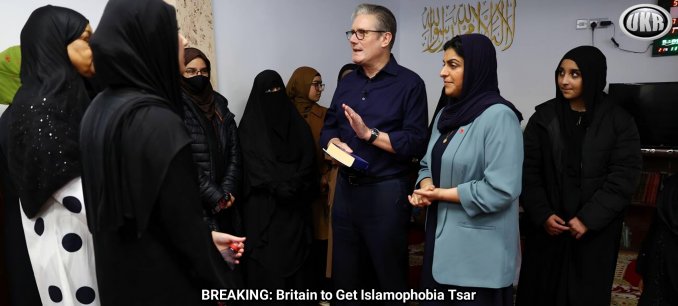
Britain is to get a new “anti-Muslim hostility tsar” under plans to be outlined by the Government on Monday, which will also include a new definition of Islamophobia. The Spectator‘s Tim Shipman has the details.
The Spectator has been leaked a draft copy of ‘Protecting What Matters’, a document outlining Labour’s new cohesion strategy which is to be unveiled in a cross Government push next week. The 47-page paper features a crackdown on extremism and names Islamists as the biggest threat to community cohesion. It also outlines fresh demands that new arrivals in Britain seek to integrate and speak good English, described as a “fundamental basis for participating in society and an expectation of those who wish to call the UK home”. It states: “Those who come here must make a genuine effort to integrate into and engage with our shared way of life.” The last census found that more than a million people could not speak English well or at all.
The report states clearly that Islamists are responsible for three-quarters of the police’s counterterror workload and 94% of all terror-related deaths in the past 25 years. The plan also rejects calls, predominantly from British Muslims, for blasphemy laws in the UK.
Following the case of the religious studies teacher at Batley Grammar school, who was forced into hiding after showing caricatures of the Prophet Muhammad, the document promises to “stand against those who try to intimidate, threaten and harass others because they are offended by so-called “blasphemy”. We do not recognise blasphemy law in the UK.”
Further powers will be established to close extremist charities and suspend trustees with “unspent hate crime convictions”, to “strengthen monitoring” of non-violent extremism in universities and to exclude hate preachers from the UK. As part of this, there will be rules to ensure that “public bodies do not confer legitimacy, funding or influence on extremist groups”.
But the plans will also raise alarm bells on free speech by outlining new rules to tackle “divisive content” and “ensure trusted news sources are prominent”. Critics fear these measures will be used to silence critics of Islamists or even TV channels like GB News which some Labour people view as too Right-wing. …
The creation of a “special representative on anti-Muslim hostility” is likely to give a prominent platform to an activist voice. Their job will be to “champion efforts across the UK to tackle hostility and hatred directed at Muslims and those perceived to be Muslim”.
Alongside that is a new definition of anti-Muslim hatred, which has been watered down to avoid defining Muslims as a race, but which will still condemn “the prejudicial stereotyping of Muslims, as part of a collective group with set characteristics, to stir up hatred against them, irrespective of their actual opinions, beliefs or actions as individuals”. Critics think this will create a blasphemy law by the back door.
Worth reading in full.
See Related Article Below
The good and bad news about Labour’s leaked social cohesion strategy
ANDREW GILLIGAN
Some things in the government’s leaked social cohesion strategy will be deeply neuralgic to many. There is the creation of a “special representative on anti-Muslim hostility,” which will almost certainly hand an official bully pulpit to an activist such as Baroness Gohir, who has attacked media coverage of the grooming scandal as “disproportionate” and being “used…to fuel racism and Islamophobia,” or to a figure such as Dominic Grieve.
The leaked strategy is clear that Islamism is the country’s greatest extremist threat
There’s a claim that last summer’s widespread flying of English, Scottish and Union flags were “tools of hate” and the “misuse [of] national symbols to exclude or intimidate.” There’s the statement that “integration is a two-way street” – that the indigenous community must adapt to the practices of newer arrivals. And there is the party-political tone of the first chapter, jarring for something meant to be about bringing people together, which blames austerity and “immigration policy under the last government” for social tensions with far older, deeper, more complex roots.
The strategy creates clear free speech risks, pledging to crack down on “divisive content” online. But “division,” or disagreement, is necessary for democratic debate. If everyone agreed, or was forced to agree, it would not be a debate.
There are also, however, some policies here that would constitute major breakthroughs – if they actually happen. In contrast to last year’s dismal “counter-extremism sprint,” leaked to us at Policy Exchange and disowned by ministers the next day, the new strategy is clear-eyed that Islamism – responsible for three-quarters of the police’s counter-terror workload and 94 per cent of all terrorist deaths in the last quarter-century – is the country’s greatest extremist threat. And it recognises Islamism’s institutional strength.
There will be new powers to shut down extremist charities and suspend trustees, to “strengthen monitoring” of non-violent extremism in universities and to exclude hate preachers from the UK. There will be greater oversight of home schooling, sometimes exploited by extremists, and a “dedicated Home Office horizon-scanning function to identify and disrupt individuals and events of extremist concern” in hireable venues and outdoor spaces. There will be an annual “state of extremism” report, hopefully a counter to the one-sided work of groups like Hope not Hate.
In its chapter four, “resilient communities,” the strategy promises to “embed the [Conservative] government’s 2024 extremism definition across central and local government” and “embed the 2024 engagement principles so that public bodies do not confer legitimacy, funding or influence on extremist groups.”
[…]
A section entitled “resetting the social contract” makes clear that “those who come here must make a genuine effort to integrate into and engage with our shared way of life” and must speak good English, as almost a tenth of the non-white population do not: “the ability to use and understand our shared language should be a fundamental basis for participating in society and an expectation of those who wish to call the UK home.” Perhaps the same principle could be extended to Green Party election leaflets?
The Spectator: continue reading

••••
The Liberty Beacon Project is now expanding at a near exponential rate, and for this we are grateful and excited! But we must also be practical. For 7 years we have not asked for any donations, and have built this project with our own funds as we grew. We are now experiencing ever increasing growing pains due to the large number of websites and projects we represent. So we have just installed donation buttons on our websites and ask that you consider this when you visit them. Nothing is too small. We thank you for all your support and your considerations … (TLB)
••••
Comment Policy: As a privately owned web site, we reserve the right to remove comments that contain spam, advertising, vulgarity, threats of violence, racism, or personal/abusive attacks on other users. This also applies to trolling, the use of more than one alias, or just intentional mischief. Enforcement of this policy is at the discretion of this websites administrators. Repeat offenders may be blocked or permanently banned without prior warning.
••••
Disclaimer: TLB websites contain copyrighted material the use of which has not always been specifically authorized by the copyright owner. We are making such material available to our readers under the provisions of “fair use” in an effort to advance a better understanding of political, health, economic and social issues. The material on this site is distributed without profit to those who have expressed a prior interest in receiving it for research and educational purposes. If you wish to use copyrighted material for purposes other than “fair use” you must request permission from the copyright owner.
••••
Disclaimer: The information and opinions shared are for informational purposes only including, but not limited to, text, graphics, images and other material are not intended as medical advice or instruction. Nothing mentioned is intended to be a substitute for professional medical advice, diagnosis or treatment.
Disclaimer: The views and opinions expressed in this article are those of the author and do not necessarily reflect the official policy or position of The Liberty Beacon Project.


Leave a Reply