

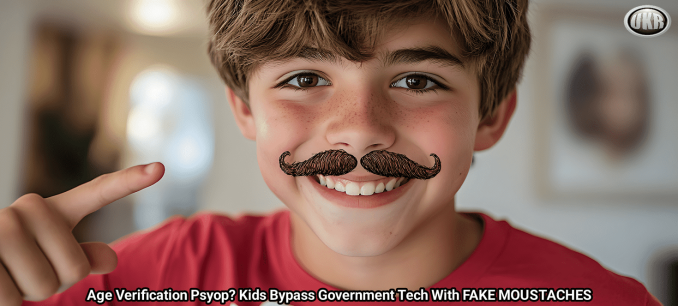
Government’s online safety crusade exposed as children outwit facial recognition with eyebrow pencils
STEVE WATSON
The UK government’s much-hyped age verification system for social media has been reduced to a joke overnight – and the punchline is being delivered by schoolkids armed with makeup pencils and fake facial hair.
A damning new report from Internet Matters reveals that more than a third of UK children have already figured out how to dodge the latest “safeguards” imposed under the draconian Online Safety Act.
Methods include entering fake birthdays, borrowing logins, and – most hilariously – drawing on fake moustaches to fool facial age estimation tech. One parent admitted catching her son using an eyebrow pencil; the system promptly verified him.
The UK government’s age verification checks have been brought down by children wearing fake moustache’s
Brilliant pic.twitter.com/FvSAiKaZ6r
— Basil the Great (@BasilTheGreat) May 5, 2026
This comes as ministers double down on plans to restrict or outright ban social media access for under-16s. Just days ago, Education Secretary Bridget Phillipson and junior minister Olivia Bailey confirmed the government will impose “some form of age or functionality restrictions” regardless of whether a full ban is enacted.
A national consultation on the policy closes later this month, with pilots already running in hundreds of homes testing bans, time limits, and digital curfews.
But the farce unfolding in real time shows exactly why these measures were always doomed to fail – or, more cynically, why they were designed to fail.
I suspect it’s fake news so they can push for ID verifications
— Fellow Noticer (@Sendem_Bach) May 5, 2026
Either the architects of this scheme are completely incompetent, or this is a deliberate ploy to make the whole thing look ridiculous.
Why? To curtail resistance and downplay the inevitable next step: mandatory digital ID.
Age verification, or more properly defined as “identity verification,” was designed to fail, so that the government could push for a full blown digital ID system.
The people behind this are utterly dastardly and machiavellian in their lust for total power over their fellow Man.
— NPC Knuckles (@KnucklesNp26684) May 5, 2026
Eventually there will be no work-around for any of us unfortunately
— Gabhán (@OffgridIreland) May 5, 2026
We’ve seen this playbook before. When Apple began forcing iPhone users to prove their age with government ID or lose unrestricted internet access, we warned it was the thin end of the wedge.
The government’s digital ID scheme is already being rolled out. A “dystopian experiment in mass surveillance,” with critics warning it will make proving your identity online unavoidable for everything from banking to browsing.
And it’s not just Britain. The EU is charging ahead with its own war on online freedom, forcing age verification and going after VPNs in the name of “saving the children” while quietly building the infrastructure for continent-wide censorship and tracking.
Just coincidentally, the EU’s own age verification system was defeated in minutes after it was soft launched in April. So now, of course, there needs to be a further crackdown.
Digital ID systems always promise security and always deliver breaches. The EU’s new age verification app got hacked in under two minutes. Passport photos were stored unencrypted. PIN protection was bypassed with a text editor. Von der Leyen called it “technically ready.” Every…
— Reclaim The Net (@ReclaimTheNetHQ) April 19, 2026
This was never about protecting kids. They don’t care about kids. It’s about control. Every failed “safety” measure provides the perfect excuse to demand even stricter verification – biometric scans, national digital IDs, device-level monitoring.
The moustache kids aren’t the problem; they’re exposing the con.
In the US, President Trump has already drawn a line in the sand, declaring war on the Euro-style censorship machine and vowing to smash any UK-EU internet crackdown that threatens free speech.
While the UK government chases headlines with performative “child safety” gestures that collapse under the weight of a 12-year-old with a makeup pencil, the real threat isn’t social media – it’s the authoritarian apparatus being built in its name.
Your support is crucial in helping us defeat mass censorship. Please consider donating via Locals or check out our unique merch. Follow us on X @ModernityNews.
This article (Age Verification Psyop? Kids Bypass Government Tech With FAKE MOUSTACHES) was created and published by Modernity News and is republished here under “Fair Use” with attribution to the author Steve Watson
See Related Article Below
UK age-gating plans risk breaking the internet, privacy groups warn
Activists say ministers are targeting access rather than Big Tech’s data-hungry business models
CARLY PAGE
Privacy groups, VPN providers, and civil liberties outfits have lined up to warn the UK government that its latest plan to slap age gates across swathes of the internet risks breaking the web while doing little to keep kids safe.
In a joint statement, signatories including the Electronic Frontier Foundation, Mozilla, the Open Rights Group, Proton, and the Tor Project took aim at proposals now moving forward after the Children’s Wellbeing and Schools Bill cleared Parliament, with access to some platforms, services, and specific features potentially restricted by age checks.
“The open internet is a global public resource that has long since become foundational to the flourishing of individuals, businesses, and societies,” the letter states, warning that “this openness and the opportunities it affords are coming under threat in the UK.”
Ministers are now consulting on measures that could include curfews for younger users and restrictions across services ranging from games and VPNs to static websites. The signatories say that will quickly turn into a system where everyone, not just children, has to prove their age to get full access.
“Implementing such access restrictions hinges on all users having to verify their ages, not just young people,” the letter warns, adding that the approach “focuses on restricting young people’s access, rather than ensuring services are designed to uphold their rights and interests by default.”
MORE CONTEXT
-
Kids say they can beat age checks by drawing on a fake mustache
-
US state laws push age checks into the operating system
-
Keir Starmer declares ‘months’ timeline for social media age clampdown in UK
-
EU waves through open source age-check tool to keep kids safe online
Early results are not exactly inspiring. It’s been months since tougher checks under the Online Safety Act began rolling out, and some systems have already been fooled by little more than a drawn-on mustache, raising questions about how effective the tech really is at keeping minors out.
This hasn’t gone unnoticed. “Existing age assurance technologies are either insufficiently accurate, undermine privacy and data security, or are not widely available across populations,” the letter says, warning that rolling them out broadly “creates serious new security threats.”
It is not just a privacy headache either: the groups argue the policy could tilt the market further toward Big Tech. Mandating checks across more services risks “cementing the dominance of gatekeeper app stores, operating systems, and platforms’ walled gardens,” while turning the web into “a patchwork of age-gated jurisdictions.”
Instead of doubling down on access controls, the groups argue policymakers are targeting the wrong problem. “These risks are real and require thoughtful policy interventions that address the root of the issue, not just simplistic policies like access bans,” the letter says, pointing to business models built on “massive collection of user data” as a bigger driver of harm.
The closing line does not leave much room for interpretation: “Now is the time to hold tech to account, not undermine the open internet.” ®

••••
The Liberty Beacon Project is now expanding at a near exponential rate, and for this we are grateful and excited! But we must also be practical. For 7 years we have not asked for any donations, and have built this project with our own funds as we grew. We are now experiencing ever increasing growing pains due to the large number of websites and projects we represent. So we have just installed donation buttons on our websites and ask that you consider this when you visit them. Nothing is too small. We thank you for all your support and your considerations … (TLB)
••••
Comment Policy: As a privately owned web site, we reserve the right to remove comments that contain spam, advertising, vulgarity, threats of violence, racism, or personal/abusive attacks on other users. This also applies to trolling, the use of more than one alias, or just intentional mischief. Enforcement of this policy is at the discretion of this websites administrators. Repeat offenders may be blocked or permanently banned without prior warning.
••••
Disclaimer: TLB websites contain copyrighted material the use of which has not always been specifically authorized by the copyright owner. We are making such material available to our readers under the provisions of “fair use” in an effort to advance a better understanding of political, health, economic and social issues. The material on this site is distributed without profit to those who have expressed a prior interest in receiving it for research and educational purposes. If you wish to use copyrighted material for purposes other than “fair use” you must request permission from the copyright owner.
••••
Disclaimer: The information and opinions shared are for informational purposes only including, but not limited to, text, graphics, images and other material are not intended as medical advice or instruction. Nothing mentioned is intended to be a substitute for professional medical advice, diagnosis or treatment.
Disclaimer: The views and opinions expressed in this article are those of the author and do not necessarily reflect the official policy or position of The Liberty Beacon Project.


Leave a Reply